Biography
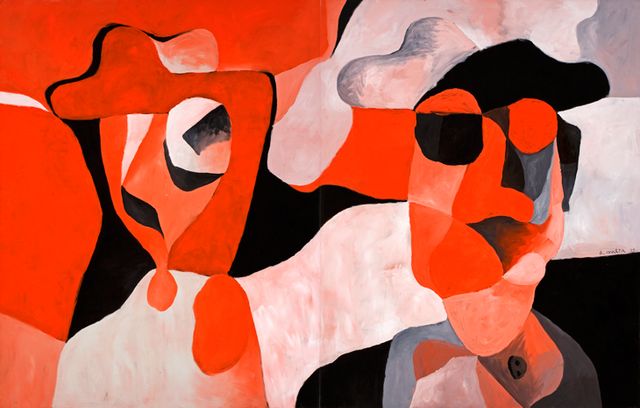
Antonio Malta studied Architecture and Urban Planning at the University of São Paulo. Some highlights among his most recent solo exhibitions are Sim Galería, in Curitiba (Brazil); Aquarelas, at Galeria Leme (São Paulo); or at the São Paulo Cultural Center. Among the group shows featuring his work are Incerteza viva, at the 32nd São Paulo Biennial in 2016; Toda janela é um projétil, é um projeto, é uma paisagem, curated by Paulo Miyada, and Auroras: pequenas pinturas; Os Muitos e o Um. Arte Contemporânea Brasileira na Coleção Andrea e José Olympio Pereira, curated by Robert Storr. Given Malta’s training as an architect, his interest in the constructive values of painting and in spatial distribution does not come as a surprise. The works on exhibit at F2 bring to mind a measured study of the compositions, the relationships between the different masses, and a desire to capture the proportions between segments and geometric lines. Color, meanwhile, acquires structural valence. We encounter works where the alternation of color is what constructs the entire surface of the canvas: white on black/black on white, giving shape to an evident visual rhythm. Other colors also come up: ochres and pink-tinged hues that lighten in a way the exhibition’s general note. Thus, from the influence of cubism and constructivism, we move to proposals of a different kind, closer to a lyrical abstraction that could be the show’s most subjective aspect. One of the most striking works in the exhibition, both for its format and its composition, is Máscara (Mask, 2014). It is comprised of two independent canvases, joined. The one on the right features a realistic depiction of a gas mask, and on the left, we see a distorted face. We also see what could be a series of letters or graphic signs (highly characteristic of a traditional cubist vocabulary). This work was inspired by events that took place in Brazil in 2013 after a rise in the price of public transportation. The many protests that took place across the country were violently countered by the police, which only contributed to generate more social tension. The police were accused of acting with complete arbitrariness. Understood in that context, Malta’s work cannot be more eloquent: it represents a situation of police repression, isolation, and alienation, where identity and communication are diffused into an indeterminate, dark, opaque space. The mask is an inevitable reference to Lygia Clark and her work around the interactions and the communication between different bodies, yet it is obvious that Clark’s proposal is kept at a remove here: in Malta’s case, the optimism and the lightness that are among the assumptions of Neo-concrete art are displaced by a clear allusion to violence and to the country’s political situation. Artistic support, iconography, and a chromatic display that leave no room for doubt.
Track Antonio Malta Campos
Get notifications when works come to auction, and access market analytics
Create Free AccountAlready have an account? Sign In
Professional documentation gives you clarity, portability, and confidence in your collection.
Learn why collectors document their holdings online


Your collection, accessible anywhere
Access your collection from any device with our cloud-based platform. Native mobile apps provide seamless synchronization and offline browsing, ensuring your collection data is always at hand.


Biography
Antonio Malta studied Architecture and Urban Planning at the University of São Paulo. Some highlights among his most recent solo exhibitions are Sim Galería, in Curitiba (Brazil); Aquarelas, at Galeria Leme (São Paulo); or at the São Paulo Cultural Center. Among the group shows featuring his work are Incerteza viva, at the 32nd São Paulo Biennial in 2016; Toda janela é um projétil, é um projeto, é uma paisagem, curated by Paulo Miyada, and Auroras: pequenas pinturas; Os Muitos e o Um. Arte Contemporânea Brasileira na Coleção Andrea e José Olympio Pereira, curated by Robert Storr. Given Malta’s training as an architect, his interest in the constructive values of painting and in spatial distribution does not come as a surprise. The works on exhibit at F2 bring to mind a measured study of the compositions, the relationships between the different masses, and a desire to capture the proportions between segments and geometric lines. Color, meanwhile, acquires structural valence. We encounter works where the alternation of color is what constructs the entire surface of the canvas: white on black/black on white, giving shape to an evident visual rhythm. Other colors also come up: ochres and pink-tinged hues that lighten in a way the exhibition’s general note. Thus, from the influence of cubism and constructivism, we move to proposals of a different kind, closer to a lyrical abstraction that could be the show’s most subjective aspect. One of the most striking works in the exhibition, both for its format and its composition, is Máscara (Mask, 2014). It is comprised of two independent canvases, joined. The one on the right features a realistic depiction of a gas mask, and on the left, we see a distorted face. We also see what could be a series of letters or graphic signs (highly characteristic of a traditional cubist vocabulary). This work was inspired by events that took place in Brazil in 2013 after a rise in the price of public transportation. The many protests that took place across the country were violently countered by the police, which only contributed to generate more social tension. The police were accused of acting with complete arbitrariness. Understood in that context, Malta’s work cannot be more eloquent: it represents a situation of police repression, isolation, and alienation, where identity and communication are diffused into an indeterminate, dark, opaque space. The mask is an inevitable reference to Lygia Clark and her work around the interactions and the communication between different bodies, yet it is obvious that Clark’s proposal is kept at a remove here: in Malta’s case, the optimism and the lightness that are among the assumptions of Neo-concrete art are displaced by a clear allusion to violence and to the country’s political situation. Artistic support, iconography, and a chromatic display that leave no room for doubt.
Track Antonio Malta Campos
Get notifications when works come to auction, and access market analytics
Create Free AccountAlready have an account? Sign In
Professional documentation gives you clarity, portability, and confidence in your collection.
Learn why collectors document their holdings onlineYour collection, accessible anywhere
Access your collection from any device with our cloud-based platform. Native mobile apps provide seamless synchronization and offline browsing, ensuring your collection data is always at hand.