Biography
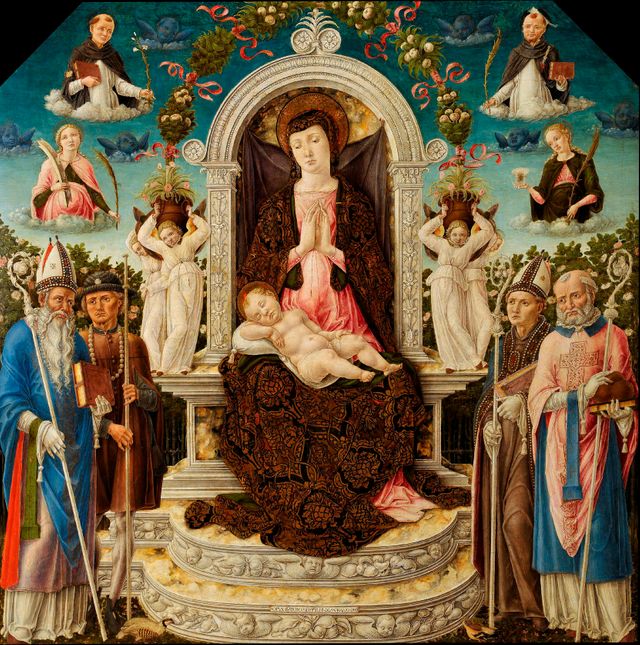
Bartolomeo Vivarini was the second member of a family of painters from the Venetian island of Murano who sustained over fifty years of considerable prestige and commercial success during the second half of the fifteenth century. He studied under his elder brother Antonio, with whom he collaborated after 1450. He probably trained in Padua as well and, in his early works especially, his debt to Andrea Mantegna is easily discerned. The output of the Vivarini workshop was vast, supplying both local Venetian clients and patrons further afield, in other parts of the Italian peninsula and across the Adriatic basin on the Dalmatian coast. Bartolomeo's first independent dated work is from 1459 and his practice developed rapidly thereafter. By the end of the 1470s, he had cornered the market for altarpieces in Venice, alternating between multipaneled structures (or polyptychs) with figures often set against gold backgrounds, and the more modern format of figures depicted in a unified space against a landscape or interior. During the 1480s, when Bartolomeo's style became increasingly linear and spare, his clientele shifted west, to small rural towns north of Bergamo. Bartolomeo’s last dated work is a triptych from 1491 today in the Accademia Carrara. Alvise Vivarini, Antonio's son but possibly Bartolomeo's pupil, carried on the family workshop.
Track Bartolomeo Vivarini
Get notifications when works come to auction, and access market analytics
Create Free AccountAlready have an account? Sign In
Professional documentation gives you clarity, portability, and confidence in your collection.
Learn why collectors document their holdings online


Your collection, accessible anywhere
Access your collection from any device with our cloud-based platform. Native mobile apps provide seamless synchronization and offline browsing, ensuring your collection data is always at hand.


Biography
Bartolomeo Vivarini was the second member of a family of painters from the Venetian island of Murano who sustained over fifty years of considerable prestige and commercial success during the second half of the fifteenth century. He studied under his elder brother Antonio, with whom he collaborated after 1450. He probably trained in Padua as well and, in his early works especially, his debt to Andrea Mantegna is easily discerned. The output of the Vivarini workshop was vast, supplying both local Venetian clients and patrons further afield, in other parts of the Italian peninsula and across the Adriatic basin on the Dalmatian coast. Bartolomeo's first independent dated work is from 1459 and his practice developed rapidly thereafter. By the end of the 1470s, he had cornered the market for altarpieces in Venice, alternating between multipaneled structures (or polyptychs) with figures often set against gold backgrounds, and the more modern format of figures depicted in a unified space against a landscape or interior. During the 1480s, when Bartolomeo's style became increasingly linear and spare, his clientele shifted west, to small rural towns north of Bergamo. Bartolomeo’s last dated work is a triptych from 1491 today in the Accademia Carrara. Alvise Vivarini, Antonio's son but possibly Bartolomeo's pupil, carried on the family workshop.
Track Bartolomeo Vivarini
Get notifications when works come to auction, and access market analytics
Create Free AccountAlready have an account? Sign In
Professional documentation gives you clarity, portability, and confidence in your collection.
Learn why collectors document their holdings onlineYour collection, accessible anywhere
Access your collection from any device with our cloud-based platform. Native mobile apps provide seamless synchronization and offline browsing, ensuring your collection data is always at hand.