Baseera Khan
Biography
Baseera Khan is a New York-based artist who sublimates colonial histories through performance and sculpture in order to map geographies of the future. Khan opened their first solo exhibition at Simone Subal, New York and a two-person show at Jenkins Johnson Projects (2019). They have exhibited in numerous locations such as Sculpture Center (2018), Aspen Museum (2017), Participant Inc. (2017), Moudy Gallery at Texas Christian University (2017), Fine Arts Center of Colorado College (2018), and has performed at several locations including the Whitney Museum of American Art and Art POP Montreal International Music Festival (2017). Khan was an artist in residence at Pioneer Works (2018-19) and Abrons Art Center (2016-17), was an International Travel Fellow to Jerusalem/Ramallah through Apexart (2015), and attended the Skowhegan School of Painting and Sculpture (2014). Khan was a recipient of the BRIC Colene Brown Art Prize and the Joan Mitchell Painters and Sculptors Grant in 2019, they were granted by both NYSCA/NYFA and Art Matters in 2018. Her work was recently acquired by the Solomon R. Guggenheim permanent collections and Kadist, San Francisco. She is published in Artforum, Art in America, BOMB, OSMOS Magazine, unbag, Brooklyn Rail, The New Yorker, The New York Times, and TDR Drama Review. She received an M.F.A. from Cornell University (2012) and a B.F.A. from the University of North Texas (2005). I am a New York-based artist who combines distinct and often mutually exclusive cultural references to explore the conditions of alienation, displacement, assimilation, and fluidity. I see bodies as collaged identities constantly subject to volatile social environments, especially within capitalist-driven societies such as the United States. I see bodies as living between the realms of surveillance and otherness which results in a suspension between exile and kinship central to my practice. To balance this subjectivity, I began to self-censor and develop secretive environments of sanctuary in my life and work. These life lessons transform into motives of obscurity that lead me to a careful deployment of material and linguistic shifts. The use of fashion, photography, textiles and music, sculpture and performance manifest my native-born femme Muslim American experience, a legacy for my aesthetic concealment.
Track Baseera Khan
Get notifications when works come to auction, and access market analytics
Create Free AccountAlready have an account? Sign In
Professional documentation gives you clarity, portability, and confidence in your collection.
Learn why collectors document their holdings online


Your collection, accessible anywhere
Access your collection from any device with our cloud-based platform. Native mobile apps provide seamless synchronization and offline browsing, ensuring your collection data is always at hand.


Baseera Khan
Biography
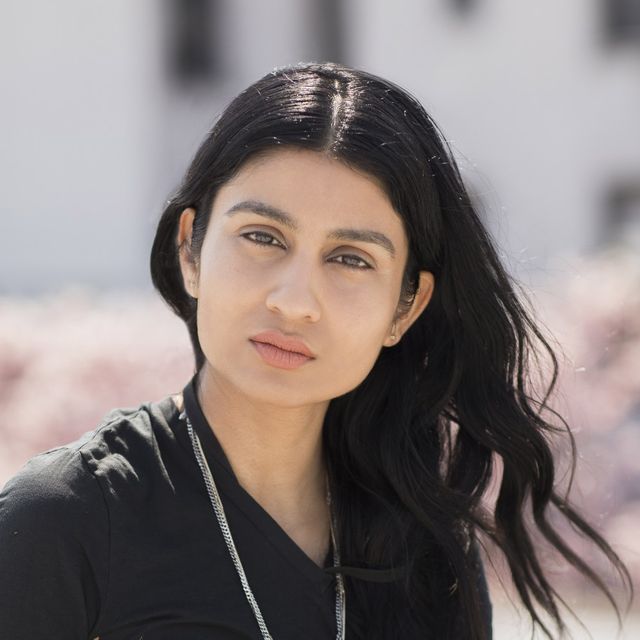
Baseera Khan is a New York-based artist who sublimates colonial histories through performance and sculpture in order to map geographies of the future. Khan opened their first solo exhibition at Simone Subal, New York and a two-person show at Jenkins Johnson Projects (2019). They have exhibited in numerous locations such as Sculpture Center (2018), Aspen Museum (2017), Participant Inc. (2017), Moudy Gallery at Texas Christian University (2017), Fine Arts Center of Colorado College (2018), and has performed at several locations including the Whitney Museum of American Art and Art POP Montreal International Music Festival (2017). Khan was an artist in residence at Pioneer Works (2018-19) and Abrons Art Center (2016-17), was an International Travel Fellow to Jerusalem/Ramallah through Apexart (2015), and attended the Skowhegan School of Painting and Sculpture (2014). Khan was a recipient of the BRIC Colene Brown Art Prize and the Joan Mitchell Painters and Sculptors Grant in 2019, they were granted by both NYSCA/NYFA and Art Matters in 2018. Her work was recently acquired by the Solomon R. Guggenheim permanent collections and Kadist, San Francisco. She is published in Artforum, Art in America, BOMB, OSMOS Magazine, unbag, Brooklyn Rail, The New Yorker, The New York Times, and TDR Drama Review. She received an M.F.A. from Cornell University (2012) and a B.F.A. from the University of North Texas (2005). I am a New York-based artist who combines distinct and often mutually exclusive cultural references to explore the conditions of alienation, displacement, assimilation, and fluidity. I see bodies as collaged identities constantly subject to volatile social environments, especially within capitalist-driven societies such as the United States. I see bodies as living between the realms of surveillance and otherness which results in a suspension between exile and kinship central to my practice. To balance this subjectivity, I began to self-censor and develop secretive environments of sanctuary in my life and work. These life lessons transform into motives of obscurity that lead me to a careful deployment of material and linguistic shifts. The use of fashion, photography, textiles and music, sculpture and performance manifest my native-born femme Muslim American experience, a legacy for my aesthetic concealment.
Track Baseera Khan
Get notifications when works come to auction, and access market analytics
Create Free AccountAlready have an account? Sign In
Professional documentation gives you clarity, portability, and confidence in your collection.
Learn why collectors document their holdings onlineYour collection, accessible anywhere
Access your collection from any device with our cloud-based platform. Native mobile apps provide seamless synchronization and offline browsing, ensuring your collection data is always at hand.