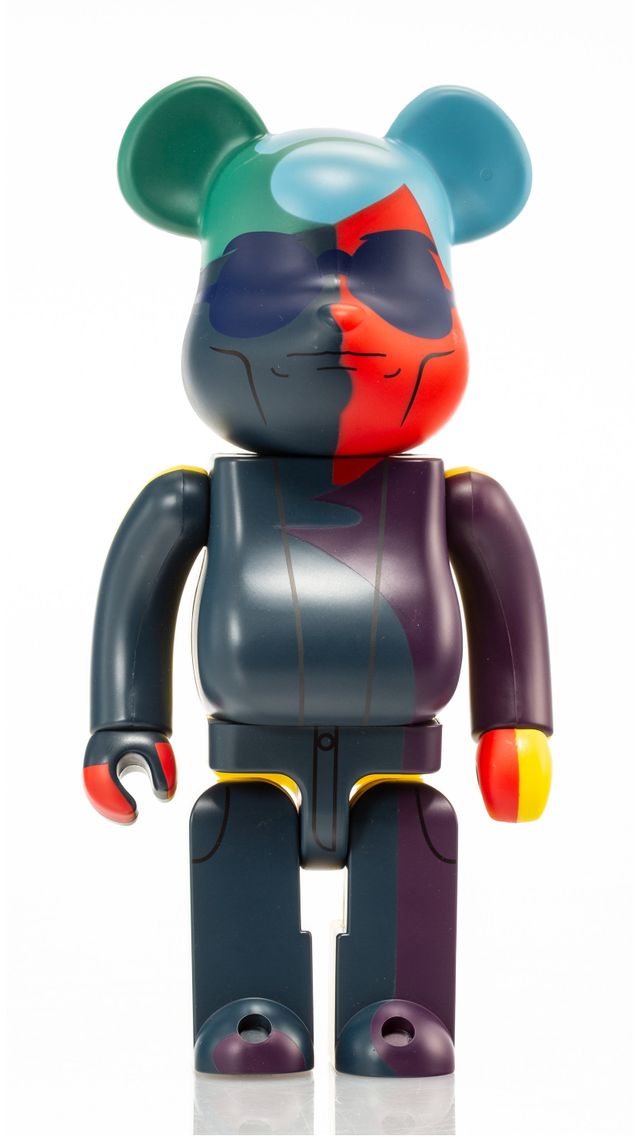
BE@RBRICK X Andy Warhol 400%
Biography
Designer Toys, also called art toys, are toys and collectibles created by artists and designers that are either self-produced or made by small, independent toy companies, typically in very limited editions. Artists use a variety of materials, such as ABS plastic, vinyl, wood, metal, latex, plush, and resin. Creators often have backgrounds in graphic design, illustration, or fine art, but many accomplished toy artists are self-taught. The first Designer Toys appeared in the 1990s in Hong Kong and Japan. By the early 2000s, the majority of Designer Toys were based upon characters created by popular Lowbrow artists, forever linking the two movements. Bearbrick (rendered Be@rbrick) is a collectible toy designed and produced by the Japanese company MediCom Toy Incorporated. The name is derived from the fact that the figure is a cartoon-style representation of a bear and that it is a variation of MediCom's Kubrick design. The at sign in the place of the letter a is a visual device that is a part of the Bearbrick brand, and as such, a trademark of MediCom Toy. The figure is an anthropomorphized bear with an extremely simplified form and a pot belly. Each plastic figure features nine parts (widely referred to as tools in the toy industry): head, torso, hips, arms, hands, and legs; These nine tools allow eight points of articulation: swivel head, swivel waist, ball joint arms, swivel wrists, and ball joint legs. Andy Warhol was born Andrew Warhola in Pittsburgh on August 6, 1928. He received a BFA from the Carnegie Institute of Technology in Pittsburgh in 1949. That same year he moved to New York, where he soon became successful as a commercial artist and illustrator. During the 1950s Warhol’s drawings were published in Glamour and other magazines and displayed in department stores. He became known for his illustrations of I. Miller shoes. In 1952 the Hugo Gallery in New York presented a show of Warhol’s illustrations for Truman Capote’s writings. He traveled in Europe and Asia in 1956. In the early 1960s Warhol began to paint comic-strip characters and images derived from advertisements; this work was characterized by the repetition of banal subjects such as Coca-Cola bottles and soup cans. He also painted celebrities at this time. Warhol’s new paintings were exhibited for the first time in 1962, initially at the Ferus Gallery in Los Angeles, and then in a solo exhibition at the Stable Gallery in New York. In 1962 he began to employ primarily a silkscreen process in place of hand painting. Working with assistants, he produced series of works depicting “death and disaster,” flowers, and cows, as well as portraits. He also made three-dimensional facsimiles of Brillo boxes and cartons of other well-known household products. Starting in the mid-1960s, at the Factory, his New York studio, Warhol concentrated on making films often featuring lengthy depictions of everyday activities, as in Sleep and Eat (both 1963). In the early 1970s he began to paint again, returning to gestural brushwork and producing monumental portraits of Mao Tse-tung, commissioned portraits, and the Hammer and Sickle series. He also became interested in writing: his autobiography, The Philosophy of Andy Warhol (From A to B and Back Again), was published in 1975, and the Factory published Interview magazine. A major retrospective of Warhol’s work organized by the Pasadena Art Museum in Pasadena, California, in 1970 traveled in the United States and abroad. Warhol died on February 22, 1987, in New York.
Track BE@RBRICK X Andy Warhol 400%
Get notifications when works come to auction, and access market analytics
Create Free AccountAlready have an account? Sign In
Professional documentation gives you clarity, portability, and confidence in your collection.
Learn why collectors document their holdings online


Your collection, accessible anywhere
Access your collection from any device with our cloud-based platform. Native mobile apps provide seamless synchronization and offline browsing, ensuring your collection data is always at hand.


BE@RBRICK X Andy Warhol 400%
Biography
Designer Toys, also called art toys, are toys and collectibles created by artists and designers that are either self-produced or made by small, independent toy companies, typically in very limited editions. Artists use a variety of materials, such as ABS plastic, vinyl, wood, metal, latex, plush, and resin. Creators often have backgrounds in graphic design, illustration, or fine art, but many accomplished toy artists are self-taught. The first Designer Toys appeared in the 1990s in Hong Kong and Japan. By the early 2000s, the majority of Designer Toys were based upon characters created by popular Lowbrow artists, forever linking the two movements. Bearbrick (rendered Be@rbrick) is a collectible toy designed and produced by the Japanese company MediCom Toy Incorporated. The name is derived from the fact that the figure is a cartoon-style representation of a bear and that it is a variation of MediCom's Kubrick design. The at sign in the place of the letter a is a visual device that is a part of the Bearbrick brand, and as such, a trademark of MediCom Toy. The figure is an anthropomorphized bear with an extremely simplified form and a pot belly. Each plastic figure features nine parts (widely referred to as tools in the toy industry): head, torso, hips, arms, hands, and legs; These nine tools allow eight points of articulation: swivel head, swivel waist, ball joint arms, swivel wrists, and ball joint legs. Andy Warhol was born Andrew Warhola in Pittsburgh on August 6, 1928. He received a BFA from the Carnegie Institute of Technology in Pittsburgh in 1949. That same year he moved to New York, where he soon became successful as a commercial artist and illustrator. During the 1950s Warhol’s drawings were published in Glamour and other magazines and displayed in department stores. He became known for his illustrations of I. Miller shoes. In 1952 the Hugo Gallery in New York presented a show of Warhol’s illustrations for Truman Capote’s writings. He traveled in Europe and Asia in 1956. In the early 1960s Warhol began to paint comic-strip characters and images derived from advertisements; this work was characterized by the repetition of banal subjects such as Coca-Cola bottles and soup cans. He also painted celebrities at this time. Warhol’s new paintings were exhibited for the first time in 1962, initially at the Ferus Gallery in Los Angeles, and then in a solo exhibition at the Stable Gallery in New York. In 1962 he began to employ primarily a silkscreen process in place of hand painting. Working with assistants, he produced series of works depicting “death and disaster,” flowers, and cows, as well as portraits. He also made three-dimensional facsimiles of Brillo boxes and cartons of other well-known household products. Starting in the mid-1960s, at the Factory, his New York studio, Warhol concentrated on making films often featuring lengthy depictions of everyday activities, as in Sleep and Eat (both 1963). In the early 1970s he began to paint again, returning to gestural brushwork and producing monumental portraits of Mao Tse-tung, commissioned portraits, and the Hammer and Sickle series. He also became interested in writing: his autobiography, The Philosophy of Andy Warhol (From A to B and Back Again), was published in 1975, and the Factory published Interview magazine. A major retrospective of Warhol’s work organized by the Pasadena Art Museum in Pasadena, California, in 1970 traveled in the United States and abroad. Warhol died on February 22, 1987, in New York.
Track BE@RBRICK X Andy Warhol 400%
Get notifications when works come to auction, and access market analytics
Create Free AccountAlready have an account? Sign In
Professional documentation gives you clarity, portability, and confidence in your collection.
Learn why collectors document their holdings onlineYour collection, accessible anywhere
Access your collection from any device with our cloud-based platform. Native mobile apps provide seamless synchronization and offline browsing, ensuring your collection data is always at hand.