Biography
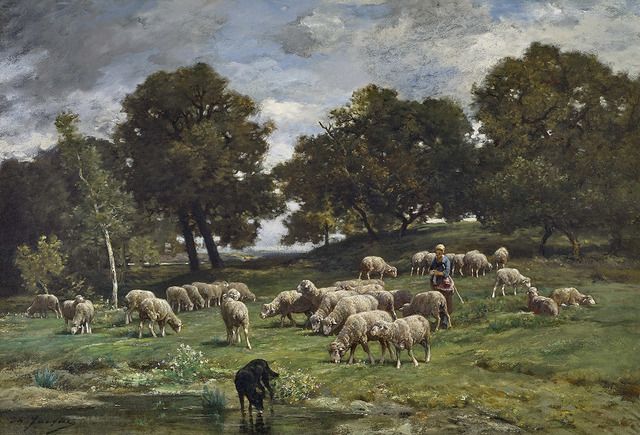
In 1849, fleeing a devastating cholera epidemic in Paris, Charles Émile Jacque (1813-1894) and his family traveled to the scenic French town of Barbizon with his friend and fellow artist Jean-François Millet (1814-1875). The men’s ensuing interest in nature and the depiction of rural life led to a significant shift in subject matter and style, and a growing camaraderie with several members of the newly formed “School of 1830,” or Barbizon School.[i] “Jacque and I have settled to stay at Barbizon for some time,” wrote Millet to the art dealer and critic Alfred Sensier (1815-1877) in June of that year, “and have accordingly, each of us, taken rooms. The prices are excessively low compared to those in Paris; and as it is easy to get down to town if necessary, and the country is superbly beautiful, we hope to work more quietly here, and perhaps do better things. In fact, we intend to spend some time here.”[ii] The pictures that Jacque produced during and after this “quiet” yet profoundly influential time - among the most popular of his day - have recently experienced a resurgence of interest among scholars and collectors, both for the art historical traditions they preserve and the remarkable originality of their vision. Jacque’s artistic training, informal and sporadic as it was, began at 17, when he was apprenticed to a map engraver in Paris. He then served seven years in the French army, an experience that inspired a series of drawings and engravings. In 1838, Jacque traveled to London to work on literary and historical woodcarvings for a variety of books and journals. His return to Paris in 1840 saw the continued pursuit of a career in the graphic arts, as both an illustrator and a caricaturist. His contributions to such satirical publications as Le Charivari were among many contemporary illustrated vignettes featuring medical and political institutions and personages that were censured by the government. By the mid-1840s, Jacque had turned from these controversial ventures to the production of original etchings inspired by Rembrandt and the Dutch masters, and to picturesque depictions of rural life, intended for the Salon.[iii] One of the earliest artists to revive the art of etching, and credited with several significant technical innovations in the medium, Jacque would make his name in this field long before his career as a painter began. By 1848, he had completed nearly 350 etchings and, by the time of his death in 1894, over 500.[iv] Jacque’s etchings from this period are significant for reasons beyond technical and aesthetic merits alone. They confirm, through their subject matter and chronology, Jacque’s critical role in the Realist movement and his profound influence on Millet - rather than, as art history has long had it, the other way around.[v] (Indeed, Jacque seems to have influenced Millet in many aspects of his early life: the choice of Barbizon as their sanctuary in 1849, for example, had come entirely at Jacque’s behest.)[vi] “In [Jacque’s] first works,” an astute writer for The Portfolio of 1875 had penned, “he showed an inclination to a rather affected sort of elegance, and the more robust and truly rustic character of his later works has often been attributed to the influence of Millet. There have been, however, protests against this opinion, and, as appears to us, not without good reason. ‘It would seem’ says M. Guiffrey, in the preface to the excellent catalogue that he has made of Charles Jacque’s engravings, ‘it would seem, to hear a great number of critics, and M. Charles Blanc himself, as if it were the influence, or simply the example, of M. Millet which had decided M. Jacque to give back to peasants the rustic, rural look natural to those who work in the fields. M. Millet had not yet dreamt of painting the country and its inhabitants when M. Jacque had already corrected his first tendency to affected elegance in rustic scenes. Several plates of 1844, and a good many woodcuts, bear witness to this change of manner, which became visible long before M. Millet had produced his first real peasants. This artist, who about 1848, was painting bathers and little nude figures, very much appreciated by old picture-buyers, afterwards carried to its utmost limits the system already adopted by M. Jacque, and his extreme, not to say excessive, boldness, made him pass for the inventor of a theory which he has developed à outrance.’ ”[vii] Decades later, in 1922, Loys Delteil attempted to again redress the disturbing perpetuation of this myth: “It has been tried, more than once,” he observed, “to compare Millet with Jacque, or Jacque with Millet . . . Jules Claretie refers to it in these lines in his preface to the Sale of the Atelier of Jacque (November, 1897). ‘There are many controvertible points in the study, in other respects very careful, of Charles Blanc, as for example the page where the critic believes it necessary to defend Jacque from having the appearance of being an imitator of Millet. All students of the history of art know that Jacque preceded Millet in the painting of rural scenes, peasants, animals and rustic work. It is not too much to say that the penetrating and vivid intelligence of Jacque has influenced the spirit of Millet, his neighbor at Barbizon.’ ”[viii] Jacque made his debut at the Salon of 1844 with an etched reproduction of a landscape painting by Théodore Rousseau (1812-1867).[ix] Inspired, perhaps, by the evocative works of this Barbizon master, or simply by his inveterate love of innovation, Jacque’s first foray into painting would also take place in this year. (He would not exhibit his paintings, however, for some time.) In 1845, Jacque exhibited a portrait after Rembrandt, earning both the attention of the poet and critic Charles Baudelaire (1821-1867) and two government commissions, the first in 1846, and the second, a realist painting, in 1848 (Les Boeufs à l’abreuvoir [Angers, Musée de Beaux Arts]). Buoyed by the State’s recognition, Jacque submitted the first of his commissioned works to the 1847 Salon; its rejection would become the catalyst for the artist’s increasingly unsteady relationship with that conservative venue, and the strengthening of his affiliation with the avant-garde. (Despite his displeasure with the Salon, and his frequent absences from its galleries,[x] Jacque would eventually earn a string of second- and third-class medals for his etchings and paintings between 1850 and 1864. Higher accolades would prove elusive until 1889, when he earned a gold medal at the Exposition Universelle.) In 1858, nearly a decade after his transformative move to the countryside, Jacque published Le Poulailler, a treatise on his experiences as a poultry breeder in Barbizon. The book was the natural culmination of Jacque’s interests over the course of the last ten years: In addition to publishing his etchings of rustic scenes and village life in Le Magasin Pittoresque and L’Illustration, and his study of rural “types” in the spirit of Jean-François Raffaelli (1850-1924) and other Realist luminaries currently represented in the Gallery 19c inventory, he submitted several scientific articles to agricultural journals such as Le Journal d’Agriculture Pratique. His interest in chickens and other domesticated animals and unparalleled knowledge of their anatomy and habits was solidified by frequent excursions to Le Jardin des Plantes in Paris, and by his first-hand experiences with local farming practices in Barbizon.[xi] Not content to merely observe and analyze the life around him, or romanticize its ways, Jacque took it upon himself to develop real estate in the region, sell his chickens’ eggs as part of an entrepreneurial business venture, and cultivate asparagus; he also reputedly painted his plein air subjects while accompanied by a small flock of tame sheep, which served as his most instructive and devoted models.[xii] Though many Barbizon artists included animals in their pictures, notably Constant Troyon (1810-1865), whose bucolic works have often been compared to Jacque’s own, none could match the expressiveness that Jacque gave them, or invest them with as much complex significance.[xiii] Indeed, in addition to evoking the eighteenth-century traditions of the animalier, Jacque’s animal paintings – many of them life-size, as if to underscore their import – also reveal contemporary developments in French agriculture, politics, and science, compelling historians to regard them as journalistic evidence and pointed efforts at salvage ethnography, as well as fine art (see, for example, Le Printemps of 1859, currently in the Gallery 19c inventory).[xiv] These qualities confirm Jacque’s position not merely at the center of the Barbizon School, but of nineteenth-century French Realism as well, and today recast him in the art historical literature as a progressive and influential activist at the forefront of a revolution in art.[xv] The enormous success of Jacque’s works across Europe and, increasingly, Britain and America, did not result in financial gain until 1867, when the artist turned more consistently to painting and to dealers for exposure rather than the Salon. In that year, Jacque was awarded the Chevalier de la Légion d’Honneur and was elected to the juries for the Exposition Universelle and the Grand Prix de Rome. Writing in 1895 of this period, one critic noted that, “Jacque has not exhibited since 1870, chiefly because his pictures are usually sold before leaving the easel . . .”[xvi] The prominent American collector Isabella Stewart Gardner (1840-1924) purchased her first painting, a pastoral scene by Jacque, in 1873, and Henry Clay Frick (1849-1919) became another notable admirer and patron of Jacque’s work at this time. In 1881, Jacque took up watercolor, a vocation that led to an increasingly loose painterly style. Jacque’s final submission to the Salon, Intérieur d’Écurie (Interior of a Stable), was a work as characteristic in its pastoral subject matter as his first, and was exhibited in 1894.
Track Charles-Émile Jacque
Get notifications when works come to auction, and access market analytics
Create Free AccountAlready have an account? Sign In
Professional documentation gives you clarity, portability, and confidence in your collection.
Learn why collectors document their holdings online


Your collection, accessible anywhere
Access your collection from any device with our cloud-based platform. Native mobile apps provide seamless synchronization and offline browsing, ensuring your collection data is always at hand.


Biography
In 1849, fleeing a devastating cholera epidemic in Paris, Charles Émile Jacque (1813-1894) and his family traveled to the scenic French town of Barbizon with his friend and fellow artist Jean-François Millet (1814-1875). The men’s ensuing interest in nature and the depiction of rural life led to a significant shift in subject matter and style, and a growing camaraderie with several members of the newly formed “School of 1830,” or Barbizon School.[i] “Jacque and I have settled to stay at Barbizon for some time,” wrote Millet to the art dealer and critic Alfred Sensier (1815-1877) in June of that year, “and have accordingly, each of us, taken rooms. The prices are excessively low compared to those in Paris; and as it is easy to get down to town if necessary, and the country is superbly beautiful, we hope to work more quietly here, and perhaps do better things. In fact, we intend to spend some time here.”[ii] The pictures that Jacque produced during and after this “quiet” yet profoundly influential time - among the most popular of his day - have recently experienced a resurgence of interest among scholars and collectors, both for the art historical traditions they preserve and the remarkable originality of their vision. Jacque’s artistic training, informal and sporadic as it was, began at 17, when he was apprenticed to a map engraver in Paris. He then served seven years in the French army, an experience that inspired a series of drawings and engravings. In 1838, Jacque traveled to London to work on literary and historical woodcarvings for a variety of books and journals. His return to Paris in 1840 saw the continued pursuit of a career in the graphic arts, as both an illustrator and a caricaturist. His contributions to such satirical publications as Le Charivari were among many contemporary illustrated vignettes featuring medical and political institutions and personages that were censured by the government. By the mid-1840s, Jacque had turned from these controversial ventures to the production of original etchings inspired by Rembrandt and the Dutch masters, and to picturesque depictions of rural life, intended for the Salon.[iii] One of the earliest artists to revive the art of etching, and credited with several significant technical innovations in the medium, Jacque would make his name in this field long before his career as a painter began. By 1848, he had completed nearly 350 etchings and, by the time of his death in 1894, over 500.[iv] Jacque’s etchings from this period are significant for reasons beyond technical and aesthetic merits alone. They confirm, through their subject matter and chronology, Jacque’s critical role in the Realist movement and his profound influence on Millet - rather than, as art history has long had it, the other way around.[v] (Indeed, Jacque seems to have influenced Millet in many aspects of his early life: the choice of Barbizon as their sanctuary in 1849, for example, had come entirely at Jacque’s behest.)[vi] “In [Jacque’s] first works,” an astute writer for The Portfolio of 1875 had penned, “he showed an inclination to a rather affected sort of elegance, and the more robust and truly rustic character of his later works has often been attributed to the influence of Millet. There have been, however, protests against this opinion, and, as appears to us, not without good reason. ‘It would seem’ says M. Guiffrey, in the preface to the excellent catalogue that he has made of Charles Jacque’s engravings, ‘it would seem, to hear a great number of critics, and M. Charles Blanc himself, as if it were the influence, or simply the example, of M. Millet which had decided M. Jacque to give back to peasants the rustic, rural look natural to those who work in the fields. M. Millet had not yet dreamt of painting the country and its inhabitants when M. Jacque had already corrected his first tendency to affected elegance in rustic scenes. Several plates of 1844, and a good many woodcuts, bear witness to this change of manner, which became visible long before M. Millet had produced his first real peasants. This artist, who about 1848, was painting bathers and little nude figures, very much appreciated by old picture-buyers, afterwards carried to its utmost limits the system already adopted by M. Jacque, and his extreme, not to say excessive, boldness, made him pass for the inventor of a theory which he has developed à outrance.’ ”[vii] Decades later, in 1922, Loys Delteil attempted to again redress the disturbing perpetuation of this myth: “It has been tried, more than once,” he observed, “to compare Millet with Jacque, or Jacque with Millet . . . Jules Claretie refers to it in these lines in his preface to the Sale of the Atelier of Jacque (November, 1897). ‘There are many controvertible points in the study, in other respects very careful, of Charles Blanc, as for example the page where the critic believes it necessary to defend Jacque from having the appearance of being an imitator of Millet. All students of the history of art know that Jacque preceded Millet in the painting of rural scenes, peasants, animals and rustic work. It is not too much to say that the penetrating and vivid intelligence of Jacque has influenced the spirit of Millet, his neighbor at Barbizon.’ ”[viii] Jacque made his debut at the Salon of 1844 with an etched reproduction of a landscape painting by Théodore Rousseau (1812-1867).[ix] Inspired, perhaps, by the evocative works of this Barbizon master, or simply by his inveterate love of innovation, Jacque’s first foray into painting would also take place in this year. (He would not exhibit his paintings, however, for some time.) In 1845, Jacque exhibited a portrait after Rembrandt, earning both the attention of the poet and critic Charles Baudelaire (1821-1867) and two government commissions, the first in 1846, and the second, a realist painting, in 1848 (Les Boeufs à l’abreuvoir [Angers, Musée de Beaux Arts]). Buoyed by the State’s recognition, Jacque submitted the first of his commissioned works to the 1847 Salon; its rejection would become the catalyst for the artist’s increasingly unsteady relationship with that conservative venue, and the strengthening of his affiliation with the avant-garde. (Despite his displeasure with the Salon, and his frequent absences from its galleries,[x] Jacque would eventually earn a string of second- and third-class medals for his etchings and paintings between 1850 and 1864. Higher accolades would prove elusive until 1889, when he earned a gold medal at the Exposition Universelle.) In 1858, nearly a decade after his transformative move to the countryside, Jacque published Le Poulailler, a treatise on his experiences as a poultry breeder in Barbizon. The book was the natural culmination of Jacque’s interests over the course of the last ten years: In addition to publishing his etchings of rustic scenes and village life in Le Magasin Pittoresque and L’Illustration, and his study of rural “types” in the spirit of Jean-François Raffaelli (1850-1924) and other Realist luminaries currently represented in the Gallery 19c inventory, he submitted several scientific articles to agricultural journals such as Le Journal d’Agriculture Pratique. His interest in chickens and other domesticated animals and unparalleled knowledge of their anatomy and habits was solidified by frequent excursions to Le Jardin des Plantes in Paris, and by his first-hand experiences with local farming practices in Barbizon.[xi] Not content to merely observe and analyze the life around him, or romanticize its ways, Jacque took it upon himself to develop real estate in the region, sell his chickens’ eggs as part of an entrepreneurial business venture, and cultivate asparagus; he also reputedly painted his plein air subjects while accompanied by a small flock of tame sheep, which served as his most instructive and devoted models.[xii] Though many Barbizon artists included animals in their pictures, notably Constant Troyon (1810-1865), whose bucolic works have often been compared to Jacque’s own, none could match the expressiveness that Jacque gave them, or invest them with as much complex significance.[xiii] Indeed, in addition to evoking the eighteenth-century traditions of the animalier, Jacque’s animal paintings – many of them life-size, as if to underscore their import – also reveal contemporary developments in French agriculture, politics, and science, compelling historians to regard them as journalistic evidence and pointed efforts at salvage ethnography, as well as fine art (see, for example, Le Printemps of 1859, currently in the Gallery 19c inventory).[xiv] These qualities confirm Jacque’s position not merely at the center of the Barbizon School, but of nineteenth-century French Realism as well, and today recast him in the art historical literature as a progressive and influential activist at the forefront of a revolution in art.[xv] The enormous success of Jacque’s works across Europe and, increasingly, Britain and America, did not result in financial gain until 1867, when the artist turned more consistently to painting and to dealers for exposure rather than the Salon. In that year, Jacque was awarded the Chevalier de la Légion d’Honneur and was elected to the juries for the Exposition Universelle and the Grand Prix de Rome. Writing in 1895 of this period, one critic noted that, “Jacque has not exhibited since 1870, chiefly because his pictures are usually sold before leaving the easel . . .”[xvi] The prominent American collector Isabella Stewart Gardner (1840-1924) purchased her first painting, a pastoral scene by Jacque, in 1873, and Henry Clay Frick (1849-1919) became another notable admirer and patron of Jacque’s work at this time. In 1881, Jacque took up watercolor, a vocation that led to an increasingly loose painterly style. Jacque’s final submission to the Salon, Intérieur d’Écurie (Interior of a Stable), was a work as characteristic in its pastoral subject matter as his first, and was exhibited in 1894.
Track Charles-Émile Jacque
Get notifications when works come to auction, and access market analytics
Create Free AccountAlready have an account? Sign In
Professional documentation gives you clarity, portability, and confidence in your collection.
Learn why collectors document their holdings onlineYour collection, accessible anywhere
Access your collection from any device with our cloud-based platform. Native mobile apps provide seamless synchronization and offline browsing, ensuring your collection data is always at hand.