Biography
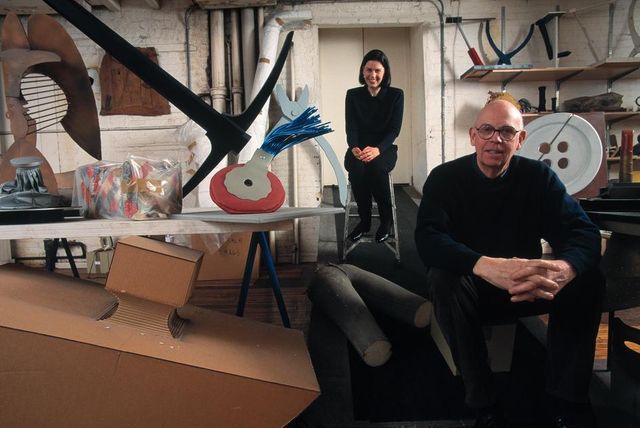
Claes Oldenburg: In public sites, our sculptures reflect both the surroundings and their context, but through our imagination and selective perception – which is what makes them also personal. We feel free to use all the approaches that come naturally to our non-monumental works: variations in scale, similes, transformations, a wide range of materials, and, of course, our use of familiar objects. We want to communicate with the public but on our own terms, even if the images are stereotypical. Our dialogue, which leads to the definition of a project, may take place anywhere, but we usually make decisions in our studio where we are surrounded by objects, models, notes, and drawings from the recent past and present, stimulated, whenever possible, by recollected observations of a site. We work our way through one image after another in words and sketches, testing them in models that can serve as the starting point of fabrication in large scale. (1) Coosje van Bruggen: The predilection for deliberate, improvisatory primitiveness, the recovery of the inherent nature of materials or of the magic of a previous life present in a bundle of ancient burlap, for example, turn the studio into a state of flux, a place that is a source of images changing into other, equivalent ones. Italo Calvino talks about "a field of analogies, symmetries, confrontations." That’s our particular landscape, the one in which we function. Working together supposes an almost complete understanding of the other, an impossibility in any case, so instead we choose a unity of opposites, a convergence of our different dynamics, of symmetry and asymmetry, of acceleration or implied speed and stillness, of a polychrome and monochrome palette, gravity and lightness -- all interrelating and interchangeable elements to be used by either one of us. Juxtaposed or superimposed, the components are put together into an image through a dialogue between us that proceeds like a game of Ping-Pong, to and fro, toward its ultimate crystallization, first into a sketch and then into a three-dimensional study or a model, a process of using the senses rather than analysis, in sharp contrast to the rational fabrication phase that follows.
Track Claes Oldenburg and Coosje van Bruggen
Get notifications when works come to auction, and access market analytics
Create Free AccountAlready have an account? Sign In
Professional documentation gives you clarity, portability, and confidence in your collection.
Learn why collectors document their holdings online


Your collection, accessible anywhere
Access your collection from any device with our cloud-based platform. Native mobile apps provide seamless synchronization and offline browsing, ensuring your collection data is always at hand.


Biography
Claes Oldenburg: In public sites, our sculptures reflect both the surroundings and their context, but through our imagination and selective perception – which is what makes them also personal. We feel free to use all the approaches that come naturally to our non-monumental works: variations in scale, similes, transformations, a wide range of materials, and, of course, our use of familiar objects. We want to communicate with the public but on our own terms, even if the images are stereotypical. Our dialogue, which leads to the definition of a project, may take place anywhere, but we usually make decisions in our studio where we are surrounded by objects, models, notes, and drawings from the recent past and present, stimulated, whenever possible, by recollected observations of a site. We work our way through one image after another in words and sketches, testing them in models that can serve as the starting point of fabrication in large scale. (1) Coosje van Bruggen: The predilection for deliberate, improvisatory primitiveness, the recovery of the inherent nature of materials or of the magic of a previous life present in a bundle of ancient burlap, for example, turn the studio into a state of flux, a place that is a source of images changing into other, equivalent ones. Italo Calvino talks about "a field of analogies, symmetries, confrontations." That’s our particular landscape, the one in which we function. Working together supposes an almost complete understanding of the other, an impossibility in any case, so instead we choose a unity of opposites, a convergence of our different dynamics, of symmetry and asymmetry, of acceleration or implied speed and stillness, of a polychrome and monochrome palette, gravity and lightness -- all interrelating and interchangeable elements to be used by either one of us. Juxtaposed or superimposed, the components are put together into an image through a dialogue between us that proceeds like a game of Ping-Pong, to and fro, toward its ultimate crystallization, first into a sketch and then into a three-dimensional study or a model, a process of using the senses rather than analysis, in sharp contrast to the rational fabrication phase that follows.
Track Claes Oldenburg and Coosje van Bruggen
Get notifications when works come to auction, and access market analytics
Create Free AccountAlready have an account? Sign In
Professional documentation gives you clarity, portability, and confidence in your collection.
Learn why collectors document their holdings onlineYour collection, accessible anywhere
Access your collection from any device with our cloud-based platform. Native mobile apps provide seamless synchronization and offline browsing, ensuring your collection data is always at hand.