Biography
Clifton Karhu first went to Japan with the US Army after WW II. He then studied at the Minnesota Art School from 1950-1952 before returning to Japan as a missionary in 1952. Several years later he began doing artwork again -- both paintings and watercolors. In 1963 he moved to Kyoto from Gifu and began learning the cutting and printing techniques of traditional Ukiyo-e style woodblock printmaking. By then he had mastered the language, the social mores and became committed to remaining in Japan. Some say he became more Japanese than the native-born, wearing traditional attire as he walked the neighborhoods of Kyoto and his second home in Kanazawa. He was the first foreign member of the Japan Print Association, and even became President of the Kyoto chapter. Karhu is famous for using a rich blend of colors, usually with a strong overprinting of black line – unlike earlier Japanese print styles. Subjects are mostly locations in and around Kyoto, and in particular traditional architecture. These buildings provide linearity and stability to the art, some of which may employ quite bright and strong color. Special effects and moods are created with the use of light and shadow filtering across scenes. He often used multiple shades of the same color to give subtle variation in design. Although people are typically absent in Karhu’s work, there is always a feeling of human presence behind closed doors.
Track Clifton Karhu
Get notifications when works come to auction, and access market analytics
Create Free AccountAlready have an account? Sign In
Professional documentation gives you clarity, portability, and confidence in your collection.
Learn why collectors document their holdings online


Your collection, accessible anywhere
Access your collection from any device with our cloud-based platform. Native mobile apps provide seamless synchronization and offline browsing, ensuring your collection data is always at hand.


Biography
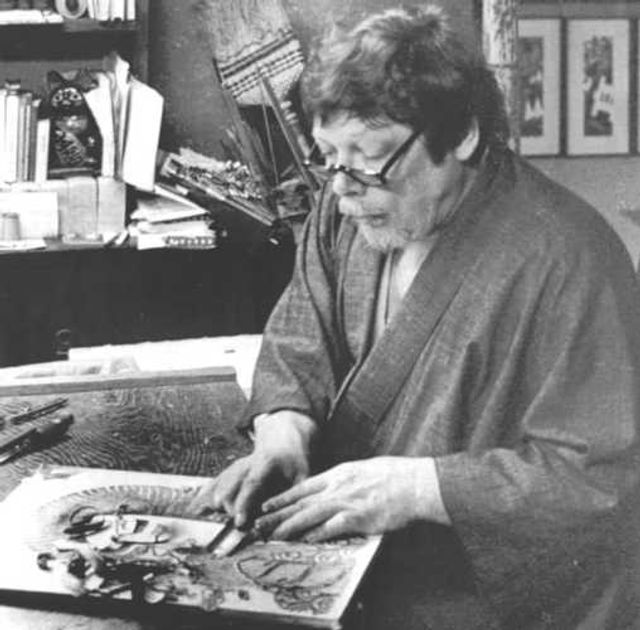
Clifton Karhu first went to Japan with the US Army after WW II. He then studied at the Minnesota Art School from 1950-1952 before returning to Japan as a missionary in 1952. Several years later he began doing artwork again -- both paintings and watercolors. In 1963 he moved to Kyoto from Gifu and began learning the cutting and printing techniques of traditional Ukiyo-e style woodblock printmaking. By then he had mastered the language, the social mores and became committed to remaining in Japan. Some say he became more Japanese than the native-born, wearing traditional attire as he walked the neighborhoods of Kyoto and his second home in Kanazawa. He was the first foreign member of the Japan Print Association, and even became President of the Kyoto chapter. Karhu is famous for using a rich blend of colors, usually with a strong overprinting of black line – unlike earlier Japanese print styles. Subjects are mostly locations in and around Kyoto, and in particular traditional architecture. These buildings provide linearity and stability to the art, some of which may employ quite bright and strong color. Special effects and moods are created with the use of light and shadow filtering across scenes. He often used multiple shades of the same color to give subtle variation in design. Although people are typically absent in Karhu’s work, there is always a feeling of human presence behind closed doors.
Track Clifton Karhu
Get notifications when works come to auction, and access market analytics
Create Free AccountAlready have an account? Sign In
Professional documentation gives you clarity, portability, and confidence in your collection.
Learn why collectors document their holdings onlineYour collection, accessible anywhere
Access your collection from any device with our cloud-based platform. Native mobile apps provide seamless synchronization and offline browsing, ensuring your collection data is always at hand.