Biography
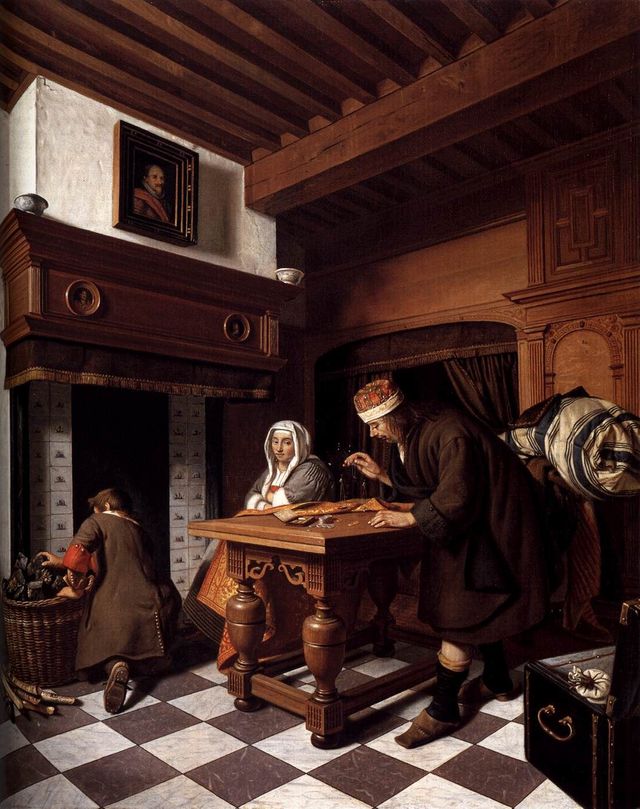
Cornelis de Man was almost forgotten until 1903, when art historian Hofstede de Groot rediscovered his work. Little is known of his life. He may have been from a family of jewelers; he was certainly related to the clergy, which automatically would have elevated him to a social class both feared and highly esteemed. In 1642 de Man was received into the Delft's Guild of Saint Luke. He then traveled in France and Italy for nine years, working in Paris, Florence, Rome, and Venice. He returned to Delft in 1654, where he remained until his death. De Man was a pillar of the community and served repeatedly as regent of the guild. De Man is best known for his interior scenes of bourgeois families, which show the influence of Jan Vermeer and Pieter de Hooch, but he also painted Italianate and naturalistic Dutch landscapes and church interiors. In addition, he painted and occasionally etched portraits. His sitters were usually clerics and scholars, whom he depicted soberly, coldly, and correctly, often in professional settings. To compensate for their lack of facial expression, de Man painted emotive, "speaking" hands. His earliest genre pictures date from around 1658.
Track Cornelis De Man
Get notifications when works come to auction, and access market analytics
Create Free AccountAlready have an account? Sign In
Professional documentation gives you clarity, portability, and confidence in your collection.
Learn why collectors document their holdings online


Your collection, accessible anywhere
Access your collection from any device with our cloud-based platform. Native mobile apps provide seamless synchronization and offline browsing, ensuring your collection data is always at hand.


Biography
Cornelis de Man was almost forgotten until 1903, when art historian Hofstede de Groot rediscovered his work. Little is known of his life. He may have been from a family of jewelers; he was certainly related to the clergy, which automatically would have elevated him to a social class both feared and highly esteemed. In 1642 de Man was received into the Delft's Guild of Saint Luke. He then traveled in France and Italy for nine years, working in Paris, Florence, Rome, and Venice. He returned to Delft in 1654, where he remained until his death. De Man was a pillar of the community and served repeatedly as regent of the guild. De Man is best known for his interior scenes of bourgeois families, which show the influence of Jan Vermeer and Pieter de Hooch, but he also painted Italianate and naturalistic Dutch landscapes and church interiors. In addition, he painted and occasionally etched portraits. His sitters were usually clerics and scholars, whom he depicted soberly, coldly, and correctly, often in professional settings. To compensate for their lack of facial expression, de Man painted emotive, "speaking" hands. His earliest genre pictures date from around 1658.
Track Cornelis De Man
Get notifications when works come to auction, and access market analytics
Create Free AccountAlready have an account? Sign In
Professional documentation gives you clarity, portability, and confidence in your collection.
Learn why collectors document their holdings onlineYour collection, accessible anywhere
Access your collection from any device with our cloud-based platform. Native mobile apps provide seamless synchronization and offline browsing, ensuring your collection data is always at hand.