Biography
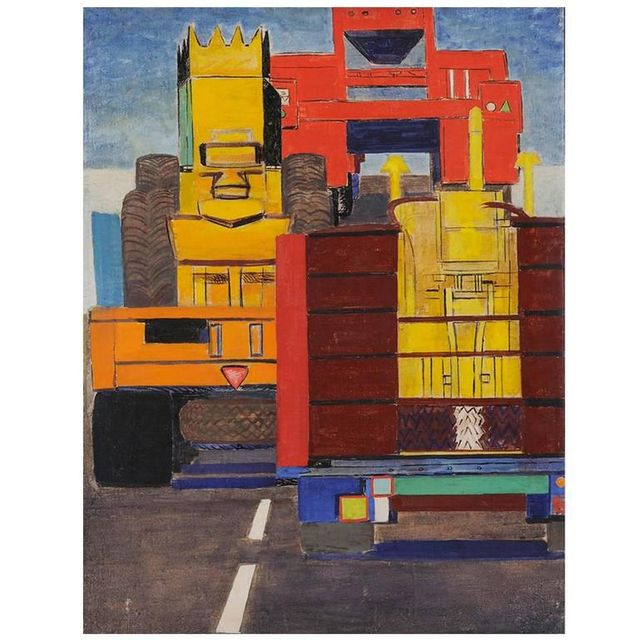
Son of the Belgian painter Maria Lambiotte and of a magistrate, Paul Salkin, who worked for a long time in the Belgian Congo and was a counselor at the Katanga Court of Appeal , he lived his first years at the abbey of Cortenbergh where he worked alongside the son of a friend of his father, also a magistrate, the painter Paul Delvaux , with whom he will remain friends throughout his life. He will collaborate with him on several large mural works. He will influence Delvaux a lot (and not the other way around), and it is notably he who will train him to draw and paint skeletons like him. He draws a lot from an early age and notably obtains at the age of 10 a prize in a major competition in Paris, in front of hundreds of other designers much older than him. In 1914-1918, Salkin was impressed by the First World War and he began to draw Chinese ink drawings of battlefields out of his imagination and of a very striking realism. He attended classes at the Academy of Fine Arts in Saint-Gilles (Brussels) from 1917 to 1919. After having worked under the tutelage of Ferdinand Schirren, he left for Paris in 1921 to study with C. Rossi and Bernard Naudin . In 1923, he married Suzanne Angelroth. In 1929, the writer Olivier de Bouveignes organized an exhibition of black and white drawings by Salkin which was to be a great success. From 1930, the Belgian state ordered and bought works from Salkin. In 1931, he held his first exhibition on the theme of cars. In 1933, drafts-projects on the theme of the "dance of death" were already appearing, populated by skeletons. In 1935, Salkin was in charge, with the architect Jean-Jules Eggerickx , of the decoration of the pavilion of the "household electricity" for the international and universal exhibition of Brussels of 1935. In 1938, having obtained a first grant from the Belgian State, he traveled to Italy, where he studied fresco. He visits Verona , Mantua , Padua , Venice , Ravenna , Florence , Assisi and Rome . Mobilized in 1939, he was taken prisoner of war in 1940, but was released fairly quickly. His eldest son, Paul, then aged 18, joined the Walloon Legion and left for the Eastern Front . Soon after, he was reported missing, plunging his father and his family into immense sadness. At the end of 1940, he went with his friend Paul Delvaux to the Natural History Museum in Brussels , where he made several studies of the human skeleton. In 1941, he became professor of artistic drawing at the Professional, Industrial and Decorative Arts School of Anderlecht , where he later became director and where he met in particular the painter Max Van Dyck , professor of decorative arts. He will eventually have an important career as a teacher, also working at the academies of Namur and Tournai , as well as at La Cambre (ENSAV). He studied the architecture of the city as well as Greek, Assyrian, Sumerian and Christian statuary. He also studied Spanish and Italian painting and sculpture as well as the Flemish primitives . From 1947 to 1955, the Spanish period saw the themes of bulls, bullfights and female figures treated in very vivid tones. In 1949, Salkin designed the Taureaux fresco for the Liège telephone and telegraph service . At the Museum of Natural History In 1952, Salkin took part in the creation of a fresco by his friend Paul Delvaux at the Ostend casino . In 1953, Lucien Christophe bought a painting from Salkin for the Walloon Art Museum in Liège . In 1956, Salkin again took part in the creation of a fresco commissioned from Paul Delvaux by Gilbert Périer, director of Sabena and a great collector of Brussels art. In 1965, Salkin painted a large mural, a 42 square meter fresco, for the post office in his office in Ixelles, representing the history of the post office . Then comes the first period of circulation , from 1956 to 1960, around the theme of automobile traffic. In 1957, Salkin exhibited for the first time at the Palais des Beaux-Arts in Brussels . This is the first time he has shown and exhibited works depicting cars and focusing on the theme of automobile traffic. The artist will subsequently exhibit many times at the Palais des Beaux-Arts in Brussels. In 1962, he married Francine Verhuyck with whom he had a son: Stéphane Salkin. The period from 1961 to 1965 is a so-called “non-objective” period, therefore an abstract period, tending towards expressionism. In 1965, during his pension as a teacher, he left Brussels to settle, with his wife and son, in the south of France, in the Var , in Cotignac , where the Salkin family had a villa built. with a large workshop in which he will continue his work until his death in 1977. The return to the figurative took place in 1966: his friend Marcel Broodthaers , who had greatly appreciated his Circulations neglected for abstraction, advised him to return to it, and he would then focus his creations again around automobile traffic and more precisely around trucks; "Truck period". He introduces humans as well as various animals in his Circulations : "locomotor machines between which pass animals and characters symbolizing the extravagance, derision and madness of this time", according to the biographical text written by Hubert Nyssen in 2004 for the News National Biography . He also depicts, especially in his drawings, the youth of the late 1960s: May 68 , the hippies on the beaches of Saint-Tropez . In 1968, the Royal Museums of Fine Arts of Belgium bought him a painting called: Circulation . In 1969, the Prints Cabinet of the Royal Library of Belgium bought two works from him entitled: Automobiles de course and Rencontres - grouping of standing men and women . In the last years of his life, between 1970 and 1972, he produced a large work of 14 meters long consisting of an assembly of 12 canvases: The tango of the antigenesis , so named by reference to the Antimémoires of Malraux, crazy farandole of naked women dancing with skeletons, his absolute “masterpiece”. After his death on Aug 27, 1977, his widow, Francine Salkin, begins to promote his work. In the spring of 1981, Émile Salkin was the guest of honor of the Society of French Artists during their spring show at the Grand Palais in Paris. Several major exhibitions have recently been devoted to him: An Émile Salkin retrospective took place, at the initiative and with the collaboration of the Ministry of the French Community of Belgium at the Maison de la culture de Tournai duOctober 5 at November 16, 1997. A second major retrospective exhibition was also held at the International Contemporary Art Center of Carros ( castle of Carros ) during the spring and summer 1998. A third major retrospective exhibition also took place at the PMMK , the modern art museum of the city of Ostend fromFebruary 23, 2002 at June 16, 2002. He is considered a great precursor (if not "the" precursor) of pop art , dixit Pierre Restany , expert and international art critic contacted by Willy Van Den Bussche, Curator of PMMK 2 , having produced works with a pop art tendency with its Circulations from 1956 [ref. necessary] . During the last decades, one could see its definite influence in the advertisements presenting characters and animals in the middle of the traffic. He produced several frescoes, including one for the chapel of Estaimbourg in 1954. An Émile Salkin room, devoted entirely and exclusively to the artist, was created at the initiative of the curator of the Ostend Museum of Modern Art (PMMK), Willy Van Den Bussche, showing several great masterpieces by the artist including his great “life's work”, the Tango of antigenesis . This room was open to the public for six years, from 1997 to 2003. His works appear in the collections of the Belgian State and the French Community of Belgium, in several large collections both in Belgium and abroad, as well as in several museums: Royal Museums of Fine Arts of Brussels 3 , museum PMMK of Ostende (now Mu.ZEE ), Walloon art museum in Liège, Tournai museum, Cabinet des Estampes de Bruxelles, prestigious private collections in Belgium, France, Luxembourg (collection of the Grand Ducal family in particular) .
Track Emile Salkin
Get notifications when works come to auction, and access market analytics
Create Free AccountAlready have an account? Sign In
Professional documentation gives you clarity, portability, and confidence in your collection.
Learn why collectors document their holdings online


Your collection, accessible anywhere
Access your collection from any device with our cloud-based platform. Native mobile apps provide seamless synchronization and offline browsing, ensuring your collection data is always at hand.


Biography
Son of the Belgian painter Maria Lambiotte and of a magistrate, Paul Salkin, who worked for a long time in the Belgian Congo and was a counselor at the Katanga Court of Appeal , he lived his first years at the abbey of Cortenbergh where he worked alongside the son of a friend of his father, also a magistrate, the painter Paul Delvaux , with whom he will remain friends throughout his life. He will collaborate with him on several large mural works. He will influence Delvaux a lot (and not the other way around), and it is notably he who will train him to draw and paint skeletons like him. He draws a lot from an early age and notably obtains at the age of 10 a prize in a major competition in Paris, in front of hundreds of other designers much older than him. In 1914-1918, Salkin was impressed by the First World War and he began to draw Chinese ink drawings of battlefields out of his imagination and of a very striking realism. He attended classes at the Academy of Fine Arts in Saint-Gilles (Brussels) from 1917 to 1919. After having worked under the tutelage of Ferdinand Schirren, he left for Paris in 1921 to study with C. Rossi and Bernard Naudin . In 1923, he married Suzanne Angelroth. In 1929, the writer Olivier de Bouveignes organized an exhibition of black and white drawings by Salkin which was to be a great success. From 1930, the Belgian state ordered and bought works from Salkin. In 1931, he held his first exhibition on the theme of cars. In 1933, drafts-projects on the theme of the "dance of death" were already appearing, populated by skeletons. In 1935, Salkin was in charge, with the architect Jean-Jules Eggerickx , of the decoration of the pavilion of the "household electricity" for the international and universal exhibition of Brussels of 1935. In 1938, having obtained a first grant from the Belgian State, he traveled to Italy, where he studied fresco. He visits Verona , Mantua , Padua , Venice , Ravenna , Florence , Assisi and Rome . Mobilized in 1939, he was taken prisoner of war in 1940, but was released fairly quickly. His eldest son, Paul, then aged 18, joined the Walloon Legion and left for the Eastern Front . Soon after, he was reported missing, plunging his father and his family into immense sadness. At the end of 1940, he went with his friend Paul Delvaux to the Natural History Museum in Brussels , where he made several studies of the human skeleton. In 1941, he became professor of artistic drawing at the Professional, Industrial and Decorative Arts School of Anderlecht , where he later became director and where he met in particular the painter Max Van Dyck , professor of decorative arts. He will eventually have an important career as a teacher, also working at the academies of Namur and Tournai , as well as at La Cambre (ENSAV). He studied the architecture of the city as well as Greek, Assyrian, Sumerian and Christian statuary. He also studied Spanish and Italian painting and sculpture as well as the Flemish primitives . From 1947 to 1955, the Spanish period saw the themes of bulls, bullfights and female figures treated in very vivid tones. In 1949, Salkin designed the Taureaux fresco for the Liège telephone and telegraph service . At the Museum of Natural History In 1952, Salkin took part in the creation of a fresco by his friend Paul Delvaux at the Ostend casino . In 1953, Lucien Christophe bought a painting from Salkin for the Walloon Art Museum in Liège . In 1956, Salkin again took part in the creation of a fresco commissioned from Paul Delvaux by Gilbert Périer, director of Sabena and a great collector of Brussels art. In 1965, Salkin painted a large mural, a 42 square meter fresco, for the post office in his office in Ixelles, representing the history of the post office . Then comes the first period of circulation , from 1956 to 1960, around the theme of automobile traffic. In 1957, Salkin exhibited for the first time at the Palais des Beaux-Arts in Brussels . This is the first time he has shown and exhibited works depicting cars and focusing on the theme of automobile traffic. The artist will subsequently exhibit many times at the Palais des Beaux-Arts in Brussels. In 1962, he married Francine Verhuyck with whom he had a son: Stéphane Salkin. The period from 1961 to 1965 is a so-called “non-objective” period, therefore an abstract period, tending towards expressionism. In 1965, during his pension as a teacher, he left Brussels to settle, with his wife and son, in the south of France, in the Var , in Cotignac , where the Salkin family had a villa built. with a large workshop in which he will continue his work until his death in 1977. The return to the figurative took place in 1966: his friend Marcel Broodthaers , who had greatly appreciated his Circulations neglected for abstraction, advised him to return to it, and he would then focus his creations again around automobile traffic and more precisely around trucks; "Truck period". He introduces humans as well as various animals in his Circulations : "locomotor machines between which pass animals and characters symbolizing the extravagance, derision and madness of this time", according to the biographical text written by Hubert Nyssen in 2004 for the News National Biography . He also depicts, especially in his drawings, the youth of the late 1960s: May 68 , the hippies on the beaches of Saint-Tropez . In 1968, the Royal Museums of Fine Arts of Belgium bought him a painting called: Circulation . In 1969, the Prints Cabinet of the Royal Library of Belgium bought two works from him entitled: Automobiles de course and Rencontres - grouping of standing men and women . In the last years of his life, between 1970 and 1972, he produced a large work of 14 meters long consisting of an assembly of 12 canvases: The tango of the antigenesis , so named by reference to the Antimémoires of Malraux, crazy farandole of naked women dancing with skeletons, his absolute “masterpiece”. After his death on Aug 27, 1977, his widow, Francine Salkin, begins to promote his work. In the spring of 1981, Émile Salkin was the guest of honor of the Society of French Artists during their spring show at the Grand Palais in Paris. Several major exhibitions have recently been devoted to him: An Émile Salkin retrospective took place, at the initiative and with the collaboration of the Ministry of the French Community of Belgium at the Maison de la culture de Tournai duOctober 5 at November 16, 1997. A second major retrospective exhibition was also held at the International Contemporary Art Center of Carros ( castle of Carros ) during the spring and summer 1998. A third major retrospective exhibition also took place at the PMMK , the modern art museum of the city of Ostend fromFebruary 23, 2002 at June 16, 2002. He is considered a great precursor (if not "the" precursor) of pop art , dixit Pierre Restany , expert and international art critic contacted by Willy Van Den Bussche, Curator of PMMK 2 , having produced works with a pop art tendency with its Circulations from 1956 [ref. necessary] . During the last decades, one could see its definite influence in the advertisements presenting characters and animals in the middle of the traffic. He produced several frescoes, including one for the chapel of Estaimbourg in 1954. An Émile Salkin room, devoted entirely and exclusively to the artist, was created at the initiative of the curator of the Ostend Museum of Modern Art (PMMK), Willy Van Den Bussche, showing several great masterpieces by the artist including his great “life's work”, the Tango of antigenesis . This room was open to the public for six years, from 1997 to 2003. His works appear in the collections of the Belgian State and the French Community of Belgium, in several large collections both in Belgium and abroad, as well as in several museums: Royal Museums of Fine Arts of Brussels 3 , museum PMMK of Ostende (now Mu.ZEE ), Walloon art museum in Liège, Tournai museum, Cabinet des Estampes de Bruxelles, prestigious private collections in Belgium, France, Luxembourg (collection of the Grand Ducal family in particular) .
Track Emile Salkin
Get notifications when works come to auction, and access market analytics
Create Free AccountAlready have an account? Sign In
Professional documentation gives you clarity, portability, and confidence in your collection.
Learn why collectors document their holdings onlineYour collection, accessible anywhere
Access your collection from any device with our cloud-based platform. Native mobile apps provide seamless synchronization and offline browsing, ensuring your collection data is always at hand.