Biography
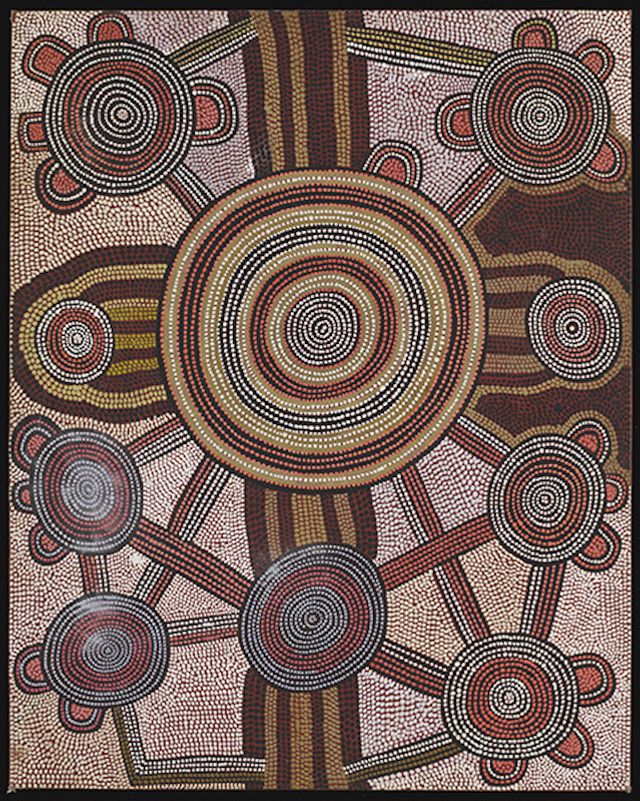
Freddy West was one of Geoffrey Bardon’s first painting men. It was his fellow Pintupi tribesmen who had painted the famous Honey Ant mural on the Papunya school, which became the catalyst for an artistic explosion that eventually changed Australian culture at large. As a group, the Pintupi had remained somewhat isolated from the other tribal groups settled at Papunya. They camped on the western fringes of the town and adhered more closely to their traditional customs. This was to have positive consequences in unexpected ways, even though at the time they were considered 'wild' by others and were neglected to some degree. A very particular painting style emerged and its success was to give both psychological and financial impetus to their absolute determination to return to their homelands, far to the west in the Gibson Desert. They constantly worried that without the ongoing rituals of increase and perpetuation, their country and the land itself would be adversely affected. Bardon remembered Freddy working during the early 1970’s in the ‘great painting room’. He was always cheery, charismatic and quite dapper in appearance. Freddy first encountered white people around 1963 as a young man, while still living a traditional nomadic lifestyle. He was full of suspicion, however, eventually the plentiful food supply at Papunya enticed him and many of his tribespeople to set off for the settlement. They left behind the difficult drought conditions and dwindling population of their desert homelands where Freddy’s own father had died from dehydration. The initial attractions offered by white society however, were quickly clouded by the conflict and disease that beset the overcrowded government project of Aboriginal assimilation. Once alcohol was discovered, the inhabitants of Papunya descended more and more into dissolution, dejection and moments of violent catastrophe. Freddy himself was jailed for a number of years after one such event. It was the painting movement that really turned the tide in a positive direction. It provided a new context for them to reassert their culture and to reaffirm their Tjukurrpa (Dreamings), the source of their religious beliefs and Law. Transferring the imagery of their culture to a permanent surface became a serious business, requiring great skill and inventiveness. Freddy participated first hand in these lengthy collaborations and spirited discussions about what could be revealed and by whom. The Dreaming is when the Ancestors created the world. They shaped the land and its creatures, and laid out the moral code for humans to live by. The many Dreamings relate to specific geographical features, animals, plants and events. Knowledge and custodianship of these stories, songs and images is inherited from father and mother, and entails deep responsibility. Infringement on someone else's totems brings considerable anxiety and often punishment. Freddy inherited responsibility for country north of Kiwirrkurra, near the shores of the great salt lake Wilkinkarra (Lake Mackay), and in particular, Snake Dreaming and the freshwater rock hole of Yunala. These form the subject of many of his paintings. His work is meticulous and precise, pulsating with concentric circles, squares and connecting lines, in-filled and accentuated with a veil of fine dots. Freddy spearheaded the return to this country and was the leader of the Kiwirrkurra outstation homestead during the 1980s, where he lived with his three surviving wives and most of his fifteen children. Vivien Johnson describes him as a ‘staunchly traditional man’. He had great skills for reading the land and surviving its arid conditions. Two of his wives and two of his sons have followed in his artistic footsteps.
Track Freddy West Tjakamarra
Get notifications when works come to auction, and access market analytics
Create Free AccountAlready have an account? Sign In
Professional documentation gives you clarity, portability, and confidence in your collection.
Learn why collectors document their holdings online


Your collection, accessible anywhere
Access your collection from any device with our cloud-based platform. Native mobile apps provide seamless synchronization and offline browsing, ensuring your collection data is always at hand.


Biography
Freddy West was one of Geoffrey Bardon’s first painting men. It was his fellow Pintupi tribesmen who had painted the famous Honey Ant mural on the Papunya school, which became the catalyst for an artistic explosion that eventually changed Australian culture at large. As a group, the Pintupi had remained somewhat isolated from the other tribal groups settled at Papunya. They camped on the western fringes of the town and adhered more closely to their traditional customs. This was to have positive consequences in unexpected ways, even though at the time they were considered 'wild' by others and were neglected to some degree. A very particular painting style emerged and its success was to give both psychological and financial impetus to their absolute determination to return to their homelands, far to the west in the Gibson Desert. They constantly worried that without the ongoing rituals of increase and perpetuation, their country and the land itself would be adversely affected. Bardon remembered Freddy working during the early 1970’s in the ‘great painting room’. He was always cheery, charismatic and quite dapper in appearance. Freddy first encountered white people around 1963 as a young man, while still living a traditional nomadic lifestyle. He was full of suspicion, however, eventually the plentiful food supply at Papunya enticed him and many of his tribespeople to set off for the settlement. They left behind the difficult drought conditions and dwindling population of their desert homelands where Freddy’s own father had died from dehydration. The initial attractions offered by white society however, were quickly clouded by the conflict and disease that beset the overcrowded government project of Aboriginal assimilation. Once alcohol was discovered, the inhabitants of Papunya descended more and more into dissolution, dejection and moments of violent catastrophe. Freddy himself was jailed for a number of years after one such event. It was the painting movement that really turned the tide in a positive direction. It provided a new context for them to reassert their culture and to reaffirm their Tjukurrpa (Dreamings), the source of their religious beliefs and Law. Transferring the imagery of their culture to a permanent surface became a serious business, requiring great skill and inventiveness. Freddy participated first hand in these lengthy collaborations and spirited discussions about what could be revealed and by whom. The Dreaming is when the Ancestors created the world. They shaped the land and its creatures, and laid out the moral code for humans to live by. The many Dreamings relate to specific geographical features, animals, plants and events. Knowledge and custodianship of these stories, songs and images is inherited from father and mother, and entails deep responsibility. Infringement on someone else's totems brings considerable anxiety and often punishment. Freddy inherited responsibility for country north of Kiwirrkurra, near the shores of the great salt lake Wilkinkarra (Lake Mackay), and in particular, Snake Dreaming and the freshwater rock hole of Yunala. These form the subject of many of his paintings. His work is meticulous and precise, pulsating with concentric circles, squares and connecting lines, in-filled and accentuated with a veil of fine dots. Freddy spearheaded the return to this country and was the leader of the Kiwirrkurra outstation homestead during the 1980s, where he lived with his three surviving wives and most of his fifteen children. Vivien Johnson describes him as a ‘staunchly traditional man’. He had great skills for reading the land and surviving its arid conditions. Two of his wives and two of his sons have followed in his artistic footsteps.
Track Freddy West Tjakamarra
Get notifications when works come to auction, and access market analytics
Create Free AccountAlready have an account? Sign In
Professional documentation gives you clarity, portability, and confidence in your collection.
Learn why collectors document their holdings onlineYour collection, accessible anywhere
Access your collection from any device with our cloud-based platform. Native mobile apps provide seamless synchronization and offline browsing, ensuring your collection data is always at hand.