Biography
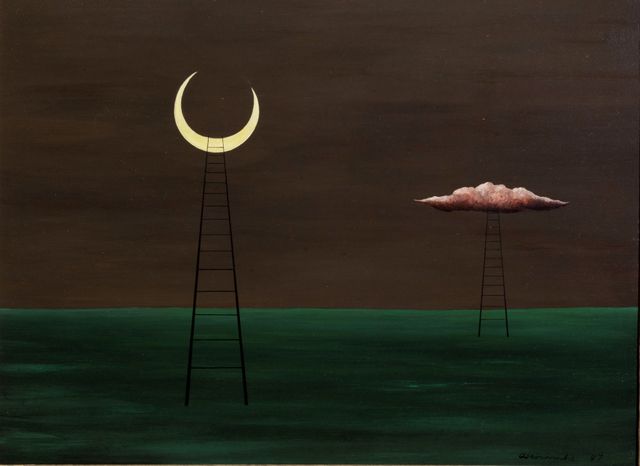
Gertrude Abercrombie was born in Austin, Texas to parents who were singers with a traveling opera company. When her mother’s opera career ended, the family established themselves in Hyde Park, where Abercrombie would spend most of her life. In 1929 she graduated from the University of Illinois in Urbana-Champaign with a degree in romance languages. She briefly studied art at the School of the Art Institute and commercial art at the American Academy for Art in Chicago, and then took a job as a commercial artist for a department store in 1931. She began painting seriously the following year. Although Abercrombie was not an “outsider artist,” she was proud of her relative lack of art training and her paintings display some of the attributes associated with unschooled artists. Because of this, she is often cited in discussions of this genre. A confirmed Midwesterner who lived the majority of her life in urban surroundings, she nonetheless often depicted rural settings; some paintings specifically titled as scenes from Aledo, the Illinois town where she spent part of her childhood. Abercrombie’s surreal scenes were drawn from her own mental landscape, no doubt expedited by her entering psychoanalysis in the 1950s with Dr. Franz Alexander, who founded the Institute for Psychoanalysis and was an important figure to such younger artists of the era as Leon Golub. During the Great Depression, Abercrombie began her regular appearances at Chicago’s few, often short-lived, galleries, in art fairs, and in the Art Institute’s annual Chicago & Vicinity exhibitions. She worked for the WPA from 1933 to 1940. In the early 1940s, her successful showings in New York together with her 1944 solo exhibition in the Art Institute’s Chicago Room established her as a major local artist. She established a powerful persona as “the queen of the bohemian artists,” having served as the model for the wild Eloisa Brace in James Purdy’s novel Malcolm. Abercrombie also presided over legendary gatherings of artists, writers (including her close friend Thomas Wilder), and musicians such as Dizzy Gillespie, Sarah Vaughan, Sonny Rollins, Charlie Parker, and Max Roach; her apartment on Dorchester Street provided an important social hub for Hyde Park’s many creative individuals. Among the visitors to her salon was Don Baum. The two became close friends, and he organized Abercrombie’s 1977 Hyde Park Art Center retrospective shortly before her death.
Track Gertrude Abercrombie
Get notifications when works come to auction, and access market analytics
Create Free AccountAlready have an account? Sign In
Professional documentation gives you clarity, portability, and confidence in your collection.
Learn why collectors document their holdings online


Your collection, accessible anywhere
Access your collection from any device with our cloud-based platform. Native mobile apps provide seamless synchronization and offline browsing, ensuring your collection data is always at hand.


Biography
Gertrude Abercrombie was born in Austin, Texas to parents who were singers with a traveling opera company. When her mother’s opera career ended, the family established themselves in Hyde Park, where Abercrombie would spend most of her life. In 1929 she graduated from the University of Illinois in Urbana-Champaign with a degree in romance languages. She briefly studied art at the School of the Art Institute and commercial art at the American Academy for Art in Chicago, and then took a job as a commercial artist for a department store in 1931. She began painting seriously the following year. Although Abercrombie was not an “outsider artist,” she was proud of her relative lack of art training and her paintings display some of the attributes associated with unschooled artists. Because of this, she is often cited in discussions of this genre. A confirmed Midwesterner who lived the majority of her life in urban surroundings, she nonetheless often depicted rural settings; some paintings specifically titled as scenes from Aledo, the Illinois town where she spent part of her childhood. Abercrombie’s surreal scenes were drawn from her own mental landscape, no doubt expedited by her entering psychoanalysis in the 1950s with Dr. Franz Alexander, who founded the Institute for Psychoanalysis and was an important figure to such younger artists of the era as Leon Golub. During the Great Depression, Abercrombie began her regular appearances at Chicago’s few, often short-lived, galleries, in art fairs, and in the Art Institute’s annual Chicago & Vicinity exhibitions. She worked for the WPA from 1933 to 1940. In the early 1940s, her successful showings in New York together with her 1944 solo exhibition in the Art Institute’s Chicago Room established her as a major local artist. She established a powerful persona as “the queen of the bohemian artists,” having served as the model for the wild Eloisa Brace in James Purdy’s novel Malcolm. Abercrombie also presided over legendary gatherings of artists, writers (including her close friend Thomas Wilder), and musicians such as Dizzy Gillespie, Sarah Vaughan, Sonny Rollins, Charlie Parker, and Max Roach; her apartment on Dorchester Street provided an important social hub for Hyde Park’s many creative individuals. Among the visitors to her salon was Don Baum. The two became close friends, and he organized Abercrombie’s 1977 Hyde Park Art Center retrospective shortly before her death.
Track Gertrude Abercrombie
Get notifications when works come to auction, and access market analytics
Create Free AccountAlready have an account? Sign In
Professional documentation gives you clarity, portability, and confidence in your collection.
Learn why collectors document their holdings onlineYour collection, accessible anywhere
Access your collection from any device with our cloud-based platform. Native mobile apps provide seamless synchronization and offline browsing, ensuring your collection data is always at hand.