Biography
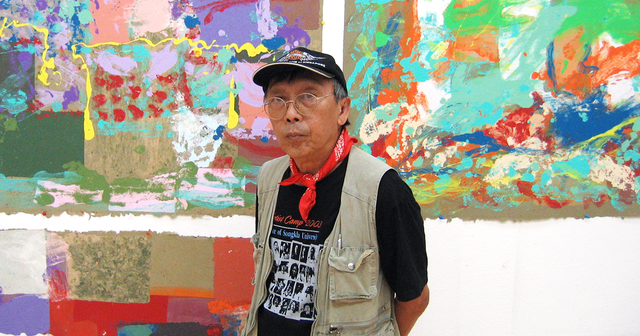
Goh Beng Kwan, was born in 1937 in Medan, Sumatra, Indonesia and resettled in Singapore in 1945. His formative studies under ‘pioneer masters’ Dr. Chen Wen Hsi [1906-1992] and Cheong Soo Pieng [1917-1983] in the 1950s instilled in him an abiding appreciation of Asian art traditions. Under an Allen Tucker Scholarship, then a Ford Foundation Scholarship, Goh pursued his art education at the reputed Art Students’ League of New York (1962-63), and Provincetown Workshop, Massachusetts (1964). Goh’s art underwent radical shifts. He was initiated into collage by the renowned collagist Leo Manso [1914-1993], and registered a renewed sense of his Chinese and Peranakan ancestries, which he began to reference in his works. Goh returned to Singapore in 1966, and in the ensuing decades, emerged as an outstanding collagist and a pivotal figure of modern art in Singapore. He introduced an astonishing range of materials into art-making including tea-wrappings, acupuncture diagrams, nails, strings and sand. His broadening of the boundaries of what was acceptable artists’ resources was enormously influential on successive generations of mixed media artists. A nostalgia for ‘unspoilt Nature’ in the face of urbanisation began to be discernible in Goh’s landscapes of the 1970s and 1980s. Goh’s collage ‘Dune’ won the first prize in the UOB Painting of the Year in 1982, and much acclaim was to follow. For his contribution to the visual arts, Goh was honoured with the Cultural Medallion in 1989. He is today regarded as one of the vanguard artists of a generation that shaped modern art history in Singapore.
Track Goh Beng Kwan
Get notifications when works come to auction, and access market analytics
Create Free AccountAlready have an account? Sign In
Professional documentation gives you clarity, portability, and confidence in your collection.
Learn why collectors document their holdings online


Your collection, accessible anywhere
Access your collection from any device with our cloud-based platform. Native mobile apps provide seamless synchronization and offline browsing, ensuring your collection data is always at hand.


Biography
Goh Beng Kwan, was born in 1937 in Medan, Sumatra, Indonesia and resettled in Singapore in 1945. His formative studies under ‘pioneer masters’ Dr. Chen Wen Hsi [1906-1992] and Cheong Soo Pieng [1917-1983] in the 1950s instilled in him an abiding appreciation of Asian art traditions. Under an Allen Tucker Scholarship, then a Ford Foundation Scholarship, Goh pursued his art education at the reputed Art Students’ League of New York (1962-63), and Provincetown Workshop, Massachusetts (1964). Goh’s art underwent radical shifts. He was initiated into collage by the renowned collagist Leo Manso [1914-1993], and registered a renewed sense of his Chinese and Peranakan ancestries, which he began to reference in his works. Goh returned to Singapore in 1966, and in the ensuing decades, emerged as an outstanding collagist and a pivotal figure of modern art in Singapore. He introduced an astonishing range of materials into art-making including tea-wrappings, acupuncture diagrams, nails, strings and sand. His broadening of the boundaries of what was acceptable artists’ resources was enormously influential on successive generations of mixed media artists. A nostalgia for ‘unspoilt Nature’ in the face of urbanisation began to be discernible in Goh’s landscapes of the 1970s and 1980s. Goh’s collage ‘Dune’ won the first prize in the UOB Painting of the Year in 1982, and much acclaim was to follow. For his contribution to the visual arts, Goh was honoured with the Cultural Medallion in 1989. He is today regarded as one of the vanguard artists of a generation that shaped modern art history in Singapore.
Track Goh Beng Kwan
Get notifications when works come to auction, and access market analytics
Create Free AccountAlready have an account? Sign In
Professional documentation gives you clarity, portability, and confidence in your collection.
Learn why collectors document their holdings onlineYour collection, accessible anywhere
Access your collection from any device with our cloud-based platform. Native mobile apps provide seamless synchronization and offline browsing, ensuring your collection data is always at hand.