Biography
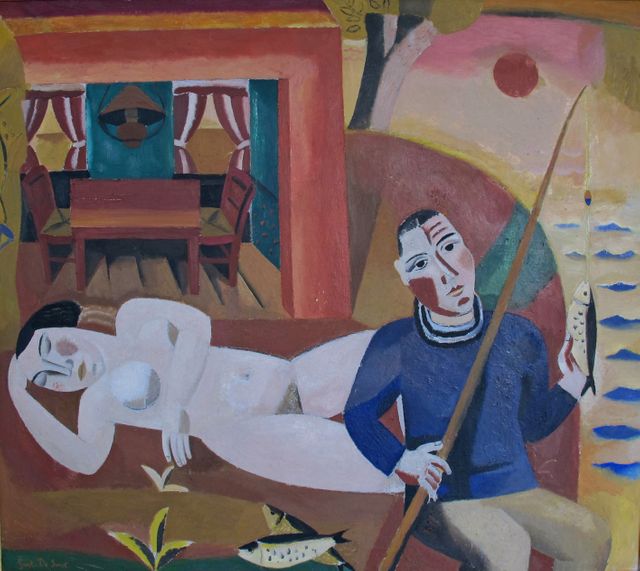
He was born in Ghent. His father, Jules, was a set decorator and photographer. Both Gustave and his brother began working in their father's studio, then attended the Royal Academy of Fine Arts, where they studied under Jean Delvin. Unlike Léon, Gustave was considered to be an indifferent student. In 1908, he and his wife followed Léon to the artists' colony in Sint-Martens-Latem. There, they initially came under the influence of Luminism and the painter Emile Claus, who lived in nearby Astene. At the beginning of World War I, he and his family joined his friend, Van den Berghe, and fled to the Netherlands. From 1914 to 1922, they moved about, visiting and staying at the art colonies in Amsterdam, Laren and Blaricum. His meeting with the Expressionist painter Henri Le Fauconnier marked a turning point in his style which, up until then, owed much to Cubism. He returned to Belgium in 1922, but continued to move frequently, usually in the company of his friends Van den Berghe and Permeke, beginning in Oostende, then to Bachte-Maria-Leerne and Afsnee, where he lived in a villa provided by the art promoter and journalist, Paul-Gustave van Hecke. In 1927, he finally settled in Deurle. It was there that his mixture of Expressionism and Cubism peaked, with a series of works depicting circus, fairground and village scenes. After his death in Deurle at the age of sixty-six, his house was preserved as a local museum.He was born in Ghent. His father, Jules, was a set decorator and photographer. Both Gustave and his brother began working in their father's studio, then attended the Royal Academy of Fine Arts, where they studied under Jean Delvin. Unlike Léon, Gustave was considered to be an indifferent student. In 1908, he and his wife followed Léon to the artists' colony in Sint-Martens-Latem. There, they initially came under the influence of Luminism and the painter Emile Claus, who lived in nearby Astene. At the beginning of World War I, he and his family joined his friend, Van den Berghe, and fled to the Netherlands. From 1914 to 1922, they moved about, visiting and staying at the art colonies in Amsterdam, Laren and Blaricum. His meeting with the Expressionist painter Henri Le Fauconnier marked a turning point in his style which, up until then, owed much to Cubism. He returned to Belgium in 1922, but continued to move frequently, usually in the company of his friends Van den Berghe and Permeke, beginning in Oostende, then to Bachte-Maria-Leerne and Afsnee, where he lived in a villa provided by the art promoter and journalist, Paul-Gustave van Hecke. In 1927, he finally settled in Deurle. It was there that his mixture of Expressionism and Cubism peaked, with a series of works depicting circus, fairground and village scenes. After his death in Deurle at the age of sixty-six, his house was preserved as a local museum.He was born in Ghent. His father, Jules, was a set decorator and photographer. Both Gustave and his brother began working in their father's studio, then attended the Royal Academy of Fine Arts, where they studied under Jean Delvin. Unlike Léon, Gustave was considered to be an indifferent student. In 1908, he and his wife followed Léon to the artists' colony in Sint-Martens-Latem. There, they initially came under the influence of Luminism and the painter Emile Claus, who lived in nearby Astene. At the beginning of World War I, he and his family joined his friend, Van den Berghe, and fled to the Netherlands. From 1914 to 1922, they moved about, visiting and staying at the art colonies in Amsterdam, Laren and Blaricum. His meeting with the Expressionist painter Henri Le Fauconnier marked a turning point in his style which, up until then, owed much to Cubism. He returned to Belgium in 1922, but continued to move frequently, usually in the company of his friends Van den Berghe and Permeke, beginning in Oostende, then to Bachte-Maria-Leerne and Afsnee, where he lived in a villa provided by the art promoter and journalist, Paul-Gustave van Hecke. In 1927, he finally settled in Deurle. It was there that his mixture of Expressionism and Cubism peaked, with a series of works depicting circus, fairground and village scenes. After his death in Deurle at the age of sixty-six, his house was preserved as a local museum.
Track Gustave De Smet
Get notifications when works come to auction, and access market analytics
Create Free AccountAlready have an account? Sign In
Professional documentation gives you clarity, portability, and confidence in your collection.
Learn why collectors document their holdings online


Your collection, accessible anywhere
Access your collection from any device with our cloud-based platform. Native mobile apps provide seamless synchronization and offline browsing, ensuring your collection data is always at hand.


Biography
He was born in Ghent. His father, Jules, was a set decorator and photographer. Both Gustave and his brother began working in their father's studio, then attended the Royal Academy of Fine Arts, where they studied under Jean Delvin. Unlike Léon, Gustave was considered to be an indifferent student. In 1908, he and his wife followed Léon to the artists' colony in Sint-Martens-Latem. There, they initially came under the influence of Luminism and the painter Emile Claus, who lived in nearby Astene. At the beginning of World War I, he and his family joined his friend, Van den Berghe, and fled to the Netherlands. From 1914 to 1922, they moved about, visiting and staying at the art colonies in Amsterdam, Laren and Blaricum. His meeting with the Expressionist painter Henri Le Fauconnier marked a turning point in his style which, up until then, owed much to Cubism. He returned to Belgium in 1922, but continued to move frequently, usually in the company of his friends Van den Berghe and Permeke, beginning in Oostende, then to Bachte-Maria-Leerne and Afsnee, where he lived in a villa provided by the art promoter and journalist, Paul-Gustave van Hecke. In 1927, he finally settled in Deurle. It was there that his mixture of Expressionism and Cubism peaked, with a series of works depicting circus, fairground and village scenes. After his death in Deurle at the age of sixty-six, his house was preserved as a local museum.He was born in Ghent. His father, Jules, was a set decorator and photographer. Both Gustave and his brother began working in their father's studio, then attended the Royal Academy of Fine Arts, where they studied under Jean Delvin. Unlike Léon, Gustave was considered to be an indifferent student. In 1908, he and his wife followed Léon to the artists' colony in Sint-Martens-Latem. There, they initially came under the influence of Luminism and the painter Emile Claus, who lived in nearby Astene. At the beginning of World War I, he and his family joined his friend, Van den Berghe, and fled to the Netherlands. From 1914 to 1922, they moved about, visiting and staying at the art colonies in Amsterdam, Laren and Blaricum. His meeting with the Expressionist painter Henri Le Fauconnier marked a turning point in his style which, up until then, owed much to Cubism. He returned to Belgium in 1922, but continued to move frequently, usually in the company of his friends Van den Berghe and Permeke, beginning in Oostende, then to Bachte-Maria-Leerne and Afsnee, where he lived in a villa provided by the art promoter and journalist, Paul-Gustave van Hecke. In 1927, he finally settled in Deurle. It was there that his mixture of Expressionism and Cubism peaked, with a series of works depicting circus, fairground and village scenes. After his death in Deurle at the age of sixty-six, his house was preserved as a local museum.He was born in Ghent. His father, Jules, was a set decorator and photographer. Both Gustave and his brother began working in their father's studio, then attended the Royal Academy of Fine Arts, where they studied under Jean Delvin. Unlike Léon, Gustave was considered to be an indifferent student. In 1908, he and his wife followed Léon to the artists' colony in Sint-Martens-Latem. There, they initially came under the influence of Luminism and the painter Emile Claus, who lived in nearby Astene. At the beginning of World War I, he and his family joined his friend, Van den Berghe, and fled to the Netherlands. From 1914 to 1922, they moved about, visiting and staying at the art colonies in Amsterdam, Laren and Blaricum. His meeting with the Expressionist painter Henri Le Fauconnier marked a turning point in his style which, up until then, owed much to Cubism. He returned to Belgium in 1922, but continued to move frequently, usually in the company of his friends Van den Berghe and Permeke, beginning in Oostende, then to Bachte-Maria-Leerne and Afsnee, where he lived in a villa provided by the art promoter and journalist, Paul-Gustave van Hecke. In 1927, he finally settled in Deurle. It was there that his mixture of Expressionism and Cubism peaked, with a series of works depicting circus, fairground and village scenes. After his death in Deurle at the age of sixty-six, his house was preserved as a local museum.
Track Gustave De Smet
Get notifications when works come to auction, and access market analytics
Create Free AccountAlready have an account? Sign In
Professional documentation gives you clarity, portability, and confidence in your collection.
Learn why collectors document their holdings onlineYour collection, accessible anywhere
Access your collection from any device with our cloud-based platform. Native mobile apps provide seamless synchronization and offline browsing, ensuring your collection data is always at hand.