Biography
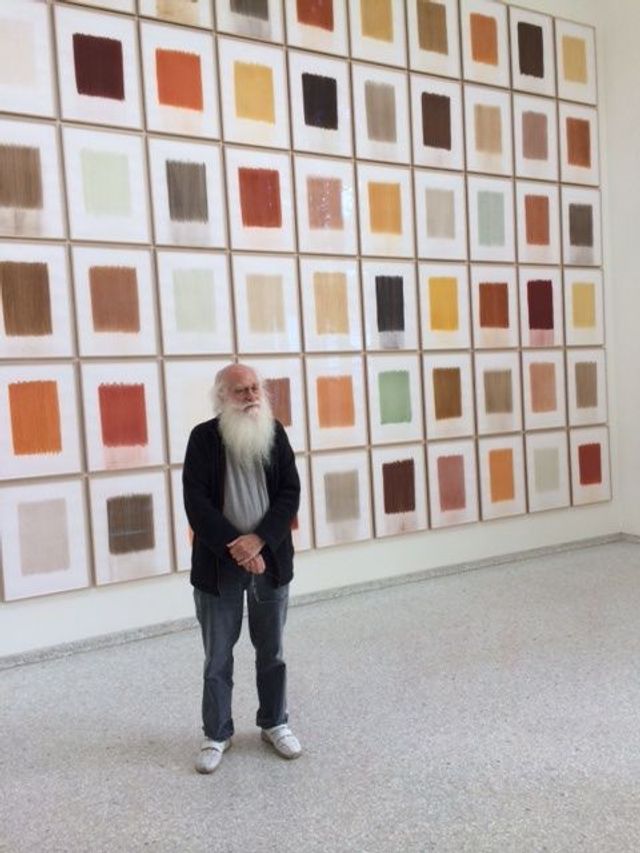
Herman de Vries, born on July 11, 1931, in Alkmaar, is a prominent Dutch artist known for his unique approach to art that often incorporates elements of nature and plants. He prefers to stylize his name in lowercase as herman de vries to eschew hierarchy, a reflection of his philosophical approach to art and life. De Vries began his artistic journey in 1953, and by the late 1950s, he had started painting, gradually evolving his practice to include installations that engage with themes of nature and ecology. One of de Vries' notable works includes an installation from 2002, which critiques the historical felling of the Donar Oak by Saint Boniface. This piece features a 7-meter oak tree planted on the Rhine's bank in Düsseldorf, surrounded by a palisade of cast-iron, gold-tipped spears, inscribed with a Latin phrase that translates to "Wynfrid cut me down, herman resurrected me." His work often involves creating sanctuaries or enclosed spaces, such as the Sanctuarium at the 1993 World Horticultural Exposition in Stuttgart, intended to remain undisturbed by human intervention. De Vries' work is collected for its profound engagement with natural elements and its commentary on human interaction with the environment. His installations and artworks invite viewers to reflect on the relationship between nature and culture, making his contributions significant in contemporary art discourse.
Track Herman De Vries
Get notifications when works come to auction, and access market analytics
Create Free AccountAlready have an account? Sign In
Professional documentation gives you clarity, portability, and confidence in your collection.
Learn why collectors document their holdings online


Your collection, accessible anywhere
Access your collection from any device with our cloud-based platform. Native mobile apps provide seamless synchronization and offline browsing, ensuring your collection data is always at hand.


Biography
Herman de Vries, born on July 11, 1931, in Alkmaar, is a prominent Dutch artist known for his unique approach to art that often incorporates elements of nature and plants. He prefers to stylize his name in lowercase as herman de vries to eschew hierarchy, a reflection of his philosophical approach to art and life. De Vries began his artistic journey in 1953, and by the late 1950s, he had started painting, gradually evolving his practice to include installations that engage with themes of nature and ecology. One of de Vries' notable works includes an installation from 2002, which critiques the historical felling of the Donar Oak by Saint Boniface. This piece features a 7-meter oak tree planted on the Rhine's bank in Düsseldorf, surrounded by a palisade of cast-iron, gold-tipped spears, inscribed with a Latin phrase that translates to "Wynfrid cut me down, herman resurrected me." His work often involves creating sanctuaries or enclosed spaces, such as the Sanctuarium at the 1993 World Horticultural Exposition in Stuttgart, intended to remain undisturbed by human intervention. De Vries' work is collected for its profound engagement with natural elements and its commentary on human interaction with the environment. His installations and artworks invite viewers to reflect on the relationship between nature and culture, making his contributions significant in contemporary art discourse.
Track Herman De Vries
Get notifications when works come to auction, and access market analytics
Create Free AccountAlready have an account? Sign In
Professional documentation gives you clarity, portability, and confidence in your collection.
Learn why collectors document their holdings onlineYour collection, accessible anywhere
Access your collection from any device with our cloud-based platform. Native mobile apps provide seamless synchronization and offline browsing, ensuring your collection data is always at hand.