Biography
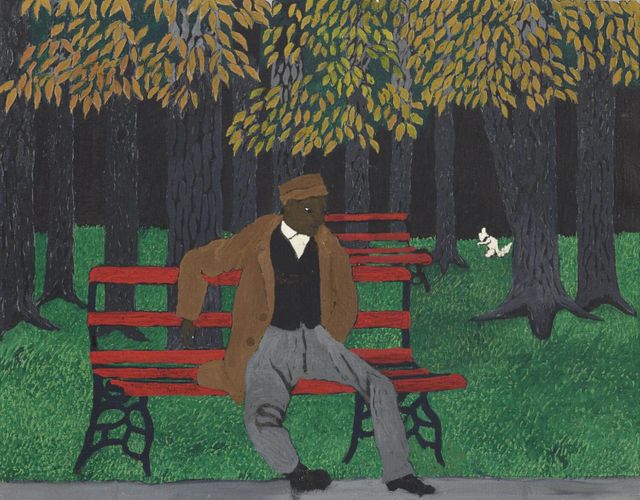
Horace Pippin, a self-taught African-American painter, was born February 22, 1888, in West Chester, Pennsylvania. His subject matter ranged from depictions of trench warfare to historical, religious, and genre paintings, all executed with personal interpretations of those subjects. At the age of three Pippin moved with his family to Goshen, New York, where he attended a segregated one-room school. When he was ten years old, he answered a magazine advertisement and received a box of crayon pencils, paint, and two brushes. In 1903 Pippin left school to support his ailing mother, and after her death in 1911 moved to Paterson, New Jersey, where he worked packing and crating pictures and furniture; he later worked as an iron molder. He enlisted in the army in 1917 and was seriously wounded in France, where he received the French Croix de Guerre. Pippin left the army in 1919 with a crippled right arm, married in 1920, and returned to West Chester. Exploring alternate means of expression after the injury to his arm, Pippin had begun to produce burnt-wood panels, a technique known as pyrography, but his preferred medium, despite his disability, was oil painting. In 1931 he completed an oil painting about the war, a therapeutic expression that provided an outlet for his memories and acted as a catalyst for his career. Horace Pippin was the first African-American painter to express his concerns about war and social-political injustices in his art, and his compositions on those themes are forceful and striking. He was also the first African-American to have paintings accepted by the West Chester County Art Association, and his importance was noted by its president, the scholar and collector Christian Brinton, as well as by the painter and illustrator N.C. Wyeth. Pippin became known in the region, and in 1939 the Robert Carlen Galleries of Philadelphia became his dealer. In 1940 Pippin received his first formal instruction in art when he was invited to give lectures at the Barnes Foundation in Merion, Pennsylvania, but his attendance was sporadic and brief. Among his most renowned works are his three paintings of John Brown, the abolitionist. Later he created a series of paintings based on the Bible and on the Work of Edward Hicks. Pippin died on July 6, 1946, in West Chester. The Phillips Collection owns two paintings from the end of his career.
Track Horace Pippin
Get notifications when works come to auction, and access market analytics
Create Free AccountAlready have an account? Sign In
Professional documentation gives you clarity, portability, and confidence in your collection.
Learn why collectors document their holdings online


Your collection, accessible anywhere
Access your collection from any device with our cloud-based platform. Native mobile apps provide seamless synchronization and offline browsing, ensuring your collection data is always at hand.


Biography
Horace Pippin, a self-taught African-American painter, was born February 22, 1888, in West Chester, Pennsylvania. His subject matter ranged from depictions of trench warfare to historical, religious, and genre paintings, all executed with personal interpretations of those subjects. At the age of three Pippin moved with his family to Goshen, New York, where he attended a segregated one-room school. When he was ten years old, he answered a magazine advertisement and received a box of crayon pencils, paint, and two brushes. In 1903 Pippin left school to support his ailing mother, and after her death in 1911 moved to Paterson, New Jersey, where he worked packing and crating pictures and furniture; he later worked as an iron molder. He enlisted in the army in 1917 and was seriously wounded in France, where he received the French Croix de Guerre. Pippin left the army in 1919 with a crippled right arm, married in 1920, and returned to West Chester. Exploring alternate means of expression after the injury to his arm, Pippin had begun to produce burnt-wood panels, a technique known as pyrography, but his preferred medium, despite his disability, was oil painting. In 1931 he completed an oil painting about the war, a therapeutic expression that provided an outlet for his memories and acted as a catalyst for his career. Horace Pippin was the first African-American painter to express his concerns about war and social-political injustices in his art, and his compositions on those themes are forceful and striking. He was also the first African-American to have paintings accepted by the West Chester County Art Association, and his importance was noted by its president, the scholar and collector Christian Brinton, as well as by the painter and illustrator N.C. Wyeth. Pippin became known in the region, and in 1939 the Robert Carlen Galleries of Philadelphia became his dealer. In 1940 Pippin received his first formal instruction in art when he was invited to give lectures at the Barnes Foundation in Merion, Pennsylvania, but his attendance was sporadic and brief. Among his most renowned works are his three paintings of John Brown, the abolitionist. Later he created a series of paintings based on the Bible and on the Work of Edward Hicks. Pippin died on July 6, 1946, in West Chester. The Phillips Collection owns two paintings from the end of his career.
Track Horace Pippin
Get notifications when works come to auction, and access market analytics
Create Free AccountAlready have an account? Sign In
Professional documentation gives you clarity, portability, and confidence in your collection.
Learn why collectors document their holdings onlineYour collection, accessible anywhere
Access your collection from any device with our cloud-based platform. Native mobile apps provide seamless synchronization and offline browsing, ensuring your collection data is always at hand.