Biography
Between 1950 and 1957, Horacio García Rossi studied at the Escuela Nacional de Bellas Artes in Buenos Aires, along with Hugo Demarco, Julio Le Parc, and Francisco Sobrino. In 1959, he moved to Paris, where he participated in the first Paris Biennial. In his earliest works, García Rossi explored the problem of multiplication of a form and the perception of movement in two-dimensional works, using only black, white, and gray. However, in the early-1960s, he began to introduce the use of projection screens and lighting into his structures. In Paris, García Rossi co-founded the Centre de Recherche d’Art Visuel (CRAV), along with Francisco García Miranda, Julio Le Parc, Francisco Sobrino, François Molnar, Sergio Moyano Servanes, Yvaral, Jöel Stein, Hugo Demarco, and François Morellet. CRAV dissolved shortly after forming, and was restructured as the Groupe de Recherche d’Art Visuel (GRAV). As art historian Jacqueline Barnitz has written, “The GRAV artists believed that art should be based on ‘scientific’ investigation of the physical properties of vision and statistics and probabilities, as the means through which they could best achieve their political and philosophical goals.” GRAV created interactive, labyrinthine structures that viewers could walk through and interact with, using industrial materials such as aluminum, Plexiglas, mirrors, and lights.” In 1964, GRAV was included in the III Documenta Kassel and in the exhibition Lumiere et mouvement, organized by the Musée d’Art modern de París in 1967. After the dissolution of GRAV in 1968, he returned to two-dimensional problems and simple structures, and he dedicated his work to the interactions between light and color. He also began to incorporate letters and words in his work. In 1989, the Centro Cultural de Arte Contemporáneo in Brescia, Italy, held a survey exhibition of his work. He has been included in numerous important surveys of the kinetic art movement García Rossi died in 2012 in Paris.
Track Horacio Garcia Rossi
Get notifications when works come to auction, and access market analytics
Create Free AccountAlready have an account? Sign In
Professional documentation gives you clarity, portability, and confidence in your collection.
Learn why collectors document their holdings online


Your collection, accessible anywhere
Access your collection from any device with our cloud-based platform. Native mobile apps provide seamless synchronization and offline browsing, ensuring your collection data is always at hand.


Biography
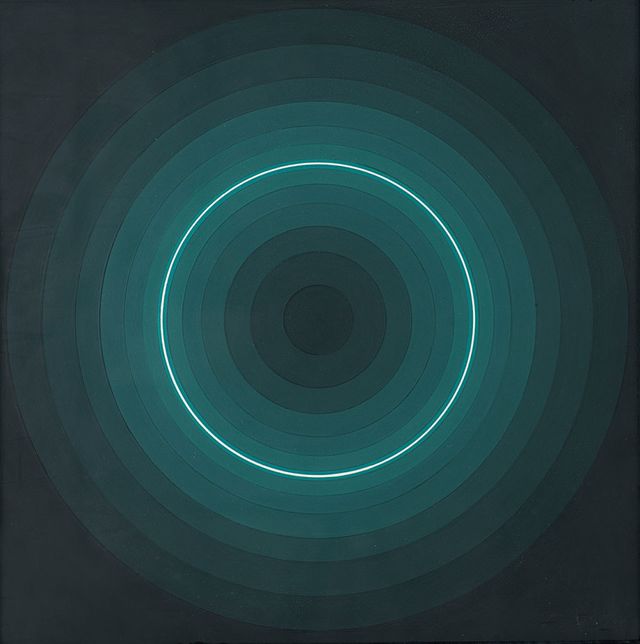
Between 1950 and 1957, Horacio García Rossi studied at the Escuela Nacional de Bellas Artes in Buenos Aires, along with Hugo Demarco, Julio Le Parc, and Francisco Sobrino. In 1959, he moved to Paris, where he participated in the first Paris Biennial. In his earliest works, García Rossi explored the problem of multiplication of a form and the perception of movement in two-dimensional works, using only black, white, and gray. However, in the early-1960s, he began to introduce the use of projection screens and lighting into his structures. In Paris, García Rossi co-founded the Centre de Recherche d’Art Visuel (CRAV), along with Francisco García Miranda, Julio Le Parc, Francisco Sobrino, François Molnar, Sergio Moyano Servanes, Yvaral, Jöel Stein, Hugo Demarco, and François Morellet. CRAV dissolved shortly after forming, and was restructured as the Groupe de Recherche d’Art Visuel (GRAV). As art historian Jacqueline Barnitz has written, “The GRAV artists believed that art should be based on ‘scientific’ investigation of the physical properties of vision and statistics and probabilities, as the means through which they could best achieve their political and philosophical goals.” GRAV created interactive, labyrinthine structures that viewers could walk through and interact with, using industrial materials such as aluminum, Plexiglas, mirrors, and lights.” In 1964, GRAV was included in the III Documenta Kassel and in the exhibition Lumiere et mouvement, organized by the Musée d’Art modern de París in 1967. After the dissolution of GRAV in 1968, he returned to two-dimensional problems and simple structures, and he dedicated his work to the interactions between light and color. He also began to incorporate letters and words in his work. In 1989, the Centro Cultural de Arte Contemporáneo in Brescia, Italy, held a survey exhibition of his work. He has been included in numerous important surveys of the kinetic art movement García Rossi died in 2012 in Paris.
Track Horacio Garcia Rossi
Get notifications when works come to auction, and access market analytics
Create Free AccountAlready have an account? Sign In
Professional documentation gives you clarity, portability, and confidence in your collection.
Learn why collectors document their holdings onlineYour collection, accessible anywhere
Access your collection from any device with our cloud-based platform. Native mobile apps provide seamless synchronization and offline browsing, ensuring your collection data is always at hand.