Biography
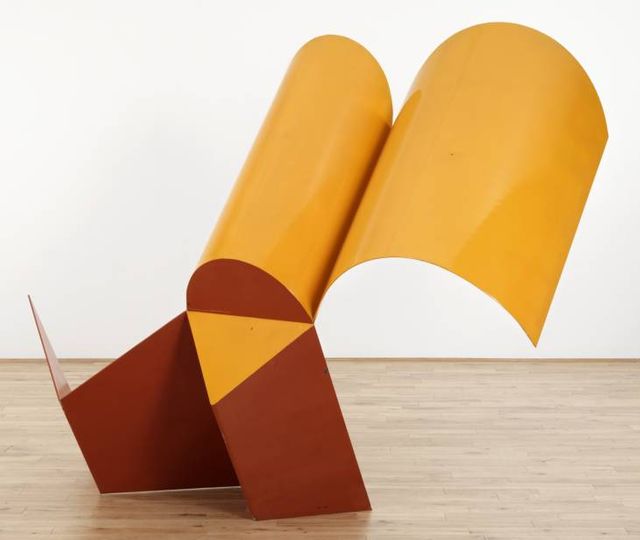
An original member of the group of sculptors known as the "New Generation" who formed the avant-garde of British sculpture after World War II, Isaac Witkin was born in Johannesburg, South Africa, and studied with Anthony Caro at St. Martin's School of Art in London in the late fifties. After teaching and exhibiting in Britain, he traveled to the United States to take up an artist's residency at Bennington College, where he stayed on, in company with Caro and other former St. Martin's sculptors, for many years. In 1965 his work was featured in the seminal Primary Structures exhibition at the Jewish Museum in New York. During the sixties and seventies, Witkin's Constructivist assemblages gradually began to take on new volumes in an attempt to break out of what he perceived as the formulaic quality of modernist sculpture. In the late seventies the artist's breakthrough came in his "Spill" series, which incorporated the accidental shapes of large stainless-steel "spills," the circles left over from steelmaking. He resumed working in bronze, pouring the molten metal directly into shaped sand to produce forms that were far more spontaneous than traditional cast sculpture. In his work from the late eighties onward, Witkin has pursued two distinctive approaches to bronze sculpture. His small hallucinatory poured works have a fantastic, expressive quality, while his monumentally scaled sculptures are cast and joined together in a centuries-old tradition.
Track Isaac Witkin
Get notifications when works come to auction, and access market analytics
Create Free AccountAlready have an account? Sign In
Professional documentation gives you clarity, portability, and confidence in your collection.
Learn why collectors document their holdings online


Your collection, accessible anywhere
Access your collection from any device with our cloud-based platform. Native mobile apps provide seamless synchronization and offline browsing, ensuring your collection data is always at hand.


Biography
An original member of the group of sculptors known as the "New Generation" who formed the avant-garde of British sculpture after World War II, Isaac Witkin was born in Johannesburg, South Africa, and studied with Anthony Caro at St. Martin's School of Art in London in the late fifties. After teaching and exhibiting in Britain, he traveled to the United States to take up an artist's residency at Bennington College, where he stayed on, in company with Caro and other former St. Martin's sculptors, for many years. In 1965 his work was featured in the seminal Primary Structures exhibition at the Jewish Museum in New York. During the sixties and seventies, Witkin's Constructivist assemblages gradually began to take on new volumes in an attempt to break out of what he perceived as the formulaic quality of modernist sculpture. In the late seventies the artist's breakthrough came in his "Spill" series, which incorporated the accidental shapes of large stainless-steel "spills," the circles left over from steelmaking. He resumed working in bronze, pouring the molten metal directly into shaped sand to produce forms that were far more spontaneous than traditional cast sculpture. In his work from the late eighties onward, Witkin has pursued two distinctive approaches to bronze sculpture. His small hallucinatory poured works have a fantastic, expressive quality, while his monumentally scaled sculptures are cast and joined together in a centuries-old tradition.
Track Isaac Witkin
Get notifications when works come to auction, and access market analytics
Create Free AccountAlready have an account? Sign In
Professional documentation gives you clarity, portability, and confidence in your collection.
Learn why collectors document their holdings onlineYour collection, accessible anywhere
Access your collection from any device with our cloud-based platform. Native mobile apps provide seamless synchronization and offline browsing, ensuring your collection data is always at hand.