Biography
Juan Downey was born in Santiago, Chile, in 1940. He received a BA in architecture from the Pontificia Universidad Católica de Chile in 1961. He traveled in Europe from that year until 1965, first to Madrid and Barcelona to study painting, then to Paris, where he focused on printmaking at twentieth-century artist W. S. Hayter’s former studio, Atelier 17. In Paris, he met Surrealist painter Matta and poet Pablo Neruda, fellow Chileans who influenced his commitment to a revolutionary art, and Kinetic artists such Julio Le Parc, who inspired his career-long exploration of the relationship between art and technology. While Downey is known primarily as a pioneering video artist, his oeuvre spans drawing, installation, new media, painting, performance, and printmaking. He lived and taught briefly in Washington, D.C., from 1965 to 1969, beginning his life as an expatriate in the United States. In the later 1960s, he produced kinetic sculptures and interactive installations and used the Sony Portapak video system. Downey was one of the first artists to experiment with the new technology and the utopian potential of feedback, which many artists would eventually exploit in order to mine the possibilities of broadcast media, traditionally dominated by a unidirectional flow of information. In 1969 Downey moved permanently to New York, where his interest in communication technologies and information systems led him to exhibit with like-minded artists at the Howard Wise Gallery. He also contributed to the magazine Radical Software (1970–74) and collaborated with Gordon Matta-Clark on Fresh Air Cart, and Juan Downey's Fresh Air (1972), a public intervention and performance in which the artists offered oxygen to city inhabitants from a portable tank mounted on a mobile cart. Downey’s best-known project, Video Trans Americas (1973–77) involves the imbrication of anthropology, autobiography, communication technology, and ecology that characterizes his work of the 1970s and ’80s. Provoked by the 1973 coup d’état in Chile, Downey embarked on a series of trips to various locations in Latin America; in 1976, he lived for over a year in the Amazon rainforest, and for eight months among the Yanomami indigenous people of the Amazon basin in southern Venezuela. In Video Trans Americas, he engaged experimental collage and nonlinear narrative techniques to probe issues of identity in the Americas while parodying the documentary approach of anthropological and ethnographic films. In subsequent videos such as The Laughing Alligator (which was shot in 1976 and 1977 and edited in 1979), Downey spliced footage from the Amazon with imagery from New York to comment on the contradictions of identity, reflecting his own hybrid status as part Mapuche, part European. Downey has had solo exhibitions at the Smithsonian Institute, Washington, D.C. (1968 and 1969); Corcoran Art Gallery, Washington, D.C., (1969); Whitney Museum of American Art, New York (1976); San Francisco Museum of Modern Art (1985); International Center of Photography, New York (1990); and IVAM Centre Julio González, València (1997–98). In 2011, the MIT List Visual Art Center, Cambridge, Massachusetts, organized the first U.S. retrospective of his work, which traveled to Arizona State University Museum, Tempe, and the Bronx Museum of the Arts, New York. He has participated in group exhibitions at the Centre Georges Pompidou, Paris (1990) and Museum of Modern Art, New York (1990, 1995, 1997, and 2010). Downey has also participated in Documenta, Kassel, Germany (1977); the Whitney Biennial, New York (1975, 1977, 1980, 1981, 1985, 1987, and 1991); and the Venice Biennale (1980 and 2001). In the last of these he was awarded an Honorable Mention for Excellence in Art, Science, and Technology for his installation About Cages. He has received two Guggenheim Fellowships; two from the Rockefeller Foundation, and nine from the National Endowment for the Arts. He was also an associate professor at Pratt Institute from 1970 to 1993.
Track Juan Downey
Get notifications when works come to auction, and access market analytics
Create Free AccountAlready have an account? Sign In
Professional documentation gives you clarity, portability, and confidence in your collection.
Learn why collectors document their holdings online


Your collection, accessible anywhere
Access your collection from any device with our cloud-based platform. Native mobile apps provide seamless synchronization and offline browsing, ensuring your collection data is always at hand.


Biography
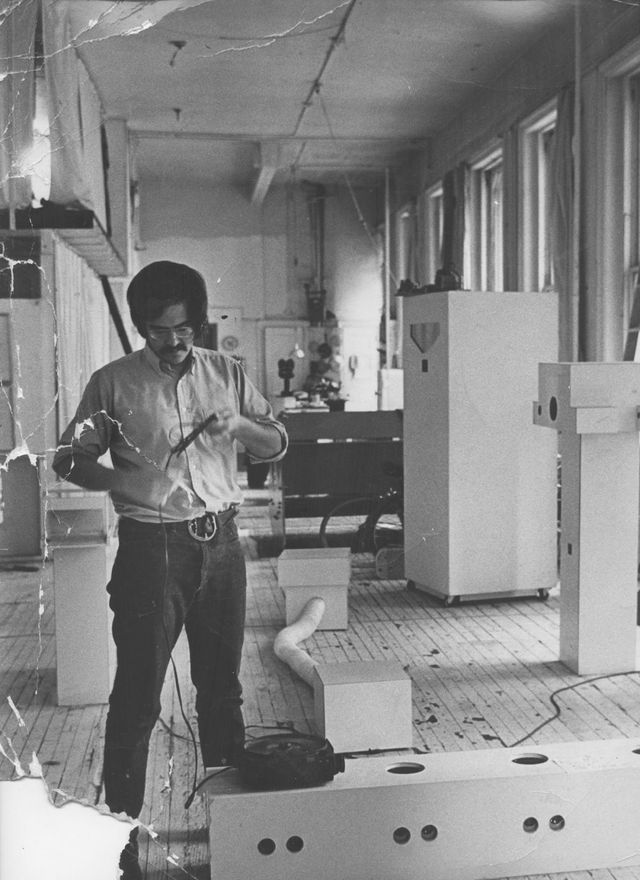
Juan Downey was born in Santiago, Chile, in 1940. He received a BA in architecture from the Pontificia Universidad Católica de Chile in 1961. He traveled in Europe from that year until 1965, first to Madrid and Barcelona to study painting, then to Paris, where he focused on printmaking at twentieth-century artist W. S. Hayter’s former studio, Atelier 17. In Paris, he met Surrealist painter Matta and poet Pablo Neruda, fellow Chileans who influenced his commitment to a revolutionary art, and Kinetic artists such Julio Le Parc, who inspired his career-long exploration of the relationship between art and technology. While Downey is known primarily as a pioneering video artist, his oeuvre spans drawing, installation, new media, painting, performance, and printmaking. He lived and taught briefly in Washington, D.C., from 1965 to 1969, beginning his life as an expatriate in the United States. In the later 1960s, he produced kinetic sculptures and interactive installations and used the Sony Portapak video system. Downey was one of the first artists to experiment with the new technology and the utopian potential of feedback, which many artists would eventually exploit in order to mine the possibilities of broadcast media, traditionally dominated by a unidirectional flow of information. In 1969 Downey moved permanently to New York, where his interest in communication technologies and information systems led him to exhibit with like-minded artists at the Howard Wise Gallery. He also contributed to the magazine Radical Software (1970–74) and collaborated with Gordon Matta-Clark on Fresh Air Cart, and Juan Downey's Fresh Air (1972), a public intervention and performance in which the artists offered oxygen to city inhabitants from a portable tank mounted on a mobile cart. Downey’s best-known project, Video Trans Americas (1973–77) involves the imbrication of anthropology, autobiography, communication technology, and ecology that characterizes his work of the 1970s and ’80s. Provoked by the 1973 coup d’état in Chile, Downey embarked on a series of trips to various locations in Latin America; in 1976, he lived for over a year in the Amazon rainforest, and for eight months among the Yanomami indigenous people of the Amazon basin in southern Venezuela. In Video Trans Americas, he engaged experimental collage and nonlinear narrative techniques to probe issues of identity in the Americas while parodying the documentary approach of anthropological and ethnographic films. In subsequent videos such as The Laughing Alligator (which was shot in 1976 and 1977 and edited in 1979), Downey spliced footage from the Amazon with imagery from New York to comment on the contradictions of identity, reflecting his own hybrid status as part Mapuche, part European. Downey has had solo exhibitions at the Smithsonian Institute, Washington, D.C. (1968 and 1969); Corcoran Art Gallery, Washington, D.C., (1969); Whitney Museum of American Art, New York (1976); San Francisco Museum of Modern Art (1985); International Center of Photography, New York (1990); and IVAM Centre Julio González, València (1997–98). In 2011, the MIT List Visual Art Center, Cambridge, Massachusetts, organized the first U.S. retrospective of his work, which traveled to Arizona State University Museum, Tempe, and the Bronx Museum of the Arts, New York. He has participated in group exhibitions at the Centre Georges Pompidou, Paris (1990) and Museum of Modern Art, New York (1990, 1995, 1997, and 2010). Downey has also participated in Documenta, Kassel, Germany (1977); the Whitney Biennial, New York (1975, 1977, 1980, 1981, 1985, 1987, and 1991); and the Venice Biennale (1980 and 2001). In the last of these he was awarded an Honorable Mention for Excellence in Art, Science, and Technology for his installation About Cages. He has received two Guggenheim Fellowships; two from the Rockefeller Foundation, and nine from the National Endowment for the Arts. He was also an associate professor at Pratt Institute from 1970 to 1993.
Track Juan Downey
Get notifications when works come to auction, and access market analytics
Create Free AccountAlready have an account? Sign In
Professional documentation gives you clarity, portability, and confidence in your collection.
Learn why collectors document their holdings onlineYour collection, accessible anywhere
Access your collection from any device with our cloud-based platform. Native mobile apps provide seamless synchronization and offline browsing, ensuring your collection data is always at hand.