Biography
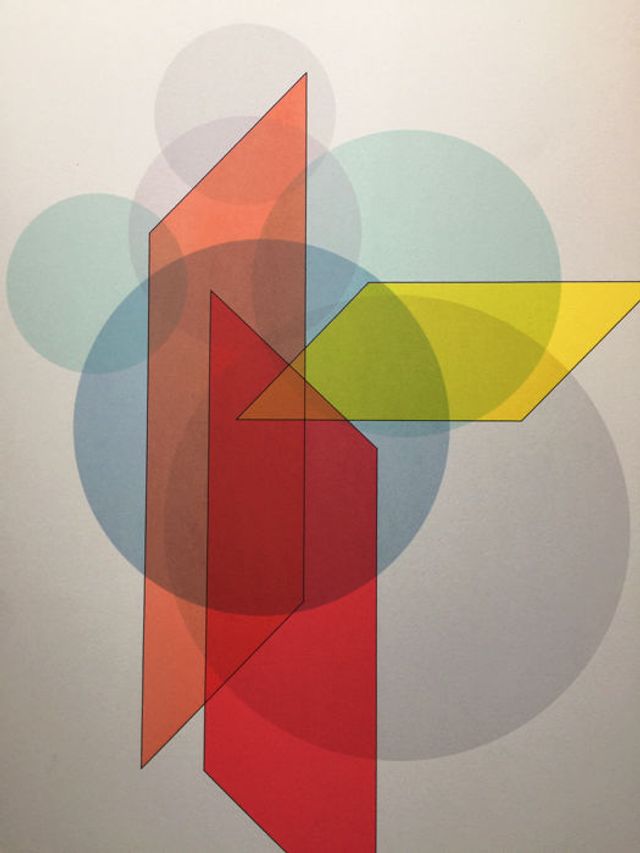
Luigi Veronesi was born in Milan in 1908. He began his art studies as an apprentice to Neapolitan painter, Carmelo Violante, who taught him all the secrets of the art, especially of landscape and figurative painting. The big Modigliani exhibition in 1930, where he discovered Kandinsky, Klee, Schlemmer and the Bauhaus group, unexpectedly opened his horizons towards abstraction. Four years later, Veronesi joined the Abstraction-Création group. He exhibited his sketches for Stravinsky's "Le Rossignol" and for Andreev's "Anatema" and began a series of studies based on the photogram, abstract photography and solarization. In 1935 he took part in the first collective exhibition of abstract art in Turin and produced ten costume sketches for Claude Débussy's "Pelléas et Mélisande". Alongside his graphic and painting work, he was to continue these stagedesign activities up until the 1940s. During this period he collaborated with the Palcoscenico theatre group, where Paolo Grassi and Strehler made their debut. He was particularly interested in musical theatre as it allowed him to study the relationship between visual arts and music and between spatial and temporal arts. Veronesi's growing interest in illustrative photomontage together with cinema and music made him the Italian artist closest to the concept of multidimensionality or art conceived as a global project that was typical of the Bauhaus. He played an active part in most of the major exhibitions over the following years, including the historic exhibition of Italian abstraction at the 33rd Venice Biennial, the Festival of Contemporary Music and a personal exhibition at the Galleria Spatia in Bolzano in 1980. At the end of the 1930s, Veronesi produced nine abstract films, seven of which were destroyed during bombing in the second world war while the remaining two survived in France, but in too poor a condition to be screened. He worked on chromatic transpositions of musical scores, developing a precise mathematical system for expressing the timbre and pitch of sounds in painting. In the 1960s he used a measuring instrument, the spectroscope, to associate a colour with the wavelength of each musical tone. Luigi Veronesi died in February 1998.
Track Luigi Veronesi
Get notifications when works come to auction, and access market analytics
Create Free AccountAlready have an account? Sign In
Professional documentation gives you clarity, portability, and confidence in your collection.
Learn why collectors document their holdings online


Your collection, accessible anywhere
Access your collection from any device with our cloud-based platform. Native mobile apps provide seamless synchronization and offline browsing, ensuring your collection data is always at hand.


Biography
Luigi Veronesi was born in Milan in 1908. He began his art studies as an apprentice to Neapolitan painter, Carmelo Violante, who taught him all the secrets of the art, especially of landscape and figurative painting. The big Modigliani exhibition in 1930, where he discovered Kandinsky, Klee, Schlemmer and the Bauhaus group, unexpectedly opened his horizons towards abstraction. Four years later, Veronesi joined the Abstraction-Création group. He exhibited his sketches for Stravinsky's "Le Rossignol" and for Andreev's "Anatema" and began a series of studies based on the photogram, abstract photography and solarization. In 1935 he took part in the first collective exhibition of abstract art in Turin and produced ten costume sketches for Claude Débussy's "Pelléas et Mélisande". Alongside his graphic and painting work, he was to continue these stagedesign activities up until the 1940s. During this period he collaborated with the Palcoscenico theatre group, where Paolo Grassi and Strehler made their debut. He was particularly interested in musical theatre as it allowed him to study the relationship between visual arts and music and between spatial and temporal arts. Veronesi's growing interest in illustrative photomontage together with cinema and music made him the Italian artist closest to the concept of multidimensionality or art conceived as a global project that was typical of the Bauhaus. He played an active part in most of the major exhibitions over the following years, including the historic exhibition of Italian abstraction at the 33rd Venice Biennial, the Festival of Contemporary Music and a personal exhibition at the Galleria Spatia in Bolzano in 1980. At the end of the 1930s, Veronesi produced nine abstract films, seven of which were destroyed during bombing in the second world war while the remaining two survived in France, but in too poor a condition to be screened. He worked on chromatic transpositions of musical scores, developing a precise mathematical system for expressing the timbre and pitch of sounds in painting. In the 1960s he used a measuring instrument, the spectroscope, to associate a colour with the wavelength of each musical tone. Luigi Veronesi died in February 1998.
Track Luigi Veronesi
Get notifications when works come to auction, and access market analytics
Create Free AccountAlready have an account? Sign In
Professional documentation gives you clarity, portability, and confidence in your collection.
Learn why collectors document their holdings onlineYour collection, accessible anywhere
Access your collection from any device with our cloud-based platform. Native mobile apps provide seamless synchronization and offline browsing, ensuring your collection data is always at hand.