Biography
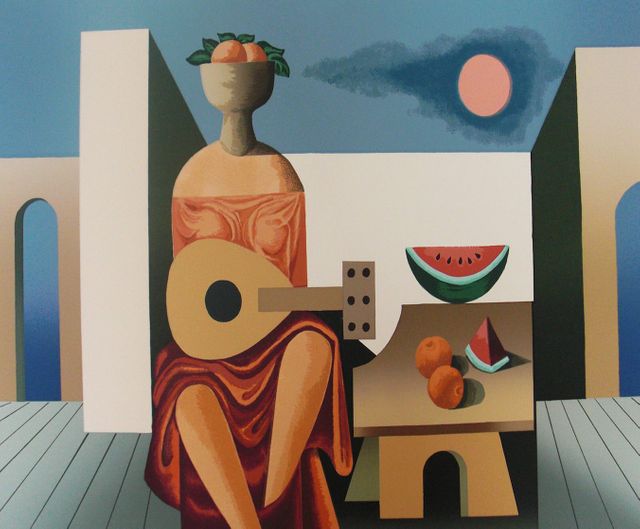
Mario Carreño was born in Havana in 1913. As many of the members of the second generation of modern Cuban artists, he attended the San Alejandro Academy of Fine Arts. He entered the Academy in 1925 but left in that same year: he discovered that he could not find it possible to express his feelings within the rigorous guidelines of very conventional teachings. Nevertheless, he formed, on his own, sufficient knowledge to lead to the sound development that both his paintings• and drawings would have. Carreño had his first one-man show in Havana in 1930. Two years later he traveled to Spain; on his return to Cuba he exhibited again in 1935. During 1936 he traveled to Mexico (where he also had an exhibition); here his works assumed the forms which are characteristic of the Mexican muralists’ movement, as well as the nuances which are typical of that school, such as the accurate definition of volumes. It is possible to follow the development of this artist’s style as he came into contact with different countries and cultures, and with other artists. Thus, in Paris he met Jacques Bohon and Jaime Colson, the latter being one of the most important among painters from the Dominican Republic, with whom Carreño would continue working in Mexico as well as in Havana. From Colson he received a strong influence of the “metaphysical” style, as we define the style that had in Giorgio de Chirico its most brilliant exponent. During the early Fifties, he abandoned figuration and started dealing with geometric and abstract forms. Returning to figurative art, his later work shows the influence of the abstract period, as he dismisses details to concentrate on the overall design of hieratic figures. However, throughout the development of his oeuvre, in periods that covered a wide range of styles, Carreño remained faithful to his attempt to define his own personal identity. He also traveled to Italy and the United States, where he taught at the New School of Social Research. He participated in important exhibits on Cuban art abroad, such as the show presented in 1944 at the Museum of Modern Art in New York which was organized by the museum’s founder Alfred H. Barr Jr. with the assistance of Jose Gomez Sicre and Maria Luisa Gomez Mena, who was Carreño ‘s wife. He received the Guggenheim International Award in 1956, the Pablo Neruda Award (Chile) in 1984, and the Cintas Foundation Fellowship in 1987. In 1957 he exhibited for the last time in Havana, traveling thereafter to several countries and settling in Santiago de Chile. In celebration ofCarreño’s eightieth birthday a large retrospective show of the artist’s work was organized in Chile. An exhibition of the works completed in Cuba was shown at the National Museum of Fine Arts in Havana in that same year; after a long absence, the master returned to Cuba to attend the opening.
Track Mario Carreño
Get notifications when works come to auction, and access market analytics
Create Free AccountAlready have an account? Sign In
Professional documentation gives you clarity, portability, and confidence in your collection.
Learn why collectors document their holdings online


Your collection, accessible anywhere
Access your collection from any device with our cloud-based platform. Native mobile apps provide seamless synchronization and offline browsing, ensuring your collection data is always at hand.


Biography
Mario Carreño was born in Havana in 1913. As many of the members of the second generation of modern Cuban artists, he attended the San Alejandro Academy of Fine Arts. He entered the Academy in 1925 but left in that same year: he discovered that he could not find it possible to express his feelings within the rigorous guidelines of very conventional teachings. Nevertheless, he formed, on his own, sufficient knowledge to lead to the sound development that both his paintings• and drawings would have. Carreño had his first one-man show in Havana in 1930. Two years later he traveled to Spain; on his return to Cuba he exhibited again in 1935. During 1936 he traveled to Mexico (where he also had an exhibition); here his works assumed the forms which are characteristic of the Mexican muralists’ movement, as well as the nuances which are typical of that school, such as the accurate definition of volumes. It is possible to follow the development of this artist’s style as he came into contact with different countries and cultures, and with other artists. Thus, in Paris he met Jacques Bohon and Jaime Colson, the latter being one of the most important among painters from the Dominican Republic, with whom Carreño would continue working in Mexico as well as in Havana. From Colson he received a strong influence of the “metaphysical” style, as we define the style that had in Giorgio de Chirico its most brilliant exponent. During the early Fifties, he abandoned figuration and started dealing with geometric and abstract forms. Returning to figurative art, his later work shows the influence of the abstract period, as he dismisses details to concentrate on the overall design of hieratic figures. However, throughout the development of his oeuvre, in periods that covered a wide range of styles, Carreño remained faithful to his attempt to define his own personal identity. He also traveled to Italy and the United States, where he taught at the New School of Social Research. He participated in important exhibits on Cuban art abroad, such as the show presented in 1944 at the Museum of Modern Art in New York which was organized by the museum’s founder Alfred H. Barr Jr. with the assistance of Jose Gomez Sicre and Maria Luisa Gomez Mena, who was Carreño ‘s wife. He received the Guggenheim International Award in 1956, the Pablo Neruda Award (Chile) in 1984, and the Cintas Foundation Fellowship in 1987. In 1957 he exhibited for the last time in Havana, traveling thereafter to several countries and settling in Santiago de Chile. In celebration ofCarreño’s eightieth birthday a large retrospective show of the artist’s work was organized in Chile. An exhibition of the works completed in Cuba was shown at the National Museum of Fine Arts in Havana in that same year; after a long absence, the master returned to Cuba to attend the opening.
Track Mario Carreño
Get notifications when works come to auction, and access market analytics
Create Free AccountAlready have an account? Sign In
Professional documentation gives you clarity, portability, and confidence in your collection.
Learn why collectors document their holdings onlineYour collection, accessible anywhere
Access your collection from any device with our cloud-based platform. Native mobile apps provide seamless synchronization and offline browsing, ensuring your collection data is always at hand.