Biography
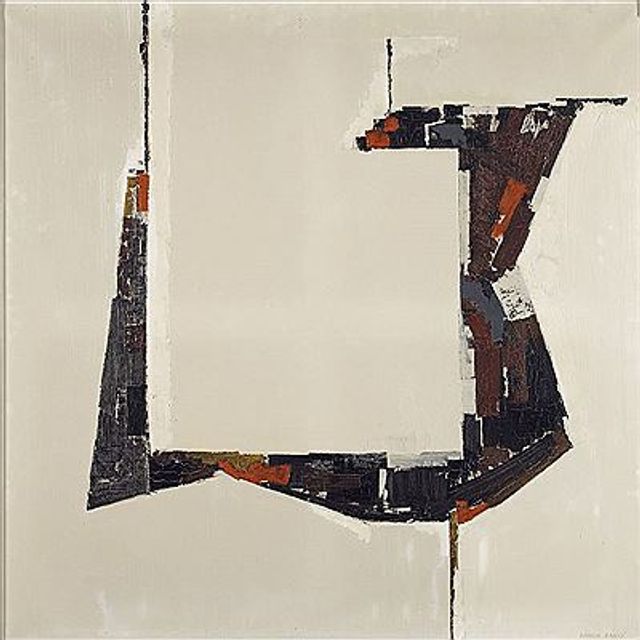
Martin Barré was born Michel Barré on September 22, 1924, in Nantes, France. He trained at the École des beaux-arts, Nantes, first in architecture and then in painting, before moving to Paris in 1948. In 1955 he exhibited his first abstract paintings at the Galerie La Roue. However, it was not until around 1958 or 1959, after he had traveled to the Netherlands, where he saw the work of Russian artist Kazimir Malevich, that his art attained the expressive rigor that became its hallmark. Barré designated space in his paintings by the distinct relationship between figure and ground, using forms that are spare and reduced, thus leaving much of the surface of the canvas open. In an effort to avoid expressionistic gestures, he applied paint with a palette knife instead of a brush. In 1960, Barré exchanged the knife for the paint tube, mixing its contents himself and then squeezing the paint directly onto the canvas. In 1963 he turned to spray paint, a medium with properties he had come to appreciate when looking at graffiti in the Parisian metro. Having found a matte black he liked, he used this method until 1967 and made paintings that either consist of white surfaces marked by subtle traces of spray paint in a corner, or are striped. In 1967 Barré decided to use stencils, and cut out the shape of an arrow from a large sheet of paper, for mark making that was controlled rather than intuitive. Then for five years Barré stopped painting altogether and concentrated on conceptual work, such as a group of photographs shown at Galerie Daniel Templon in 1968 that presented details of the Parisian gallery's empty interior. When he returned to painting in the early 1970s, Barré began using acrylics and a brush, and adopted a slightly more expressive style. Perpetually restless and seeking new ways to challenge accepted modes of abstraction, Barré soon moved on, eventually making a series of paintings in which geometric shapes in bright hues abut the edge of the canvas, usually painted a soft pink, and creating an ambiguous delineation between figure and ground. Barré showed regularly at Galerie Daniel Templon and had solo shows at a number of international museums, including the Museu de arte moderna, Rio de Janeiro (1965). He was featured in group shows at the Carnegie International, Pittsburgh (1961); Venice Biennale (1964, 1978); and Centre Georges Pompidou, Paris (1992). Interest in Barré's work has grown since his death; his work was the subject of two solo shows at Andrew Kreps Gallery, New York (2008, 2011), and was featured in La peinture après l'abstraction, 1955–1975: Martin Barré, Jean Degottex, Raymond Hains, Simon Hanta, Jacques Villeglé (Painting after abstraction, 1955–1975) at the Musée d'art moderne de la Ville de Paris (1999). Barré died on July 10, 1993, in Paris.
Track Martin Barre
Get notifications when works come to auction, and access market analytics
Create Free AccountAlready have an account? Sign In
Professional documentation gives you clarity, portability, and confidence in your collection.
Learn why collectors document their holdings online


Your collection, accessible anywhere
Access your collection from any device with our cloud-based platform. Native mobile apps provide seamless synchronization and offline browsing, ensuring your collection data is always at hand.


Biography
Martin Barré was born Michel Barré on September 22, 1924, in Nantes, France. He trained at the École des beaux-arts, Nantes, first in architecture and then in painting, before moving to Paris in 1948. In 1955 he exhibited his first abstract paintings at the Galerie La Roue. However, it was not until around 1958 or 1959, after he had traveled to the Netherlands, where he saw the work of Russian artist Kazimir Malevich, that his art attained the expressive rigor that became its hallmark. Barré designated space in his paintings by the distinct relationship between figure and ground, using forms that are spare and reduced, thus leaving much of the surface of the canvas open. In an effort to avoid expressionistic gestures, he applied paint with a palette knife instead of a brush. In 1960, Barré exchanged the knife for the paint tube, mixing its contents himself and then squeezing the paint directly onto the canvas. In 1963 he turned to spray paint, a medium with properties he had come to appreciate when looking at graffiti in the Parisian metro. Having found a matte black he liked, he used this method until 1967 and made paintings that either consist of white surfaces marked by subtle traces of spray paint in a corner, or are striped. In 1967 Barré decided to use stencils, and cut out the shape of an arrow from a large sheet of paper, for mark making that was controlled rather than intuitive. Then for five years Barré stopped painting altogether and concentrated on conceptual work, such as a group of photographs shown at Galerie Daniel Templon in 1968 that presented details of the Parisian gallery's empty interior. When he returned to painting in the early 1970s, Barré began using acrylics and a brush, and adopted a slightly more expressive style. Perpetually restless and seeking new ways to challenge accepted modes of abstraction, Barré soon moved on, eventually making a series of paintings in which geometric shapes in bright hues abut the edge of the canvas, usually painted a soft pink, and creating an ambiguous delineation between figure and ground. Barré showed regularly at Galerie Daniel Templon and had solo shows at a number of international museums, including the Museu de arte moderna, Rio de Janeiro (1965). He was featured in group shows at the Carnegie International, Pittsburgh (1961); Venice Biennale (1964, 1978); and Centre Georges Pompidou, Paris (1992). Interest in Barré's work has grown since his death; his work was the subject of two solo shows at Andrew Kreps Gallery, New York (2008, 2011), and was featured in La peinture après l'abstraction, 1955–1975: Martin Barré, Jean Degottex, Raymond Hains, Simon Hanta, Jacques Villeglé (Painting after abstraction, 1955–1975) at the Musée d'art moderne de la Ville de Paris (1999). Barré died on July 10, 1993, in Paris.
Track Martin Barre
Get notifications when works come to auction, and access market analytics
Create Free AccountAlready have an account? Sign In
Professional documentation gives you clarity, portability, and confidence in your collection.
Learn why collectors document their holdings onlineYour collection, accessible anywhere
Access your collection from any device with our cloud-based platform. Native mobile apps provide seamless synchronization and offline browsing, ensuring your collection data is always at hand.