Biography
Naum Gabo was born Naum Borisovich Pevzner in Bryansk, Russia, in 1890. He studied science and medicine at the University of Munich from 1910 to 1912, and later moved on to study philosophy and art history until 1914, influenced by the lectures of Heinrich Wölfflin and the philosophy of Henri Bergson. Simultaneously, he studied engineering at the Technische Hochschule in Munich, which housed a large collection of mathematical models. He moved to Norway during most of World War I, and began to produce sculptural constructions using cardboard, plywood, and iron, with the encouragement of his brother, artist Antoine Pevsner. Around this time, he adopted the surname Gabo to distinguish himself from Pevsner. The two brothers returned to Russia in 1917, lured by the promise of revolution, and became active proponents of what would become known as Constructivism. While his early sculptures were figurative, he moved on to abstract, architectonic works such as Column (1920), which included its integral base. Gabo's 1920 tract, the "Realisticheskii manifest" ("Realistic Manifesto"), outlined several of his concepts of art, including the rejection of Cubism and Futurism, an embrace of public art that encompassed space and time as essential elements, and the idea that "art has its absolute, independent value."¹ This concept of autonomy ran counter to the Bolsheviks' doctrine of artistic utility, and prompted Gabo's departure for Berlin in 1922. There, he produced designs for Diaghilev's ballet La Chatte (The Cat) in 1926, lectured at the Bauhaus in 1928, came into contact with Hans Richter and Kurt Schwitters, and had an important solo show at the Kestner-Gesellschaft in Hannover in 1930. By 1932, Nazism drove him and Pevsner first to Paris where he joined Abstraction-Création (Abstraction-Creation), in the company of Piet Mondrian and other De Stijl artists, and then to London in 1936. There he became acquainted with Herbert Read and Ben Nicholson, with whom he edited Circle in 1937. Through the industrial chemist John Sisson, he was introduced to Perspex, the new plastic developed by Imperial Chemical Industries, which he used in several iconic works, such as Translucent Variation on Spheric Theme (1937). While living in Cornwall during World War II, he continued to experiment with different media, even while some materials were in short supply: Linear Construction in Space (1942) incorporated nylon microfilament. In 1946 Gabo emigrated to the United States. After a major exhibition of his work in 1948 (shared with his brother Pevsner), which provided a platform for his text "The Philosophy of Constructivist Art," he began to show regularly in the U.S. and Europe and to undertake public commissions, such as his 1951 Construction Suspended in Space for the Baltimore Museum of Art. In the 1950s Gabo continued to explore scientific and mathematical images through a new medium, wood engraving, which he utilized throughout the last two decades of his life. Gabo has been the subject of numerous exhibitions at major institutions, including a traveling retrospective at the Dallas Museum of Art; Art Gallery of Toronto; Solomon R. Guggenheim Museum, New York; Akademie der Künste, Berlin; Kunstsammling Nordrhein-Westfalen, Düsseldorf; and Tate Gallery, London (1985–87). Other retrospectives include those held at Nasjonalgalleriet, Oslo (1971); Nationalgalerie, Berlin (1971); Musée national d'art moderne, Paris (1972); Albright-Knox Gallery, Buffalo, New York (1968); and Stedelijk Museum, Amsterdam (1965). Gabo died in Waterbury, Connecticut, on August 23, 1977.
Track Naum Gabo
Get notifications when works come to auction, and access market analytics
Create Free AccountAlready have an account? Sign In
Professional documentation gives you clarity, portability, and confidence in your collection.
Learn why collectors document their holdings online


Your collection, accessible anywhere
Access your collection from any device with our cloud-based platform. Native mobile apps provide seamless synchronization and offline browsing, ensuring your collection data is always at hand.


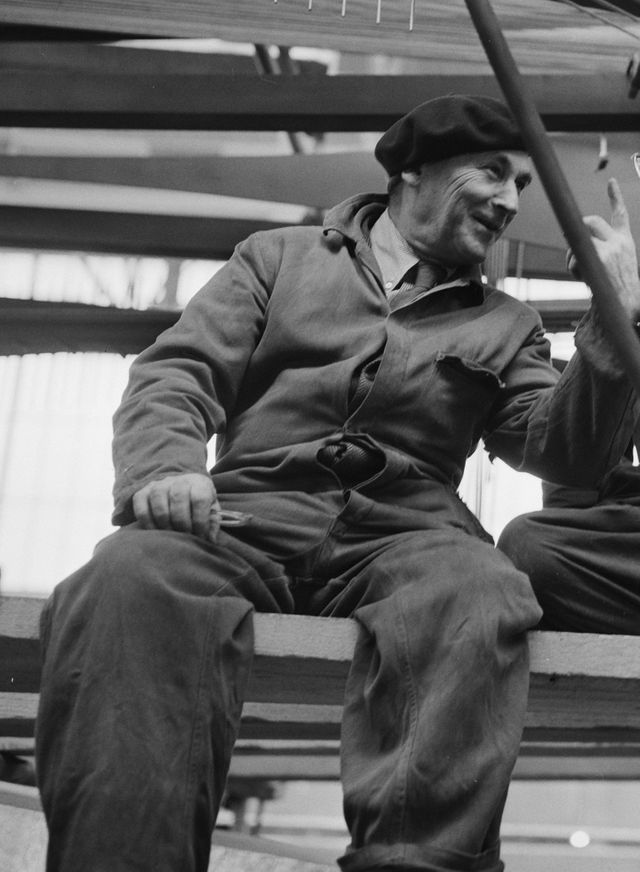
Biography
Naum Gabo was born Naum Borisovich Pevzner in Bryansk, Russia, in 1890. He studied science and medicine at the University of Munich from 1910 to 1912, and later moved on to study philosophy and art history until 1914, influenced by the lectures of Heinrich Wölfflin and the philosophy of Henri Bergson. Simultaneously, he studied engineering at the Technische Hochschule in Munich, which housed a large collection of mathematical models. He moved to Norway during most of World War I, and began to produce sculptural constructions using cardboard, plywood, and iron, with the encouragement of his brother, artist Antoine Pevsner. Around this time, he adopted the surname Gabo to distinguish himself from Pevsner. The two brothers returned to Russia in 1917, lured by the promise of revolution, and became active proponents of what would become known as Constructivism. While his early sculptures were figurative, he moved on to abstract, architectonic works such as Column (1920), which included its integral base. Gabo's 1920 tract, the "Realisticheskii manifest" ("Realistic Manifesto"), outlined several of his concepts of art, including the rejection of Cubism and Futurism, an embrace of public art that encompassed space and time as essential elements, and the idea that "art has its absolute, independent value."¹ This concept of autonomy ran counter to the Bolsheviks' doctrine of artistic utility, and prompted Gabo's departure for Berlin in 1922. There, he produced designs for Diaghilev's ballet La Chatte (The Cat) in 1926, lectured at the Bauhaus in 1928, came into contact with Hans Richter and Kurt Schwitters, and had an important solo show at the Kestner-Gesellschaft in Hannover in 1930. By 1932, Nazism drove him and Pevsner first to Paris where he joined Abstraction-Création (Abstraction-Creation), in the company of Piet Mondrian and other De Stijl artists, and then to London in 1936. There he became acquainted with Herbert Read and Ben Nicholson, with whom he edited Circle in 1937. Through the industrial chemist John Sisson, he was introduced to Perspex, the new plastic developed by Imperial Chemical Industries, which he used in several iconic works, such as Translucent Variation on Spheric Theme (1937). While living in Cornwall during World War II, he continued to experiment with different media, even while some materials were in short supply: Linear Construction in Space (1942) incorporated nylon microfilament. In 1946 Gabo emigrated to the United States. After a major exhibition of his work in 1948 (shared with his brother Pevsner), which provided a platform for his text "The Philosophy of Constructivist Art," he began to show regularly in the U.S. and Europe and to undertake public commissions, such as his 1951 Construction Suspended in Space for the Baltimore Museum of Art. In the 1950s Gabo continued to explore scientific and mathematical images through a new medium, wood engraving, which he utilized throughout the last two decades of his life. Gabo has been the subject of numerous exhibitions at major institutions, including a traveling retrospective at the Dallas Museum of Art; Art Gallery of Toronto; Solomon R. Guggenheim Museum, New York; Akademie der Künste, Berlin; Kunstsammling Nordrhein-Westfalen, Düsseldorf; and Tate Gallery, London (1985–87). Other retrospectives include those held at Nasjonalgalleriet, Oslo (1971); Nationalgalerie, Berlin (1971); Musée national d'art moderne, Paris (1972); Albright-Knox Gallery, Buffalo, New York (1968); and Stedelijk Museum, Amsterdam (1965). Gabo died in Waterbury, Connecticut, on August 23, 1977.
Track Naum Gabo
Get notifications when works come to auction, and access market analytics
Create Free AccountAlready have an account? Sign In
Professional documentation gives you clarity, portability, and confidence in your collection.
Learn why collectors document their holdings onlineYour collection, accessible anywhere
Access your collection from any device with our cloud-based platform. Native mobile apps provide seamless synchronization and offline browsing, ensuring your collection data is always at hand.