Biography
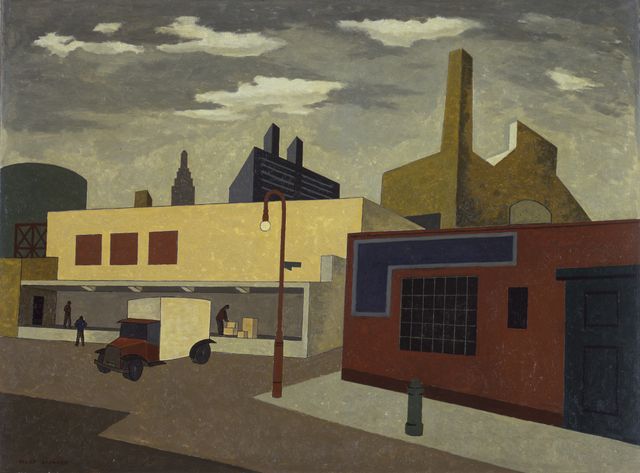
Niles Spencer, associated with the Precisionists and known for the simplicity of his architectural images, was born in 1893 in Pawtucket, Rhode Island. Spencer’s family owned a prosperous textile mill in Pawtucket and this early relationship with industry provided the artist with a subject that would fascinate him throughout his career. From 1913 to 1915, he attended the Rhode Island School of Design in Providence. Settling in New York in 1916, he enrolled in Kenneth Hayes Miller’s anatomy class at the Art Students League and studied with George Bellows and Robert Henri at a private art school in the Bronx. Spencer divided his time between New York and Ogunquit, Maine, where the he spent the summers with other modern American artists who had gathered around Hamilton Easter Field, painter, critic, and founder of The Arts magazine. During the early 1920s, Spencer traveled to Europe, where he was drawn to the art of both the Cubists and the Italian Renaissance painters. The planes of color and faceted forms of Spencer’s early still-life compositions are reminiscent of Cézanne, whose structured compositions seem to have affected Spencer’s architectural landscapes and the more abstract style that would characterize his mature work. Throughout the 1920s, Spencer exhibited frequently, securing two one-man shows at the Daniel Gallery in 1925 and 1928, and he joined the Whitney Studio Club and the Whitney Studio Galleries, New York, where he showed until 1930. During this time, the artist lived in Provincetown, producing landscapes and still-lifes filled with the atmospheric light and subtle tonalities that were inspired by his New England surroundings. In these works, as in his later scenes of industrial New York, the artist employs the window-view structure, exemplified in The Dormer Window (1927), which relies on geometric design in depicting the domestic objects of the artists home. When the Spencer moved back to New York, he focused on dynamic New York scenes that featuring clearly drawn architectural forms of the skyscrapers and of factories and their machinery. These works of the early 1930s and 1940s most closely align the artist with the Precisionist painters such as Charles Sheeler and Charles Demuth. From the mid-1940s until around 1951, Spencer moved even further towards abstraction, creating complex compositions combining extremely simplified architectural forms, mainly those of industrial America. Spencer died in 1952.
Track Niles Spencer
Get notifications when works come to auction, and access market analytics
Create Free AccountAlready have an account? Sign In
Professional documentation gives you clarity, portability, and confidence in your collection.
Learn why collectors document their holdings online


Your collection, accessible anywhere
Access your collection from any device with our cloud-based platform. Native mobile apps provide seamless synchronization and offline browsing, ensuring your collection data is always at hand.


Biography
Niles Spencer, associated with the Precisionists and known for the simplicity of his architectural images, was born in 1893 in Pawtucket, Rhode Island. Spencer’s family owned a prosperous textile mill in Pawtucket and this early relationship with industry provided the artist with a subject that would fascinate him throughout his career. From 1913 to 1915, he attended the Rhode Island School of Design in Providence. Settling in New York in 1916, he enrolled in Kenneth Hayes Miller’s anatomy class at the Art Students League and studied with George Bellows and Robert Henri at a private art school in the Bronx. Spencer divided his time between New York and Ogunquit, Maine, where the he spent the summers with other modern American artists who had gathered around Hamilton Easter Field, painter, critic, and founder of The Arts magazine. During the early 1920s, Spencer traveled to Europe, where he was drawn to the art of both the Cubists and the Italian Renaissance painters. The planes of color and faceted forms of Spencer’s early still-life compositions are reminiscent of Cézanne, whose structured compositions seem to have affected Spencer’s architectural landscapes and the more abstract style that would characterize his mature work. Throughout the 1920s, Spencer exhibited frequently, securing two one-man shows at the Daniel Gallery in 1925 and 1928, and he joined the Whitney Studio Club and the Whitney Studio Galleries, New York, where he showed until 1930. During this time, the artist lived in Provincetown, producing landscapes and still-lifes filled with the atmospheric light and subtle tonalities that were inspired by his New England surroundings. In these works, as in his later scenes of industrial New York, the artist employs the window-view structure, exemplified in The Dormer Window (1927), which relies on geometric design in depicting the domestic objects of the artists home. When the Spencer moved back to New York, he focused on dynamic New York scenes that featuring clearly drawn architectural forms of the skyscrapers and of factories and their machinery. These works of the early 1930s and 1940s most closely align the artist with the Precisionist painters such as Charles Sheeler and Charles Demuth. From the mid-1940s until around 1951, Spencer moved even further towards abstraction, creating complex compositions combining extremely simplified architectural forms, mainly those of industrial America. Spencer died in 1952.
Track Niles Spencer
Get notifications when works come to auction, and access market analytics
Create Free AccountAlready have an account? Sign In
Professional documentation gives you clarity, portability, and confidence in your collection.
Learn why collectors document their holdings onlineYour collection, accessible anywhere
Access your collection from any device with our cloud-based platform. Native mobile apps provide seamless synchronization and offline browsing, ensuring your collection data is always at hand.