Biography
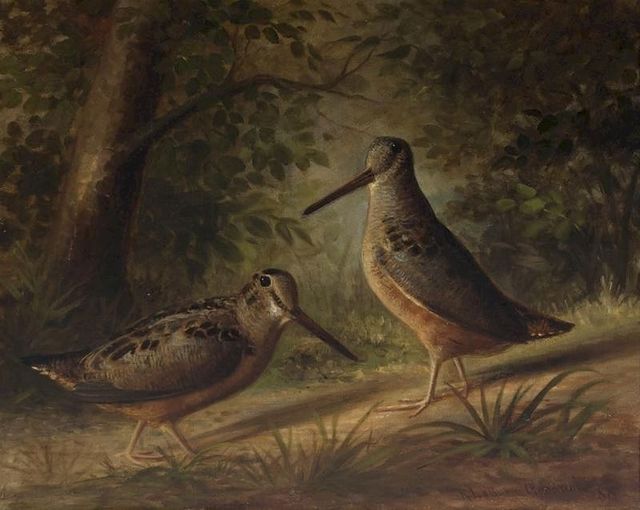
Richard La Barre Goodwin was a portrait and still-life painter best known for his many renderings of simple cabin doors hung with the spoils and paraphernalia of the hunt. Goodwin was born in Albany, New York, son of a prolific portrait painter. He studied with several obscure teachers, apparently in New York City. Wounded in the first Battle of Bull Run during the Civil War and discharged from the Union Army, he launched himself as an itinerant artist in 1862. Goodwin spent a quarter-century roaming western New York State and painting portraits. In the 1880s, while working in Syracuse, he painted his first still life. Goodwin's still-life paintings are of a type known as trompe l'oeil (French for "fool the eye") because the meticulously rendered objects, arranged against a simulated surface that corresponds illusionistically with the painting's canvas support, appear as real, three-dimensional things projecting into the viewer's space. Although frequently disdained by contemporary critics for their "low" subject matter, trompe-l'oeil paintings were highly popular with ordinary Americans in the last decades of the nineteenth century. Goodwin probably developed his idea for the cabin door painting that became his trademark under the influence of similar works by American still-life painter Michael Harnett (1848-1892). In contrast to Harnett's elegant objects with their distinctly European associations, however, Goodwin pictured common, American items redolent of humble rusticity. Even after abandoning portraits for still-life painting, Goodwin continued his peripatetic ways. When he worked in Washington, D.C., between 1890 and 1893, he sold a number of cabin-door paintings to members of the California delegation, notably Senator Leland Stanford. He spent seven years in Chicago after traveling there to visit the World's Columbian Exposition of 1893. Goodwin subsequently lived in Colorado Springs, Colorado; Los Angeles, California; and San Francisco, where many of his works were destroyed in the fire that followed the 1906 earthquake. He moved on to Portland, Oregon; returned to Rochester, New York, in 1908; and had just settled in Orange, New Jersey, when he died at the age of seventy. Like many members of his generation of American still-life painters, Goodwin fell into obscurity after his death. Since the 1960s, however, the works of such trompe-l'oeil painters have enjoyed a resurgence of attention from scholars and the public alike.
Track Richard Labarre Goodwin
Get notifications when works come to auction, and access market analytics
Create Free AccountAlready have an account? Sign In
Professional documentation gives you clarity, portability, and confidence in your collection.
Learn why collectors document their holdings online


Your collection, accessible anywhere
Access your collection from any device with our cloud-based platform. Native mobile apps provide seamless synchronization and offline browsing, ensuring your collection data is always at hand.


Biography
Richard La Barre Goodwin was a portrait and still-life painter best known for his many renderings of simple cabin doors hung with the spoils and paraphernalia of the hunt. Goodwin was born in Albany, New York, son of a prolific portrait painter. He studied with several obscure teachers, apparently in New York City. Wounded in the first Battle of Bull Run during the Civil War and discharged from the Union Army, he launched himself as an itinerant artist in 1862. Goodwin spent a quarter-century roaming western New York State and painting portraits. In the 1880s, while working in Syracuse, he painted his first still life. Goodwin's still-life paintings are of a type known as trompe l'oeil (French for "fool the eye") because the meticulously rendered objects, arranged against a simulated surface that corresponds illusionistically with the painting's canvas support, appear as real, three-dimensional things projecting into the viewer's space. Although frequently disdained by contemporary critics for their "low" subject matter, trompe-l'oeil paintings were highly popular with ordinary Americans in the last decades of the nineteenth century. Goodwin probably developed his idea for the cabin door painting that became his trademark under the influence of similar works by American still-life painter Michael Harnett (1848-1892). In contrast to Harnett's elegant objects with their distinctly European associations, however, Goodwin pictured common, American items redolent of humble rusticity. Even after abandoning portraits for still-life painting, Goodwin continued his peripatetic ways. When he worked in Washington, D.C., between 1890 and 1893, he sold a number of cabin-door paintings to members of the California delegation, notably Senator Leland Stanford. He spent seven years in Chicago after traveling there to visit the World's Columbian Exposition of 1893. Goodwin subsequently lived in Colorado Springs, Colorado; Los Angeles, California; and San Francisco, where many of his works were destroyed in the fire that followed the 1906 earthquake. He moved on to Portland, Oregon; returned to Rochester, New York, in 1908; and had just settled in Orange, New Jersey, when he died at the age of seventy. Like many members of his generation of American still-life painters, Goodwin fell into obscurity after his death. Since the 1960s, however, the works of such trompe-l'oeil painters have enjoyed a resurgence of attention from scholars and the public alike.
Track Richard Labarre Goodwin
Get notifications when works come to auction, and access market analytics
Create Free AccountAlready have an account? Sign In
Professional documentation gives you clarity, portability, and confidence in your collection.
Learn why collectors document their holdings onlineYour collection, accessible anywhere
Access your collection from any device with our cloud-based platform. Native mobile apps provide seamless synchronization and offline browsing, ensuring your collection data is always at hand.