Biography
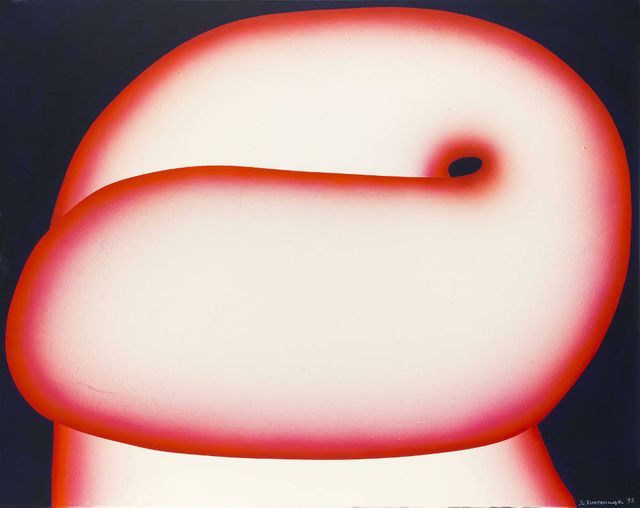
Born in 1922 in Mie Prefecture, Motonaga was a member of the legendary Gutai Art Association (1954–72), which became famous for groundbreaking performance works and innovations in painting, sculpture, and installation art. He emerged at a time when post-atomic surrealist existentialism was at the forefront of artistic development in Japan. However, Motonaga chose a different path and turned his back on the destruction wrought by the war in order to create paintings, sculptures, and performances that were fresh, jubilant, and playful. In 1954, he began employing a vocabulary of embryonic shapes, flying objects, and cartoon-like forms, modeled in heavy oil paint, that revealed his interest in children’s art, manga, and popular culture, and collapsed distinctions between high and low art. By 1957, Motonaga’s work had become more abstract and featured flowing lines and pools of brightly colored pigment poured and dripped onto the canvas. This “classic style,” which developed concurrently with Morris Louis’s Veil paintings, occupied Motonaga until the mid-1960s when his anthropomorphic sensibility returned in paintings featuring extruded and knotted forms that were delicately modeled with airbrush. Thereafter in the 1970s, the artist’s scratchy hand-drawn forms reappeared along with the use of canned spray paint, creating a style that was fresh and raw, akin to graffiti and animation. Motonaga occupied a unique position in the Japanese art world, creating a distinct visual continuity between the artists and imagery of the immediate postwar era and the concerns that emerged in the work of contemporary painters such as Takashi Murakami, Yoshitomo Nara, and beyond. Motonaga’s work has been the subject of many retrospective exhibitions, most notably at Hyogo Prefectural Museum of Art, Kobe, 1998; Hiroshima City Museum of Contemporary Art, 2003; Nagano Prefectural Shinano Art Museum, 2005; and Mie Prefectural Museum of Art, 2009. The first Western retrospective of Motonaga’s art will take place at the Dallas Museum of Art in 2014.
Track Sadamasa Motonaga
Get notifications when works come to auction, and access market analytics
Create Free AccountAlready have an account? Sign In
Professional documentation gives you clarity, portability, and confidence in your collection.
Learn why collectors document their holdings online


Your collection, accessible anywhere
Access your collection from any device with our cloud-based platform. Native mobile apps provide seamless synchronization and offline browsing, ensuring your collection data is always at hand.


Biography
Born in 1922 in Mie Prefecture, Motonaga was a member of the legendary Gutai Art Association (1954–72), which became famous for groundbreaking performance works and innovations in painting, sculpture, and installation art. He emerged at a time when post-atomic surrealist existentialism was at the forefront of artistic development in Japan. However, Motonaga chose a different path and turned his back on the destruction wrought by the war in order to create paintings, sculptures, and performances that were fresh, jubilant, and playful. In 1954, he began employing a vocabulary of embryonic shapes, flying objects, and cartoon-like forms, modeled in heavy oil paint, that revealed his interest in children’s art, manga, and popular culture, and collapsed distinctions between high and low art. By 1957, Motonaga’s work had become more abstract and featured flowing lines and pools of brightly colored pigment poured and dripped onto the canvas. This “classic style,” which developed concurrently with Morris Louis’s Veil paintings, occupied Motonaga until the mid-1960s when his anthropomorphic sensibility returned in paintings featuring extruded and knotted forms that were delicately modeled with airbrush. Thereafter in the 1970s, the artist’s scratchy hand-drawn forms reappeared along with the use of canned spray paint, creating a style that was fresh and raw, akin to graffiti and animation. Motonaga occupied a unique position in the Japanese art world, creating a distinct visual continuity between the artists and imagery of the immediate postwar era and the concerns that emerged in the work of contemporary painters such as Takashi Murakami, Yoshitomo Nara, and beyond. Motonaga’s work has been the subject of many retrospective exhibitions, most notably at Hyogo Prefectural Museum of Art, Kobe, 1998; Hiroshima City Museum of Contemporary Art, 2003; Nagano Prefectural Shinano Art Museum, 2005; and Mie Prefectural Museum of Art, 2009. The first Western retrospective of Motonaga’s art will take place at the Dallas Museum of Art in 2014.
Track Sadamasa Motonaga
Get notifications when works come to auction, and access market analytics
Create Free AccountAlready have an account? Sign In
Professional documentation gives you clarity, portability, and confidence in your collection.
Learn why collectors document their holdings onlineYour collection, accessible anywhere
Access your collection from any device with our cloud-based platform. Native mobile apps provide seamless synchronization and offline browsing, ensuring your collection data is always at hand.