Biography
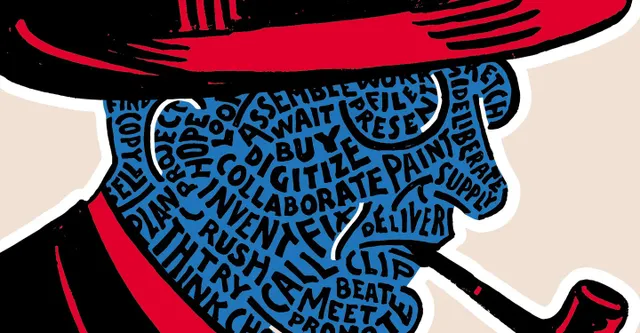
Seymour Chwast is not your typical revolutionary firebrand. HIs name is a dead giveaway. It is inconceivable that the masses could be moved to frothing frenzy by chanting SEE-MORE, SEE-MORE, SEE-MORE! It just doesn’t have the same rousing cadence as CHE, CHE, CHE, or MAO, MAO, MAO, or even BO-NO, BO-NO, BO-NO! Nonetheless, Seymour led a major revolution in American illustration and graphic design during the late 1950s and early 1960s, triggering the shift from sentimental realism to comic expressionism, among other radical feats. The illustrations for magazines, posters, advertisements, book jackets, record covers, product packages, and children’s books that he created after founding Push Pin Studios with Milton Glaser and Edward Sorel in 1954 directly influenced two generations (statistical fact) and indirectly inspired another two (educated conjecture) of international illustrators and designers to explore an eclectic range of stylistic an conceptual methods. He was very instrumental in wedding illustration to typographic design (a concept that was viewed as passé by modernists). In addition, Chwast (pronounced “kwast”) contributed his distinct brand of absurdist wit to twentieth-century applied art and design. And although his methods were unapologetically rooted in vintage-style decorative traditions, his work never slavishly copied the past. Instead, he synthesized, reinvented, and often parodied it. Seymour’s art was postmodern long before the term was coined. Yet it was resolutely modern in its rejection of the nostalgic and romantic representation, as in the acolytes of Norman Rockwell, that had been popular in mainstream advertising magazines at the time. Instead of prosaic or melodramatic tableau, Seymour emphasized clever concept. What makes the very best of his art so arresting, and so identifiable, is the tenacity of his ideas—simple, complex, rational, and even absurd ideas. Droll humor and conceptual acuity were the foundation on which he built a visual language that advanced editorial illustration beyond pictorial mimicry of a sentence or headline. His images complemented and supplemented the words, gave them additional layers of meaning. What’s more, Seymour is master of the visual pun, which enables him to manipulate pictorial concepts as a sculptor shapes soft clay. He is also skilled at what comedians call the slow burn or double take: using commonplace things as foils for uncommon illusions, he twists imagery into double entendres. Seymour employs one of the most adaptable pictorial lexicons in the world (big claim based on educational conjecture and rooted in statistical fact). Yet when he repeats himself, as all artists do, he makes every effort to turn such repetition into something great. Seymour is nothing if not novel (you can make a book on that). However concept—the big idea—alone does not make art that shall be called “a Seymour.” Although Seymours are rendered in various media and numerous techniques, there are some quintessential graphic traits. Each of his imaginary characters (even portraits of real individuals) have similar facial features—round lips, slits for eyes, bulbous noses. They never scowl, yet they are not cute. A seymour can be a simple vignette or a large tableau, but in whatever form the look is unmistakable. His ideas are routinely framed by means of playful stylistic conceits that, although varied, express his singular personality. Virtuosic drawing underpins almost everything he touches, but the results are never slick. His finishes are often unfinished looking and not tethered to one particular method; instead his illustration ranges from gnarly to precise, from naive to sophisticated. He is versatile with media, including monoprint, woodcut, collage, and montage; paint, ink, and charcoal; pencil, burin, and graver. Few are as flexible yet so consistent. Decades ago he may have ended the revolutionary phase of his career (even Mao knew one cannot be a revolutionary forever), but judging from his output, we see that Seymour is resilient, and endures as restlessly motivated as ever.
Track Seymour Chwast
Get notifications when works come to auction, and access market analytics
Create Free AccountAlready have an account? Sign In
Professional documentation gives you clarity, portability, and confidence in your collection.
Learn why collectors document their holdings online


Your collection, accessible anywhere
Access your collection from any device with our cloud-based platform. Native mobile apps provide seamless synchronization and offline browsing, ensuring your collection data is always at hand.


Biography
Seymour Chwast is not your typical revolutionary firebrand. HIs name is a dead giveaway. It is inconceivable that the masses could be moved to frothing frenzy by chanting SEE-MORE, SEE-MORE, SEE-MORE! It just doesn’t have the same rousing cadence as CHE, CHE, CHE, or MAO, MAO, MAO, or even BO-NO, BO-NO, BO-NO! Nonetheless, Seymour led a major revolution in American illustration and graphic design during the late 1950s and early 1960s, triggering the shift from sentimental realism to comic expressionism, among other radical feats. The illustrations for magazines, posters, advertisements, book jackets, record covers, product packages, and children’s books that he created after founding Push Pin Studios with Milton Glaser and Edward Sorel in 1954 directly influenced two generations (statistical fact) and indirectly inspired another two (educated conjecture) of international illustrators and designers to explore an eclectic range of stylistic an conceptual methods. He was very instrumental in wedding illustration to typographic design (a concept that was viewed as passé by modernists). In addition, Chwast (pronounced “kwast”) contributed his distinct brand of absurdist wit to twentieth-century applied art and design. And although his methods were unapologetically rooted in vintage-style decorative traditions, his work never slavishly copied the past. Instead, he synthesized, reinvented, and often parodied it. Seymour’s art was postmodern long before the term was coined. Yet it was resolutely modern in its rejection of the nostalgic and romantic representation, as in the acolytes of Norman Rockwell, that had been popular in mainstream advertising magazines at the time. Instead of prosaic or melodramatic tableau, Seymour emphasized clever concept. What makes the very best of his art so arresting, and so identifiable, is the tenacity of his ideas—simple, complex, rational, and even absurd ideas. Droll humor and conceptual acuity were the foundation on which he built a visual language that advanced editorial illustration beyond pictorial mimicry of a sentence or headline. His images complemented and supplemented the words, gave them additional layers of meaning. What’s more, Seymour is master of the visual pun, which enables him to manipulate pictorial concepts as a sculptor shapes soft clay. He is also skilled at what comedians call the slow burn or double take: using commonplace things as foils for uncommon illusions, he twists imagery into double entendres. Seymour employs one of the most adaptable pictorial lexicons in the world (big claim based on educational conjecture and rooted in statistical fact). Yet when he repeats himself, as all artists do, he makes every effort to turn such repetition into something great. Seymour is nothing if not novel (you can make a book on that). However concept—the big idea—alone does not make art that shall be called “a Seymour.” Although Seymours are rendered in various media and numerous techniques, there are some quintessential graphic traits. Each of his imaginary characters (even portraits of real individuals) have similar facial features—round lips, slits for eyes, bulbous noses. They never scowl, yet they are not cute. A seymour can be a simple vignette or a large tableau, but in whatever form the look is unmistakable. His ideas are routinely framed by means of playful stylistic conceits that, although varied, express his singular personality. Virtuosic drawing underpins almost everything he touches, but the results are never slick. His finishes are often unfinished looking and not tethered to one particular method; instead his illustration ranges from gnarly to precise, from naive to sophisticated. He is versatile with media, including monoprint, woodcut, collage, and montage; paint, ink, and charcoal; pencil, burin, and graver. Few are as flexible yet so consistent. Decades ago he may have ended the revolutionary phase of his career (even Mao knew one cannot be a revolutionary forever), but judging from his output, we see that Seymour is resilient, and endures as restlessly motivated as ever.
Track Seymour Chwast
Get notifications when works come to auction, and access market analytics
Create Free AccountAlready have an account? Sign In
Professional documentation gives you clarity, portability, and confidence in your collection.
Learn why collectors document their holdings onlineYour collection, accessible anywhere
Access your collection from any device with our cloud-based platform. Native mobile apps provide seamless synchronization and offline browsing, ensuring your collection data is always at hand.