Venetian School, 16th Century
Biography
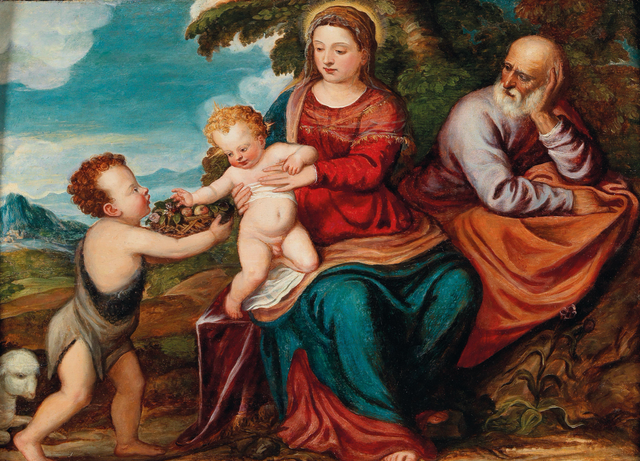
Giorgione and Titian were both apprentices at Bellini's workshop. They collaborated on numerous paintings, and their styles could be so similar that it is difficult to conclusively assign authorship. A speciality of Giorgione's were idyllic Arcadian scenes, with an example being his Three Philosophers, and this element was adopted by his master Bellini, who increased the landscape in his many Madonnas, and by Titian in work like Pastoral Concert (1508) and Sacred and Profane Love (1515). This emphasis on nature as a setting was a major contribution of the Venetian School. Titian, through his long and productive life, with a wide variety of themes and subjects was the most influential and greatest of all the Venetian painters. His early Pesaro Madonna (1519–1528) shows a bold new composition for such a traditional religious subject, putting the focal point of the Madonna off from the centre and on a steep diagonal. Colours are used to enliven the painting, but also to unify the composition, such as by the large red flag on the left counterbalancing the red in the Madonna and such skilful and sumptuous use of colour became a hallmark of the Venetian style. Titian's reclining Venus of Urbino (1538), with a lapdog on the right, balancing the face on the left, is an erotic work. Although pre-figured by the Sleeping Venus (completed by Titian after Giorgione's death in 1510) Titian is credited with establishing the reclining female nude as an important subgenre in art. Using mythological subjects, works such as the Venus of Urbino (1538) richly depict the fabrics and other textures, and use a composition that is carefully controlled by organising colours. As an example, in this painting the diagonal of the nude is matched by the opposite diagonal between the red of the cushions in the front with the red skirts of the woman in the background. With other Venetian painters such as Palma Vecchio, Titian established the genre of half-length portraits of imaginary beautiful women, often given rather vague mythological or allegorical titles, with attributes to match. The artists apparently did nothing to discourage the belief that these were modelled for by the most celebrated of Venice's famous courtesans, and in some cases this may have been the case. Titian continued to paint religious subjects with growing intensity, and mythological subjects, which produced many of his most famous later works, above all the poesie series for Philip II of Spain. With such paintings, readily transported by virtue of being oils on canvas, Titian became famous, and helped establish a reputation for Venetian art. Possession of such paintings symbolised luxurious wealth, and for his skills in portraiture he was sought by powerful, rich individuals, such as in his long relationship working for Emperor Charles V and Philip II of Spain.
Track Venetian School, 16th Century
Get notifications when works come to auction, and access market analytics
Create Free AccountAlready have an account? Sign In
Professional documentation gives you clarity, portability, and confidence in your collection.
Learn why collectors document their holdings online


Your collection, accessible anywhere
Access your collection from any device with our cloud-based platform. Native mobile apps provide seamless synchronization and offline browsing, ensuring your collection data is always at hand.


Venetian School, 16th Century
Biography
Giorgione and Titian were both apprentices at Bellini's workshop. They collaborated on numerous paintings, and their styles could be so similar that it is difficult to conclusively assign authorship. A speciality of Giorgione's were idyllic Arcadian scenes, with an example being his Three Philosophers, and this element was adopted by his master Bellini, who increased the landscape in his many Madonnas, and by Titian in work like Pastoral Concert (1508) and Sacred and Profane Love (1515). This emphasis on nature as a setting was a major contribution of the Venetian School. Titian, through his long and productive life, with a wide variety of themes and subjects was the most influential and greatest of all the Venetian painters. His early Pesaro Madonna (1519–1528) shows a bold new composition for such a traditional religious subject, putting the focal point of the Madonna off from the centre and on a steep diagonal. Colours are used to enliven the painting, but also to unify the composition, such as by the large red flag on the left counterbalancing the red in the Madonna and such skilful and sumptuous use of colour became a hallmark of the Venetian style. Titian's reclining Venus of Urbino (1538), with a lapdog on the right, balancing the face on the left, is an erotic work. Although pre-figured by the Sleeping Venus (completed by Titian after Giorgione's death in 1510) Titian is credited with establishing the reclining female nude as an important subgenre in art. Using mythological subjects, works such as the Venus of Urbino (1538) richly depict the fabrics and other textures, and use a composition that is carefully controlled by organising colours. As an example, in this painting the diagonal of the nude is matched by the opposite diagonal between the red of the cushions in the front with the red skirts of the woman in the background. With other Venetian painters such as Palma Vecchio, Titian established the genre of half-length portraits of imaginary beautiful women, often given rather vague mythological or allegorical titles, with attributes to match. The artists apparently did nothing to discourage the belief that these were modelled for by the most celebrated of Venice's famous courtesans, and in some cases this may have been the case. Titian continued to paint religious subjects with growing intensity, and mythological subjects, which produced many of his most famous later works, above all the poesie series for Philip II of Spain. With such paintings, readily transported by virtue of being oils on canvas, Titian became famous, and helped establish a reputation for Venetian art. Possession of such paintings symbolised luxurious wealth, and for his skills in portraiture he was sought by powerful, rich individuals, such as in his long relationship working for Emperor Charles V and Philip II of Spain.
Track Venetian School, 16th Century
Get notifications when works come to auction, and access market analytics
Create Free AccountAlready have an account? Sign In
Professional documentation gives you clarity, portability, and confidence in your collection.
Learn why collectors document their holdings onlineYour collection, accessible anywhere
Access your collection from any device with our cloud-based platform. Native mobile apps provide seamless synchronization and offline browsing, ensuring your collection data is always at hand.