
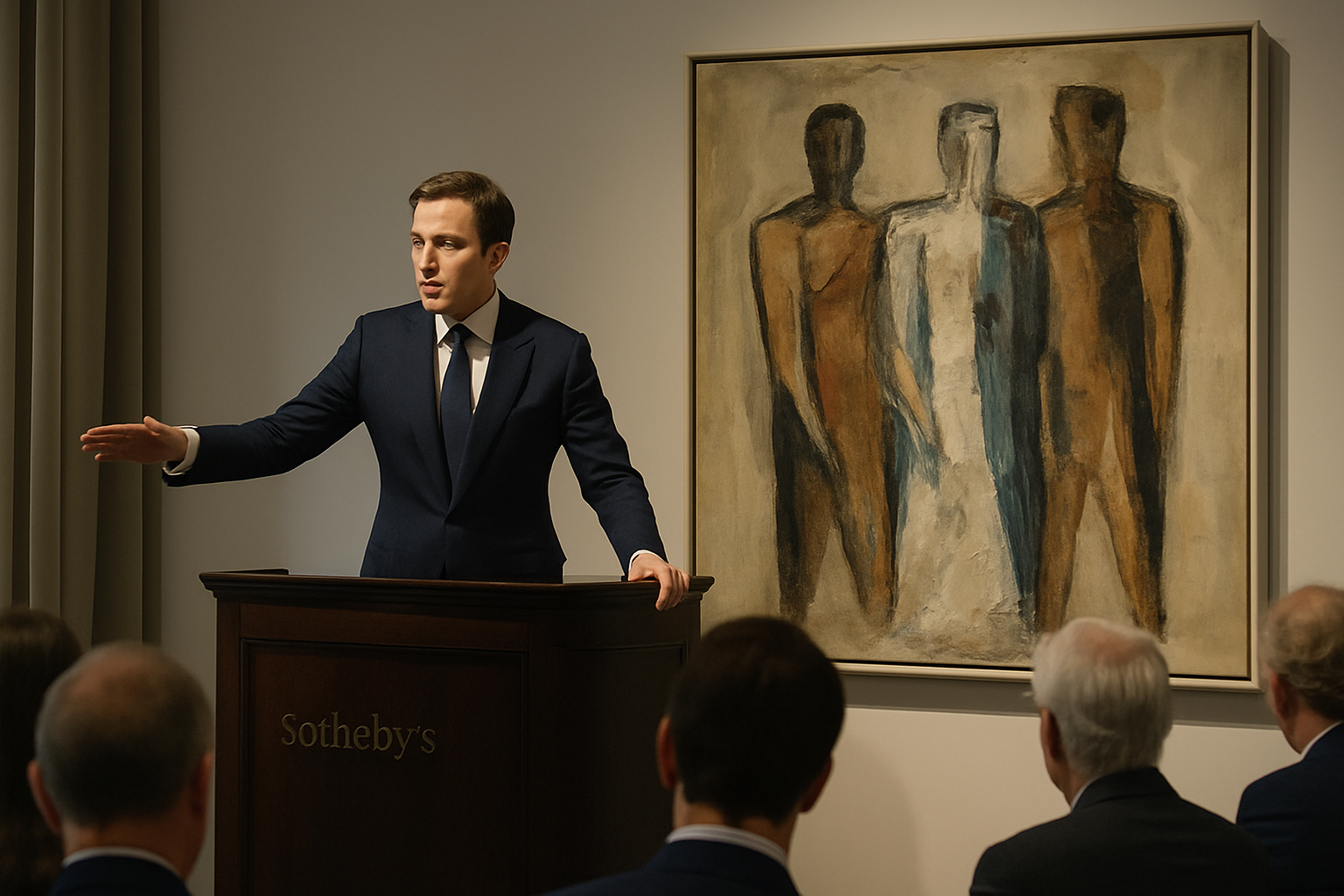
London has spent the better part of three years playing second violin to New York's auction dominance — watching blockbuster estate sales, eight-figure Klimts, and nine-figure Pollocks cross the Atlantic to Christie's and Sotheby's Manhattan salerooms. On the night of 24 June 2026, the British capital reminded the market what it is still capable of. In a single evening at Sotheby's New Bond Street, the collection of billionaire financier Joe Lewis realised £296.3 million ($392.6 million) with fees, setting a new record for the most valuable single-owner collection ever sold in the United Kingdom. When a follow-on Modern and Contemporary evening added another £97.1 million ($128.1 million), the house's total for the night reached £393.4 million ($520.7 million) — the largest sum ever achieved at auction in a single night anywhere in Europe.
The Lewis Sale: By the Numbers
The headline figures almost defy the context in which they were achieved. The £249.3 million hammer total — £296.3 million with buyer's premium — nearly tripled the previous British record of £101 million, set by the Pauline Karpidas collection just last September. That is not an incremental move; it is a structural statement about the depth of demand at the apex of the market. Even more striking: the result was achieved without any of the 25 lots being guaranteed, and only a single lot failed to sell — a modestly-estimated 1880 Degas. In a market where guarantees have become the default tool for managing sell-through risk, that clean, unhedged result deserves emphasis.
The top lot was Amedeo Modigliani's Nu assis au collier (1917–18), a rare female nude that carries significant provenance weight: Lewis had bought it at Christie's in 1995 for $12.4 million. Estimated to sell in excess of £45 million, it met expectations, going for £48.2 million ($63.9 million). The three-decade holding period produced a return that most alternative asset managers would struggle to match. A Gustav Klimt portrait from 1902, Bildnis Gertrud Loew (Gertha Felsőványi), followed at £36.2 million ($47.9 million) against a £20–30 million estimate, secured by an Asian private collector. A 1995 Lucian Freud nude rounded out the top three at £29.3 million ($38.8 million).
There were other noteworthy signals buried in the supporting lots. René Magritte's La Belle Promenade set a new auction record for a work on paper by the artist, selling for £16 million ($21.2 million) — four times its high estimate. A Gustave Caillebotte portrait, Portrait de Paul Hugot (1878), sold for £10.3 million ($13.6 million) after ten minutes of bidding, easily doubling its £4.5 million high estimate. Works by artists whose auction presence is comparatively rare tend to outperform when the surrounding confidence is high — an effect amplified here by the collection's exceptional quality throughout.
Asian Buyers and the Geography of Demand
One of the most important structural stories in the results was geography. Collectors from Asia bid on half of the 25 lots offered and accounted for around a third of the auction's total, according to Sotheby's. Several of the evening's highest-value works were secured by bidders represented by Sotheby's Asia chairman Wendy Lin — including the Klimt and, after a protracted bidding contest with Fahad Malloh, the firm's Saudi-based director of business strategy, the Schiele Danaë.
"Asian bidding is back — we also saw that in New York [in May] — and that has made a big difference," said Clare Keiller, director of research at London advisory firm Beaumont Nathan. For collectors tracking the competitive landscape, this matters. The return of aggressive Asian participation to London salerooms — after a period when Hong Kong and New York absorbed most of that energy — raises the floor for trophy-quality European modernism. It also suggests that London's post-Brexit concerns about losing relevance as a destination for international capital may be overstated, at least at the very top end.
On the week overall, Sotheby's accounted for 92 percent of London's total auction revenue — a market-share figure that is almost structurally impossible to maintain but that reflects the gravitational pull of an exceptional single-owner collection. Even stripping out the Lewis lots, Sotheby's generated roughly two-thirds of the city's weekly sales total.
Old Masters: Records, Discipline, and a Bifurcating Market
The Lewis sale did not happen in isolation. The week before, London's Old Master season played out across Sotheby's and Christie's evening rooms, and the pattern that emerged is one collectors in every category should study carefully.
At Christie's, the evening totalled £38.9 million from 39 lots, with 90 percent sold — Christie's highest ever sell-through rate by lot for the category. The top lot was Sir Thomas Lawrence's 1820 portrait of the Duke of Wellington, which sold for £9.7 million, quadrupling the previous auction record for Lawrence — which had itself been set by this same painting at Christie's in 2006, when it sold for just over £2 million. That the painting's value grew roughly five-fold over two decades, with significant acceleration in the most recent cycle, speaks to the re-rating of strong British portraiture.
Christie's also posted double records for the Dutch Golden Age flower painter Jan van Huysum: two early 18th-century still lifes sold for £6.5 million and £5.5 million, shattering the artist's auction record twice in the same evening. Both pictures were bought by the same bidder.
At Sotheby's the following night, the Hamilton Laocoön — a monumental Neoclassical marble by Auguste-Jean-Marie Carbonneaux after the celebrated ancient sculpture — was the headline lot. After a 15-minute bidding battle involving four collectors from Asia and Europe, the work sold for £13.62 million ($18 million), becoming the second-highest price ever paid for a pre-modern sculpture at auction. Hans Memling's intimate Virgin Mary Nursing the Christ Child, described as one of the last important devotional panels by the artist still in private hands, set a new record at £3.51 million ($4.66 million).
But the overall picture across both houses was not uniformly bullish. While Christie's produced just three buy-ins and set six artist records, Sotheby's generated more than three times as many unsold lots. The divergence is instructive: demand is intensely object-specific. "In Old Masters today, the category itself is no longer enough. The picture has to give collectors a reason to fall in love," was how ARTnews framed the mood.
Notably, both Andrew Fletcher, global head of Old Masters at Christie's, and Elisabeth Lobkowicz, head of Old Master paintings at Sotheby's London, observed a shift in buyers within the field, with many crossing over from contemporary art and finding Old Masters comparatively good value. At Sotheby's, 23 percent of lots sold in the evening sale went to collectors new to the category.
The K-Shaped Market in Sharp Relief
Place the Lewis sale and the Old Masters week side by side, and the pattern matches what the data has been suggesting all year. The Art Basel and UBS Global Art Market Report 2026 found that global sales increased by 4 percent year-on-year to an estimated $59.6 billion in 2025, after two years of declining values — with public auction sales leading the recovery, up 9 percent to $20.7 billion. But aggregate growth masks an increasingly lopsided distribution.
At the top — works with exceptional provenance, scholarship, rarity, and visual power — competition is fierce and records fall regularly. Below that tier, the market remains cautious. Small- to mid-tier galleries offering emerging art remain vulnerable, underscored by a number of high-profile gallery closures last year, and buyers are deliberate when it comes to quality, provenance, and art-historical significance. Sellers continue to rely more heavily on auction guarantees and private sales than in prior cycles.
The Lewis sale's clean result — no guarantees, near-perfect sell-through — succeeded partly because of the collection's intrinsic quality and partly because of the single-owner format, which allows auction houses to build a coherent narrative around a body of work. Data from Sotheby's, Christie's, and Phillips shows confidence from major single-owner sales trickling down to the rest of the art market, but that trickle is slow and uneven. Do not expect the Lewis momentum to lift all boats simultaneously.
What Collectors Should Do Now
The London summer season offers several actionable signals for collectors at different levels of the market.
- Provenance is pricing power. The Modigliani's 31-year holding period, the Magritte's institutional exhibition history, the Lawrence's documented two-decade appreciation — each underscores that documented, unbroken ownership chains command material premiums over comparable works with thinner paper trails. If you are building a collection, invest in provenance research and documentation from the moment of acquisition.
- Old Masters represent a structural entry point. With contemporary art still cooling and a fresh cohort of buyers crossing categories, well-researched Old Masters — particularly Northern European works with institutional backing — are attracting capital that would have gone elsewhere five years ago. The 23 percent new-buyer rate at Sotheby's Old Masters evening is a reliable leading indicator.
- Single-owner context creates value. Works from the Lewis collection consistently outperformed their stand-alone estimates because the curatorial coherence of the collection lent authority to every lot. If you are at a stage where your collection has a thesis — figurative art, a particular movement, a geographic school — maintaining that coherence preserves the option value of presenting it as a collection rather than disaggregating it.
- Watch the Asian re-engagement closely. Asian buyers driving a third of the Lewis evening's total, and competing for everything from Klimt to Schiele, signals that cross-regional demand for European modernism at the eight-figure level is strengthening. This compresses supply at the top and pushes prices higher for works that can credibly claim museum quality.
- Avoid mid-market ambiguity. The bifurcation in Old Masters — Christie's near-perfect sell-through against Sotheby's higher buy-in rate for less exceptional material — maps onto the broader market dynamic. Works that are good but not exceptional, in categories that are recovering but not yet recovered, remain difficult to sell at estimate. Buying well in that zone requires discipline on price.
London is not consistently back to where it was in 2014 or 2017. One record-breaking evening does not reverse structural headwinds around taxation, competition from other centres, or the cautious mid-market. But the Lewis sale demonstrated something the market genuinely needed to see: that London can mobilise a global buyer base, produce clean results without financial engineering, and deliver a single-night total that rivals anything New York has managed this cycle. For the next collector considering where to consign or where to bid this autumn, that demonstration of pulling power is not a trivial data point.