
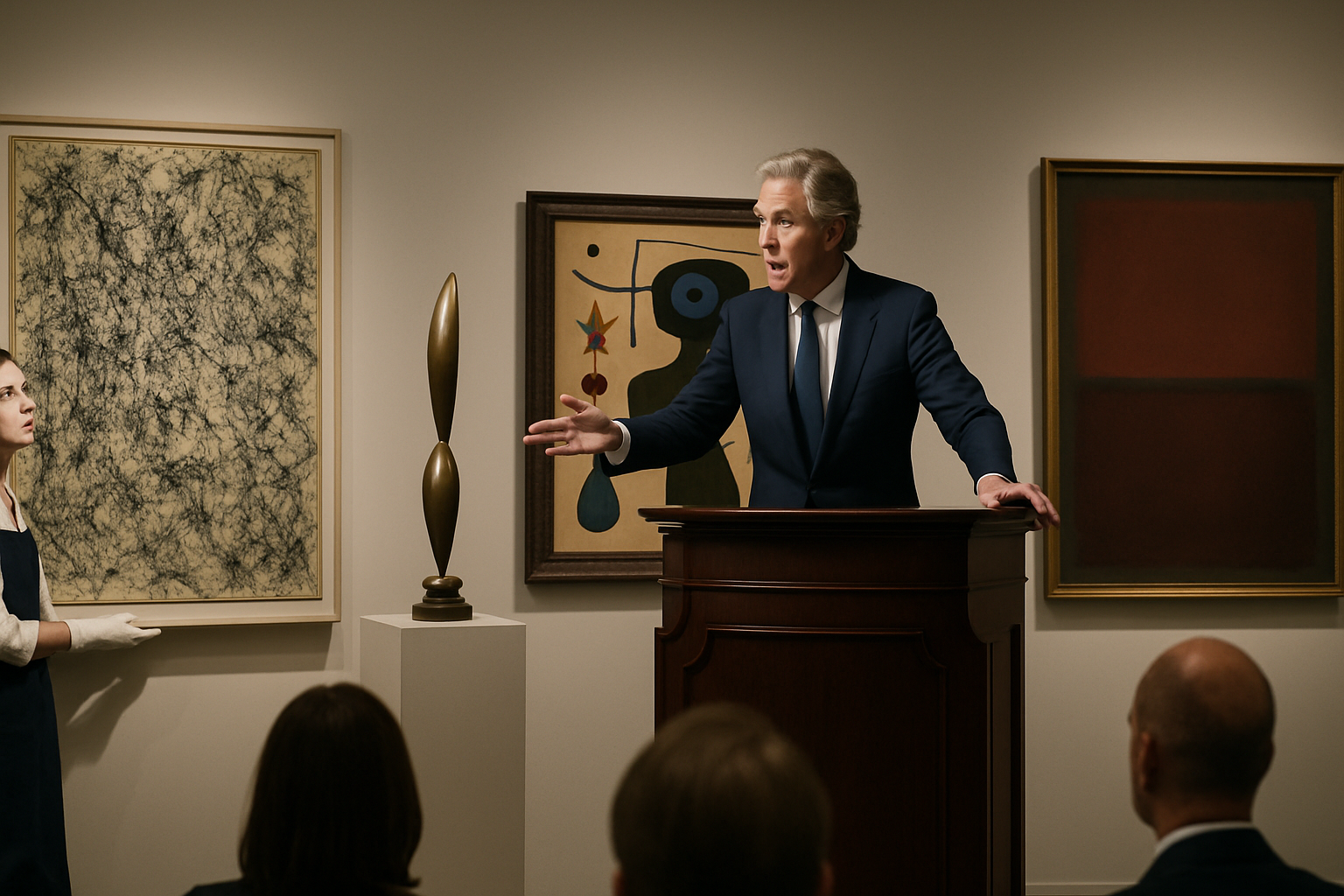
On the evening of May 18, it took Christie's exactly forty minutes to move $630 million worth of art through a single salesroom. The occasion was Masterpieces: The Private Collection of S.I. Newhouse — sixteen works assembled over a lifetime by the late Condé Nast publisher — and when the gavel fell on the final lot, it had already become one of the most consequential single-owner sales in auction history. Paired with Christie's subsequent 20th-century evening sale later that night, the house netted a combined $1.1 billion with fees, and the week-long sprint across Christie's, Sotheby's, and Phillips produced seventeen new artist auction records. The question for collectors is not whether the market roared — it did — but why, and what that tells you about where capital flows next.
The Newhouse Sale: Provenance as Price Multiplier
The headline number from the Newhouse evening belongs to Jackson Pollock. Number 7A, 1948 — a drip painting spanning more than eleven feet wide and three feet high — sold for a hammer price of $157 million, arriving at $181.2 million with fees. That figure nearly tripled Pollock's previous auction record of $61.1 million, set by Number 17 (1951) in 2021, and placed Number 7A among the four most expensive artworks ever auctioned. The painting had not been seen publicly since a 1977 Whitney Museum exhibition.
The provenance chain is worth studying closely because it encapsulates why the market paid such a premium. Acquired directly from the artist by early champion Herbert Matter, the painting later entered the collections of Kimiko and John Powers before spending twenty-five years with S.I. Newhouse. Each custodian was an institution-grade collector. Christie's positioned the work as "opening the door to a pure form of expression suitable for the modern postwar world" — but the real underwriting was the unbroken chain of connoisseur ownership. When bidding opened at $82 million and surpassed sixty bids over ten minutes, it was that provenance narrative — not just the canvas — that bidders were competing for.
The sculpture that rivaled Pollock for the evening's drama was Constantin Brancusi's Danaïde (ca. 1913), a 25-centimeter gilt and black-patina bronze. Estimated at up to $100 million, Danaïde sold for $107.6 million — making it the second most expensive sculpture ever sold at auction, trailing only Alberto Giacometti's L'Homme au doigt (1947), which achieved $141.3 million at Christie's in 2015. Newhouse had acquired it in 2002 for $18.2 million; its appreciation over two decades illustrates precisely the compounding logic of trophy provenance. Brancusi personally chose the work for his first solo exhibition in New York in 1914, where it was acquired by Eugene and Agnes Meyer, becoming part of a collection held by two of the artist's most important patrons and lifelong friends. The object carried curatorial endorsement from the moment it left the studio.
Rounding out the Newhouse fireworks: Joan Miró's Portrait de Madame K. (1924) set a new record for the artist at $53.5 million with fees. Newhouse had acquired that same painting in November 2001 — two months after 9/11 — for $12.6 million. The full Newhouse tranche at Christie's brought in $631 million, a white-glove result backed entirely by third-party guarantees.
Records Beyond Newhouse: Rothko, Matisse, and a 100% Phillips
The Newhouse collection dominated the headlines, but the supporting cast was equally instructive. In Christie's subsequent 20th-century evening sale — drawing on consignments from MoMA trustee Agnes Gund, dealer Marian Goodman, and financier Robert Mnuchin — records were set for Mark Rothko and Alice Neel. Rothko's No. 15 (Two Greens and Red Stripe) (1964) sold for $98.4 million, surpassing the $86.9 million achieved by Orange, Red, Yellow in 2012 — a fourteen-year-old benchmark that had seemed immovable. The result arrived only days after Rothko's Brown and Blacks in Reds (1957) narrowly missed the record title at Sotheby's with an $85.8 million result, confirming that institutional-quality Color Field work is commanding renewed bidder aggression.
At Sotheby's, the Modern evening sale was a disciplined performance rather than a sprint. The total landed at within-estimate $303.9 million — a 63 percent increase from the equivalent sale a year ago — with a 97.6 percent sell-through rate. The top lot was Henri Matisse's La Chaise Lorraine (circa 1919), which fetched $48.4 million against a $25 million estimate, consigned from the Barbier-Mueller Collection where it had remained for decades. A Van Gogh drawing, La Moisson en Provence (1888), went for $29.4 million within estimate; Picasso's Arlequin (Buste), from the collection of Adele and Enrico Donati, made $42.6 million.
Phillips offered the week's clearest signal of momentum recovery at the house scale. Phillips achieved a 100 percent sell-through rate and more than doubled the total of its equivalent sale last year, setting new records for Peder Severin Krøyer, Pat Passlof, and Joseph Yaeger. Passlof's Fortune (1960) sold for $580,500 against an estimate of $300,000–$500,000 — a result that matters not for scale but for what it signals about deepening collector interest in second-generation Abstract Expressionism. With only around twenty-five Passlof works having appeared at auction since 2020, price formation in that market is still early.
The K-Shaped Market: What the Headlines Obscure
Taken together, Christie's sales led the week, realizing more than $1.1 billion across two back-to-back opening night sales — almost equaling the $1.27 billion generated across Bonhams, Christie's, Sotheby's, and Phillips during the entire May season last year. Before this week, the last time more than $1 billion worth of art moved through an auction house in a single night was in 2022, when Christie's New York sold the Paul G. Allen collection for $1.5 billion — still the all-time record for a single-night sale.
But collectors should read these numbers with calibrated skepticism. The salesroom on Monday night was reportedly dominated by a tiny number of buyers. According to Artnet, there are no more than thirty "whales" — the market's biggest spenders — with the power to make a major auction sink or swim. Meanwhile, "the reality of what I'd call the real middle market — maybe $100,000 to $1 million — is that things are still a bit sticky," Candace Worth, founder of Worth Art Advisory, said. "Buyers are taking longer to make decisions."
The structural data confirm this bifurcation. In 2025, artworks under $50,000 made up 61 percent of total lots sold — significantly higher than the pre-pandemic average of 48 percent between 2015 and 2019. At the same time, price-to-estimate ratios were highest for Modern, Post-War, and Impressionist artists — in that order — demonstrating strong bidding for established names and a broader flight to quality. The market is, in short, operating on two tracks simultaneously: a rarified apex of trophy works with exceptional provenance, and a high-volume lower tier. The middle — works in the $500,000 to $5 million range without marquee names — continues to grind.
This K-shaped dynamic is consistent with the broader macro backdrop. Many of the top works carried third-party guarantees or irrevocable bids, meaning a buyer had already agreed in advance to purchase the works at a minimum price if there were no higher bids. The practice, now ubiquitous at the top end, reduces auction-night drama but also narrows genuine price discovery. When a Brancusi sells to its sole guarantor at $107.6 million, the question of whether the market truly supports that level — or whether one well-capitalized entity does — remains open.
The Provenance Premium: A Structural Shift
The most durable takeaway from this May week is not any individual hammer price but the systematization of what advisers call the provenance premium. Advisors say the previous ownership history of an artwork matters more than ever. Art sold by famed collectors like the Rockefellers, Paul Allen, the Lauder family, or the Newhouses carries ever-higher premiums as new collectors look for validation.
This is not simply sentiment. The Great Wealth Transfer — long-held collections entering the market for the first time in decades — is moving from theory to reality in 2026, bringing with it blue-chip artworks that supply the next generation of collectors with exactly the kind of curatorial endorsement they are paying for. In that context, the Newhouse result is not an outlier; it is a template.
For collectors operating in the eight-figure range, the implication is straightforward: prioritize acquisition from named, documented collections even when it means paying a provenance surcharge at entry. The resale evidence — Newhouse's $18.2 million Brancusi returning at $107.6 million; his $12.6 million Miró returning at $53.5 million — suggests that surcharge has historically been self-liquidating over the medium term.
What Collectors Should Do Now
The spring 2026 results crystallize three actionable positions for serious collectors.
- Document ownership rigorously from day one. The provenance chain that drove Number 7A from a gift between artist and friend to a $181 million result was preserved because every link was documented. Exhibition loans, insurance records, installation photographs — these are not administrative trivia but future price infrastructure.
- Recognize the middle market as opportunity, not weakness. The softness in the $100,000–$1 million range is structural for now, not terminal. Collectors with patient capital and a genuine eye have a window to acquire works by second-generation Ab-Ex painters (Passlof's auction market has fewer than thirty data points), emerging Post-War sculptors, and overlooked Impressionist and Modern works before institutional validation catches up.
- Treat guarantees as a signal, not a safety net. When a major lot is 100% covered by irrevocable bids, you are bidding against a floor established by a single motivated buyer — often a dealer repositioning for resale. That dynamic can work in your favor (it establishes a public benchmark) but it also means the price may not reflect deep, competitive demand. Know the difference before entering a bidding war.
The May 2026 season delivered its spectacle on schedule. But the lasting market intelligence — the kind that shapes a collection over decades — lies not in the $181 million hammer price but in the eighty-year provenance chain that made it possible.