
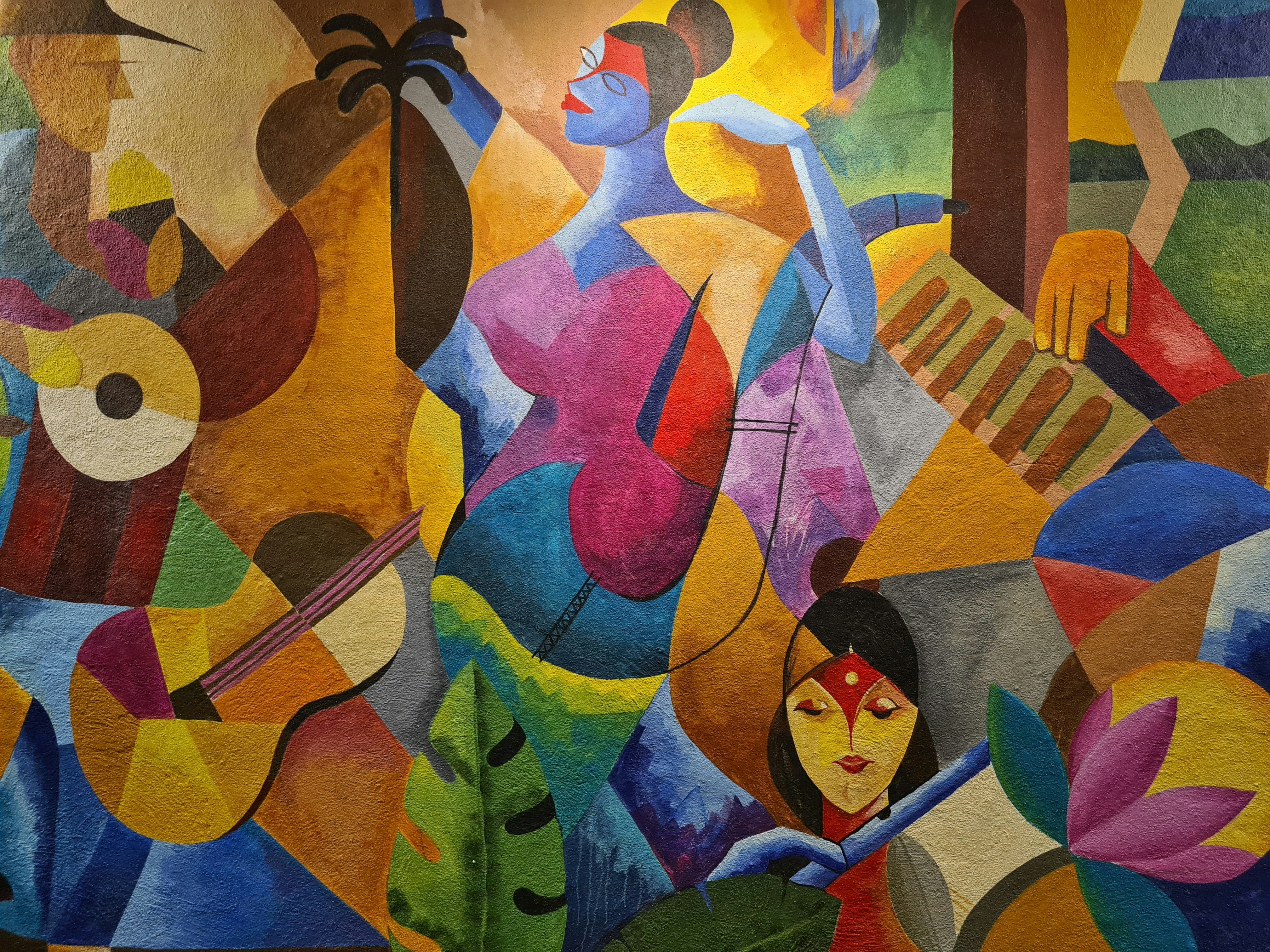
The South Asian art market has spent the better part of two decades trying to earn the kind of sustained global attention it now unmistakably commands. Prices are rising. Institutions are investing. New buyers, from Mumbai to Manhattan, are competing for the same lots. But the very success that dealers and collectors spent decades building has attracted an unwelcome companion: a surge in sophisticated forgeries that specialists say is now a genuine structural threat to the entire category.
A Market at Its Most Compelling — and Most Vulnerable
South Asian art is at a global inflection point. Record-breaking prices at auction, major institutional acquisitions, landmark retrospectives, and a collector base that is both more geographically dispersed and generationally diverse than at any prior moment define the breadth of this momentum. The numbers back this up. Maqbool Fida Husain's Second Act (1958) sold for $5.1 million at Sotheby's New York in March 2026, a result that would have been unthinkable for a South Asian modernist a decade ago.
India has emerged as the standout performer on the continent, with a median hammer price of $10,864 in 2025 and a sell-through rate of 89 percent. For context, that sell-through figure rivals the top-performing evening sale categories at the major houses. Auction houses operating across Mumbai, New York, and London are registering not isolated records but durable, compounding demand for works by South Asian artists.
Yet momentum of this magnitude creates its own hazards. Dealers and specialists say forged works are increasingly entering the market as prices for South Asian modernists climb and international demand grows. The more valuable the art becomes, the more worthwhile it becomes to fake it. This is not a theoretical risk. It is, by multiple specialist accounts, already happening at scale.
The Scale of the Problem
Forgeries are proliferating as prices for artists including S.H. Raza, M.F. Husain, and Sadequain have climbed. Dadiba Pundole, whose Mumbai gallery represented several leading Indian modernists during their lifetimes, estimates that as many as one in 10 modern artworks sold privately in India could be fake. That figure — ten percent of the private market — is staggering, and it comes from a dealer who has the deepest possible institutional knowledge of the primary market for these artists.
Charles Moore, of London's Grosvenor Gallery, said he is offered a likely fake by private sellers "every couple of weeks." Once, the obvious targets were the biggest names. Now, prices have risen enough that "it pays to forge the middle-market artists too." That shift in target profile is significant. Early-stage forgery crises in other markets — Chinese ink paintings in the 2000s, Latin American modernism in the 1990s — typically began with fakes of the most bankable names. When forgers begin working their way down the price ladder, it signals that the economics of fraud have become broadly viable across a category, not just at the top.
The fakes themselves have improved, too. Specialist sources note that early examples were often crude and identifiable. The current generation of forgeries, by contrast, is sophisticated enough to require expert analysis — and in some cases has passed initial scrutiny at legitimate venues.
Why This Boom Is Structurally Different From the Last One
South Asian art has been here before, in a fashion. The category saw a sharp run-up in the mid-2000s, followed by a correction that left many buyers with overpriced and, in some cases, questionable works. Between the cooling markets of China and the West and the ways in which South Asian art history has been packaged to target Western audiences, the region is seeing something of a moment. Less generous observers would call it a bubble, but improved institutional infrastructure and carefully calculated commercial decisions make this boom markedly different from that of the early 2000s.
There is genuine substance to that optimism. Sundaram Tagore Gallery opened its third location in London in May 2026 with its inaugural show Hybridity and Belonging in Contemporary Art. Over the past two years, the South Asian art market, particularly India, has heated up considerably. Commentators have noted the high visibility of South Asian artists at major cities this year, the huge variety of artists featured by multiple Indian galleries at both 2026 legs of Art Basel, and the return of both India and Pakistan to the Venice Biennale.
Auction houses operating across Mumbai, New York, and London are registering durable, compounding demand for works by South Asian artists, and that confidence is echoed institutionally — globally — from Venice to London. This is not speculative froth. It reflects real institutional commitments and a collector base that has genuinely broadened in geography and generation.
But the forgery problem cuts through all of it. The danger is bigger than any individual bad painting. "It just takes one scandal," as Pundole put it, to knock confidence in an artist — or an entire corner of the market. The concern is not merely about individual buyers being defrauded. It is about systemic reputational risk to a category that has finally, after years of effort, achieved genuine global credibility.
The Authentication Gap
The structural vulnerability here is authentication infrastructure — or the lack of it. Unlike the Western European modernist market, which has decades of established catalogue raisonnés, foundation oversight, and institutional provenance trails, the South Asian modernist category is still building those tools. Several of the most-forged artists — Raza, Husain, Sadequain — were prolific and peripatetic, spending significant portions of their careers in Europe and the United States, which means their works moved through multiple markets with varying levels of documentation.
After record-breaking auction sales, the market for South Asian artworks has been flooded by forgeries hoping to capitalise on the boom. The timing matters. Forgery waves tend to crest when three conditions align: prices have risen enough to make faking profitable, the authentication infrastructure is still developing, and there is a surge of new buyers who lack the accumulated pattern recognition that protects more experienced collectors. All three conditions are present in the South Asian modernist market right now.
Some of the larger auction houses have responded by tightening specialist review processes and, in select cases, commissioning material analysis before consigning works by the most frequently forged artists. But the private market — where Pundole's one-in-ten estimate applies — operates with far less oversight, and it is precisely where newer, less experienced collectors are most likely to be shopping.
What Collectors Should Do Now
The forgery crisis does not invalidate the South Asian modernist thesis. The underlying demand is real, the institutional momentum is genuine, and the best-documented works by canonical figures remain among the most compelling value propositions in the global market. But it does impose a higher burden of diligence on buyers than almost any other category commands today.
- Provenance depth matters more than usual. Prioritise works with documented exhibition histories predating 2010 — ideally with records showing the work in museum or institutional contexts before prices reached their current levels. Works that appear on the market with thin or undocumented ownership chains deserve heightened scrutiny, regardless of the seller's reputation.
- Use specialist authentication resources. For major purchases, commission independent technical analysis — infrared reflectography, pigment testing, canvas or paper dating — from conservators with specific South Asian expertise. General Old Masters conservators may lack the comparative material to identify region-specific anomalies.
- Buy from galleries with primary-market relationships. Dealers like Pundole's who represented artists directly, or who maintain close relationships with their estates and foundations, offer a provenance chain that is materially harder to fake. The premium for gallery-sourced works with these credentials is warranted.
- Treat private-market deals at a significant discount. If Pundole's estimate of one-in-ten private-market works being fake is even approximately correct, the discount required to justify unvetted private acquisition is substantial. Price it accordingly, or don't buy.
- Monitor catalogue raisonné development. Several South Asian modernist estates are actively developing comprehensive catalogues. When they appear, expect market repricing — works excluded from the catalogue will face sharp discounts; included works may appreciate. Staying ahead of this process is the clearest structural opportunity in the category.
The Bigger Picture
Asia's fine art auction market generated $2.2 billion in total sales in 2025, down sharply from its $5.4 billion peak in 2021, while lot volume has held steady at roughly 61,000 works sold per year — suggesting that the market is repricing even as collectors remain active. Within that broader Asian picture, Asia's five major regions — China, India, Japan, Korea, and Southeast Asia — have splintered into distinct market trajectories, with price disparities now at their widest point in a decade. India and South Asia more broadly are the clear outperformers in that divergence.
That outperformance is the opportunity. The forgery wave is the tax on accessing it carelessly. The collectors who will look back on this moment as their best entry point into a category with genuine long-term institutional and market depth are the ones who invest in diligence now rather than discovering, years later, what the private sellers of August 2026 knew and didn't disclose.
The South Asian modernist market is not about to collapse. But it is being tested, and the test is authentication. Collectors who understand that distinction — and act on it — are positioned to benefit. Those who treat the boom as self-validating are taking on risks that the hammer price won't reflect until it's too late.