
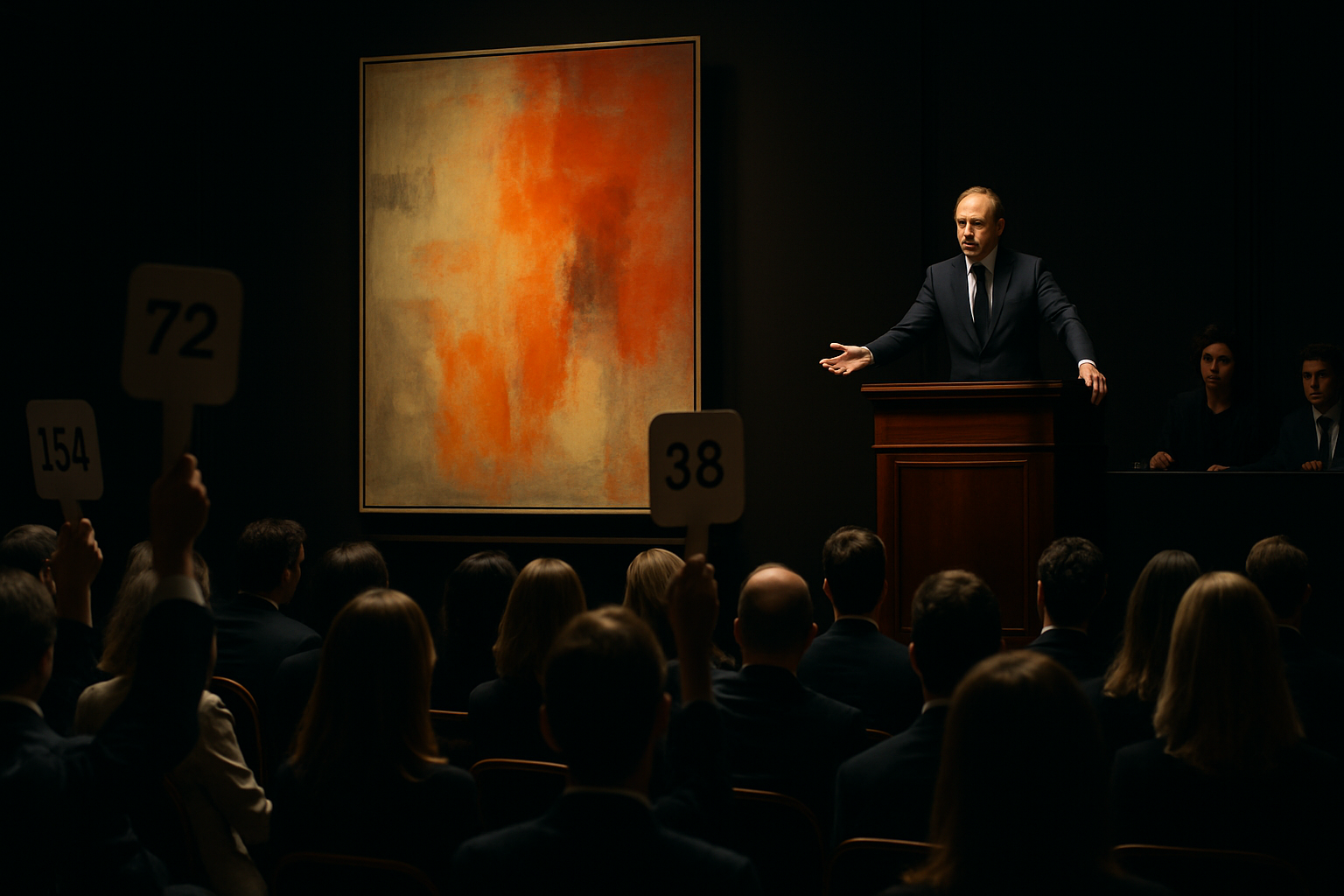
Two data points, separated by one day, arrived this week to frame the art market's recovery with unusual precision. On October 7, Sotheby's New York rang up $38.6 million in a single Contemporary Curated session — the highest total ever recorded for that sale format. The following morning, Artprice published its 33rd Annual Contemporary Art Market Report, drawing on worldwide auction results for more than 60,000 contemporary artists between July 2025 and June 2026. Read together, these two moments tell a story that is simultaneously encouraging and clarifying: the market is back, but on very different terms than the speculative peak of 2021–2022.
The Headline Number and What Lies Beneath It
Artprice's report opens with a figure that commands attention: from July 2025 through June 2026, the global art market returned decisively to growth, with fine art auction sales increasing by 41%. But collectors who stop at that headline will misread the recovery entirely. This momentum owes less to contemporary art than to modern and postwar works.
Contemporary art — defined by Artprice as work by artists born after 1945 — participated in the recovery, but modestly. After three consecutive years of decline, contemporary art returned to growth, with sales value rising 6%. Growth was stronger in volume terms, at 9%, and the number of lots sold set a new record for the sixth consecutive year. That divergence between value and volume is the key signal: more works are transacting, but average prices are not recovering at the same pace. The market is broader and more active, not necessarily richer.
The situation is starker still for ultra-contemporary art — works by artists under 40. That segment continued to contract, falling 26.6%. The report notes, pointedly, that the correction affecting ultra-contemporary art is reversing some of the speculative price surges and gradually bringing prices back toward more sustainable levels, without preventing occasional bursts of enthusiasm. For collectors who loaded up on emerging names at 2021 and 2022 prices, "gradual normalization" is a polite description of real losses.
The US as the Sole Engine of Growth
Geography is where the Artprice data becomes most actionable. The recovery, for all its apparent breadth, is essentially an American story. The increase in global contemporary art auction sales amounts to approximately $100 million, and that entire $100 million gain was recorded in the United States during the reporting period. The report spans 64 countries, 558 cities with active auction markets, and 1,055 auction houses — yet the incremental dollar gain is concentrated in a single market.
That dominance extends beyond aggregate sales to the very top of the price pyramid. American artists account for half of all million-dollar sales during the reporting period. For collectors seeking exposure to works with proven secondary-market depth, this concentration in American postwar and contemporary names is not merely a statistical curiosity — it is a structural feature of where liquidity actually lives.
Europe offers a more mixed picture. In Europe, the United Kingdom remained stable as the world's third-largest market by sales value, while France posted growth of 22%. France's most striking result was the increase in its number of transactions, up 18% year over year, placing it third worldwide by volume — behind the United States and the United Kingdom — and confirming the depth of its auction market. France's rise is a notable structural shift: Paris's consolidation as a serious auction hub, accelerated by Art Basel Paris and a deepening galerie ecosystem, is now visible in the data.
Asia presents the sharpest contrasts. China recorded a marked decline; still the world's second-largest market, it saw auction sales fall 18%, yet retained around 40 million-dollar results, recorded primarily in Hong Kong and Beijing. At the same time, other Asian markets are recovering, led by South Korea, where the Seoul market is strengthening. The Middle East tells a cautionary tale: despite its steadily strengthening institutional base, the region's auction sales fell 28%, a contraction largely attributable to the Gulf countries amid a sharply deteriorating geopolitical environment. Institutional ambition and market liquidity are not the same thing.
Sotheby's October 7 Sale: The Data in Action
If the Artprice report provides the map, the Sotheby's Contemporary Curated sale on October 7 provided a real-time navigation check. Sotheby's achieved the highest-ever total for a Contemporary Curated sale, ringing up $38.6 million. The sale featured works picked by Knicks center forward and six-time NBA All-Star Karl-Anthony Towns and Jordyn Woods, a model and socialite, along with the collection of architect Robert A.M. Stern, who died last year.
The Stern collection component was the cleaner read on where confirmed institutional taste trades today. The Stern selection totaled $8.7 million, surpassing its $5.5 million high estimate, with 90% of lots finding buyers. The group was led by Andy Warhol's Flowers, selling for $6.3 million. Warhol at $6.3 million is squarely within the territory Artprice identifies as resilient — established American postwar, deep secondary market, recognizable body of work.
Towns and Woods brought a more personal curatorial lens. The couple assembled a selection of 10 works by postwar and contemporary artists including Andy Warhol and Roy Lichtenstein; Helen Frankenthaler, Alma Thomas, and Sam Gilliam; and George Condo, John Chamberlain, Ed Ruscha, and Rashid Johnson. Pieces like Condo's I Want My Brain Back carried personal resonance, symbolizing Towns' devastating loss of family members to COVID-19 in 2020. The willingness of Sotheby's to hand curatorial power to celebrity collectors — the house has previously assigned Contemporary Curated duties to Oprah Winfrey, Robert Pattinson, Victoria Beckham, Kelly Rowland, Kevin Love, and Rich Paul — is itself a market signal, not just a marketing exercise. It speaks directly to where new demand is originating.
The broader pattern at the fall's opening sales reinforced what Artprice documented statistically. Across recent sales at Christie's, Phillips, and Sotheby's in New York, bidders chased down established artists, recognizable bodies of work, and lots carrying estimates that left some room to run, with records and bidding wars along the way. Unlike a few years ago, when newly hot contemporary artists could seemingly leap from one auction record to another, much of the strongest bidding this time centered on artists whose markets have been built over decades.
Gen Z Enters the Million-Dollar Room
One structural shift deserves particular attention: the emergence of Gen Z as a meaningful force at the top of the market, not just at entry level. According to the Art Basel and UBS Survey of Global Collecting by Arts Economics, in 2025 and the first half of 2026, Gen Z spent more on fine art than any other generation — more than twice as high as Baby Boomers, Gen Xers, and Millennials. More strikingly: Gen Z made up nearly half of all collectors buying artworks priced above $1 million in 2026.
This is not the Gen Z of affordable print drops and Instagram-discovered painters selling in the low thousands. This is inherited wealth, accelerated liquidity events, and a generation that grew up navigating digital markets now applying that comfort to physical art. The implications for pricing dynamics and taste formation at the top of the market are significant. Men were more likely to buy at higher price points — 13% of men buying works over $100,000 compared to 7% for women — but women had higher participation across mediums, including painting, photography, digital works, and emerging artists.
What Collectors Should Do With This Information
The Artprice report and the fall auction results point in a consistent direction. Liquidity is real but selective. Three practical implications stand out.
- Prioritize established market depth over speculative velocity. The ultra-contemporary correction, now in its third year with a 26.6% decline in the most recent reporting period, has not bottomed uniformly. Works by artists under 40 purchased at 2021–2022 multiples are still normalizing. New acquisitions in that space require a longer hold conviction and should be sized accordingly.
- The US dollar premium is real. With the entire $100 million incremental gain in contemporary auction sales concentrated in the American market, and American artists accounting for half of all million-dollar results, collectors seeking secondary-market liquidity should be weighting their exposure toward established American postwar and contemporary names — not because other markets lack interesting work, but because exit liquidity is materially stronger here.
- France deserves a closer look. A 22% rise in sales value and an 18% rise in transaction volume, combined with Art Basel Paris cementing its calendar position, suggests that the Paris market is not merely recovering but structurally deepening. Galleries with strong Paris presences and French artist rosters — particularly those with institutional museum backing — are worth monitoring more carefully than they were two years ago.
The broader picture is of a market that has digested its own excess and is now trading on fundamentals rather than momentum. That is, on balance, a healthier condition than what preceded it — even if it is a less exciting one. The collectors who prosper in this environment will be those who understand not just which works are desirable, but precisely where the buyers for those works actually live.