Emma Webster
Biography
Emma Webster first constructs intricate dioramas of collaged samples from historic paintings (from Bosch to Bierstadt). These maquettes evoke set design with backdrops staged and lit for each work. Scale shifts conflate the panoramic with the miniature, and the dioramas are a pastiche of idylls. In these operatic and thrilling paintings, nature is fraught with artifice. The animals are clay figurines. The foliage is plastic. Lighting comes from a flashlight. The entire view is straightforward, giving a clear vantage point. The artist’s hand is evident, fabricating an idealized scene that speaks to her desire to build one’s own world: an Arcadia. The show’s title Arcadia alludes to recycled and reassembled notions of nature and art passed down from antiquity. These fake bucolics, where each tree is as much a reflection of its maker’s hands as it is a symbol, point to the ways humanity manipulates nature, seeing nature only as it relates to mankind itself. As in garden design, man contrives his own aesthetic of “natural” beauty despite the existence of another untamed and unpredictable reality. Considering climate change and deforestation, Emma Webster’s landscape as still life rings a warning. Emma Webster (USA/UK, b. 1989) is a Californian painter with an MFA in Painting from Yale School of Art (2018) and BA in Art Practice from Stanford University (2011). She was an Artist-in-Residence at the Anderson Ranch Art Center (2018), and the Dumfries Royal Drawing School, Scotland (2017); among others. Her work was recently included in Spirited Densities, Thomas Erben Gallery, New York City (2018) and is in the collection of the Cantor Arts Center, Stanford University, Palo Alto, CA. The artist lives and works in Los Angeles.
Track Emma Webster
Get notifications when works come to auction, and access market analytics
Create Free AccountAlready have an account? Sign In
Professional documentation gives you clarity, portability, and confidence in your collection.
Learn why collectors document their holdings online


Your collection, accessible anywhere
Access your collection from any device with our cloud-based platform. Native mobile apps provide seamless synchronization and offline browsing, ensuring your collection data is always at hand.


Emma Webster
Biography
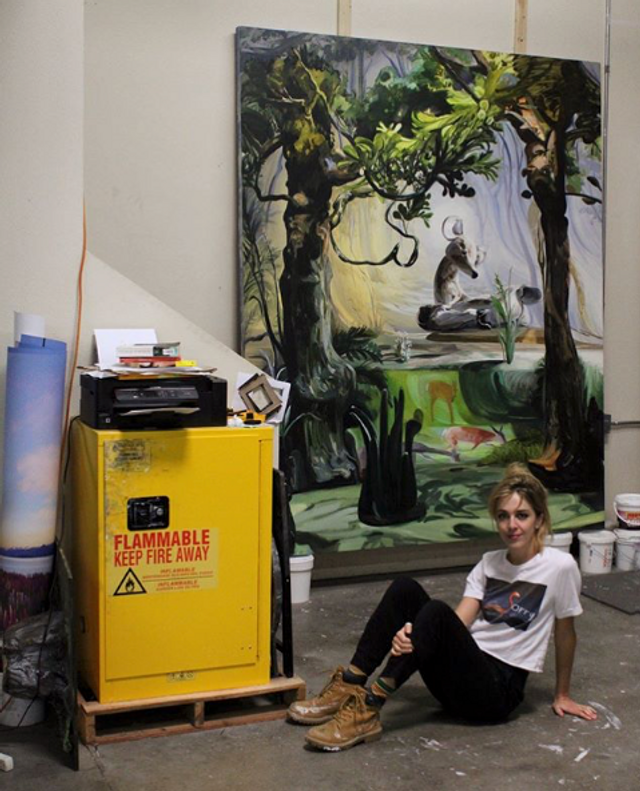
Emma Webster first constructs intricate dioramas of collaged samples from historic paintings (from Bosch to Bierstadt). These maquettes evoke set design with backdrops staged and lit for each work. Scale shifts conflate the panoramic with the miniature, and the dioramas are a pastiche of idylls. In these operatic and thrilling paintings, nature is fraught with artifice. The animals are clay figurines. The foliage is plastic. Lighting comes from a flashlight. The entire view is straightforward, giving a clear vantage point. The artist’s hand is evident, fabricating an idealized scene that speaks to her desire to build one’s own world: an Arcadia. The show’s title Arcadia alludes to recycled and reassembled notions of nature and art passed down from antiquity. These fake bucolics, where each tree is as much a reflection of its maker’s hands as it is a symbol, point to the ways humanity manipulates nature, seeing nature only as it relates to mankind itself. As in garden design, man contrives his own aesthetic of “natural” beauty despite the existence of another untamed and unpredictable reality. Considering climate change and deforestation, Emma Webster’s landscape as still life rings a warning. Emma Webster (USA/UK, b. 1989) is a Californian painter with an MFA in Painting from Yale School of Art (2018) and BA in Art Practice from Stanford University (2011). She was an Artist-in-Residence at the Anderson Ranch Art Center (2018), and the Dumfries Royal Drawing School, Scotland (2017); among others. Her work was recently included in Spirited Densities, Thomas Erben Gallery, New York City (2018) and is in the collection of the Cantor Arts Center, Stanford University, Palo Alto, CA. The artist lives and works in Los Angeles.
Track Emma Webster
Get notifications when works come to auction, and access market analytics
Create Free AccountAlready have an account? Sign In
Professional documentation gives you clarity, portability, and confidence in your collection.
Learn why collectors document their holdings onlineYour collection, accessible anywhere
Access your collection from any device with our cloud-based platform. Native mobile apps provide seamless synchronization and offline browsing, ensuring your collection data is always at hand.