Biography
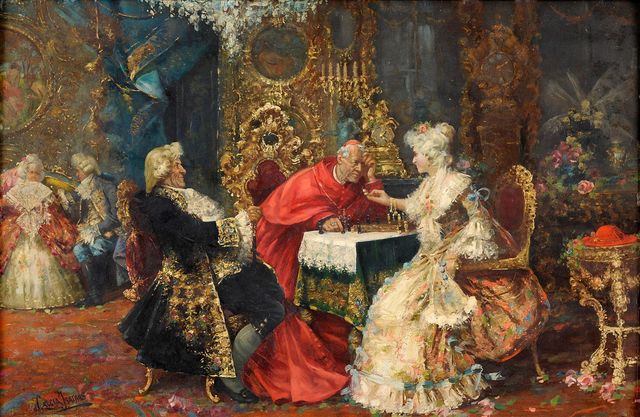
José García Ramos is one of the most important masters of Sevillian genre painting of the late 19th century. He was born in Seville on 2 March 1852 and received his artistic training at the School of Fine Arts, where he was a pupil of Eduardo Cano and a follower of José Jiménez Aranda, with whom he moved to Rome in 1872. During his stay in Rome García Ramos was deeply impressed by the art of Fortuny, which led him to adopt the précieux style and vivid colours in his painting. A tireless traveller, he went back to Italy in 1877 and four years later spent a term in Paris with Jiménez Aranda and returned to Seville in 1882, where he would later be appointed a member of the Academy of Fine Arts in 1893. He was an extraordinary prolific artist who took part successfully in the National Exhibition of Fine Arts, winning a third-place medal in 1884 for El raptor and a second prize for Hermanos, ¡cada uno por sí mismo! (“Brothers, Every Man for Himself!”) in 1901. A year earlier, in 1900, he had won a third prize at the Paris Exposition Universelle. He died in Seville on 2 April 1912. García Ramos became one of the great painters of the period thanks to the mastery and spontaneity with which he recreated typical scenes of his native Andalusia. His small pictures flooded the market. He was very skilled at compositional layout and drawing and also painted tableautins and anecdotal works.
Track José García Ramos
Get notifications when works come to auction, and access market analytics
Create Free AccountAlready have an account? Sign In
Professional documentation gives you clarity, portability, and confidence in your collection.
Learn why collectors document their holdings online


Your collection, accessible anywhere
Access your collection from any device with our cloud-based platform. Native mobile apps provide seamless synchronization and offline browsing, ensuring your collection data is always at hand.


Biography
José García Ramos is one of the most important masters of Sevillian genre painting of the late 19th century. He was born in Seville on 2 March 1852 and received his artistic training at the School of Fine Arts, where he was a pupil of Eduardo Cano and a follower of José Jiménez Aranda, with whom he moved to Rome in 1872. During his stay in Rome García Ramos was deeply impressed by the art of Fortuny, which led him to adopt the précieux style and vivid colours in his painting. A tireless traveller, he went back to Italy in 1877 and four years later spent a term in Paris with Jiménez Aranda and returned to Seville in 1882, where he would later be appointed a member of the Academy of Fine Arts in 1893. He was an extraordinary prolific artist who took part successfully in the National Exhibition of Fine Arts, winning a third-place medal in 1884 for El raptor and a second prize for Hermanos, ¡cada uno por sí mismo! (“Brothers, Every Man for Himself!”) in 1901. A year earlier, in 1900, he had won a third prize at the Paris Exposition Universelle. He died in Seville on 2 April 1912. García Ramos became one of the great painters of the period thanks to the mastery and spontaneity with which he recreated typical scenes of his native Andalusia. His small pictures flooded the market. He was very skilled at compositional layout and drawing and also painted tableautins and anecdotal works.
Track José García Ramos
Get notifications when works come to auction, and access market analytics
Create Free AccountAlready have an account? Sign In
Professional documentation gives you clarity, portability, and confidence in your collection.
Learn why collectors document their holdings onlineYour collection, accessible anywhere
Access your collection from any device with our cloud-based platform. Native mobile apps provide seamless synchronization and offline browsing, ensuring your collection data is always at hand.