Biography
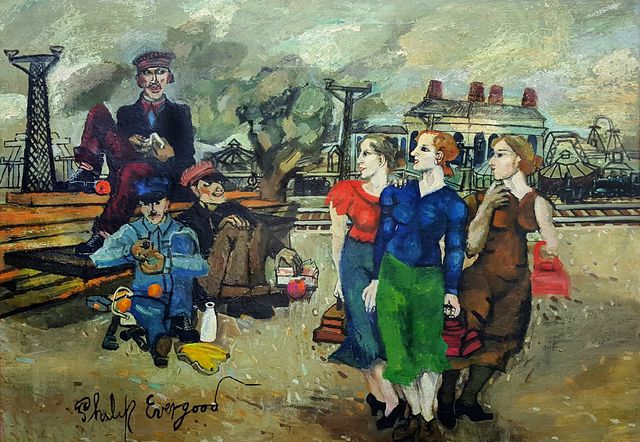
Born in New York City with the name Philip Blashki, he became, with the name Philip Evergood, one of the leading modernists of the 20th Century with styles combining abstraction and realism and subjects in the 1930s that made him one of the leading social realists of his time. He was raised in London, England where he moved in 1909 with his parents until 1923. He studied at Eton and Cambridge University and then at the Slade School with Henry Tonks and Havard Thomas. Returning to New York, he was a student of George Luks and William von Schlegell at the Art Students League. From 1924 to 1926, he traveled in Europe and studied in Paris at the Academie Julian and again lived abroad from 1929 to 1931. He was especially influenced by the Spanish artist El Greco. During the 1930s, he was a muralist for the W.P.A. in the Federal Art Project, and his mural work includes “The Story of Richmond Hill” for the library in that part of New York City, and another work, “Cotton from Field to Mill” for the Post Office in Jackson, Georgia. Politically active, he served as President of the New York Artists Union. He also taught at various institutions in the 1940s, and in 1952 moved to Southbury, Connecticut and two years later to Bridgeport until his death. In the 1920s and 1930s, he focused on many Biblical themes with a distorted style reflective of both Cezanne and El Greco in that his figures seemed to be in fanciful worlds or “imagined space”. (Baigell) By 1935, he did American Scene painting with politically and social-message works whose themes were the unhappiness of people caught in the Depression. In the 1940s, he distanced himself from political and social issues to figures that were more fanciful and free seeming.
Track Philip Evergood
Get notifications when works come to auction, and access market analytics
Create Free AccountAlready have an account? Sign In
Professional documentation gives you clarity, portability, and confidence in your collection.
Learn why collectors document their holdings online


Your collection, accessible anywhere
Access your collection from any device with our cloud-based platform. Native mobile apps provide seamless synchronization and offline browsing, ensuring your collection data is always at hand.


Biography
Born in New York City with the name Philip Blashki, he became, with the name Philip Evergood, one of the leading modernists of the 20th Century with styles combining abstraction and realism and subjects in the 1930s that made him one of the leading social realists of his time. He was raised in London, England where he moved in 1909 with his parents until 1923. He studied at Eton and Cambridge University and then at the Slade School with Henry Tonks and Havard Thomas. Returning to New York, he was a student of George Luks and William von Schlegell at the Art Students League. From 1924 to 1926, he traveled in Europe and studied in Paris at the Academie Julian and again lived abroad from 1929 to 1931. He was especially influenced by the Spanish artist El Greco. During the 1930s, he was a muralist for the W.P.A. in the Federal Art Project, and his mural work includes “The Story of Richmond Hill” for the library in that part of New York City, and another work, “Cotton from Field to Mill” for the Post Office in Jackson, Georgia. Politically active, he served as President of the New York Artists Union. He also taught at various institutions in the 1940s, and in 1952 moved to Southbury, Connecticut and two years later to Bridgeport until his death. In the 1920s and 1930s, he focused on many Biblical themes with a distorted style reflective of both Cezanne and El Greco in that his figures seemed to be in fanciful worlds or “imagined space”. (Baigell) By 1935, he did American Scene painting with politically and social-message works whose themes were the unhappiness of people caught in the Depression. In the 1940s, he distanced himself from political and social issues to figures that were more fanciful and free seeming.
Track Philip Evergood
Get notifications when works come to auction, and access market analytics
Create Free AccountAlready have an account? Sign In
Professional documentation gives you clarity, portability, and confidence in your collection.
Learn why collectors document their holdings onlineYour collection, accessible anywhere
Access your collection from any device with our cloud-based platform. Native mobile apps provide seamless synchronization and offline browsing, ensuring your collection data is always at hand.